
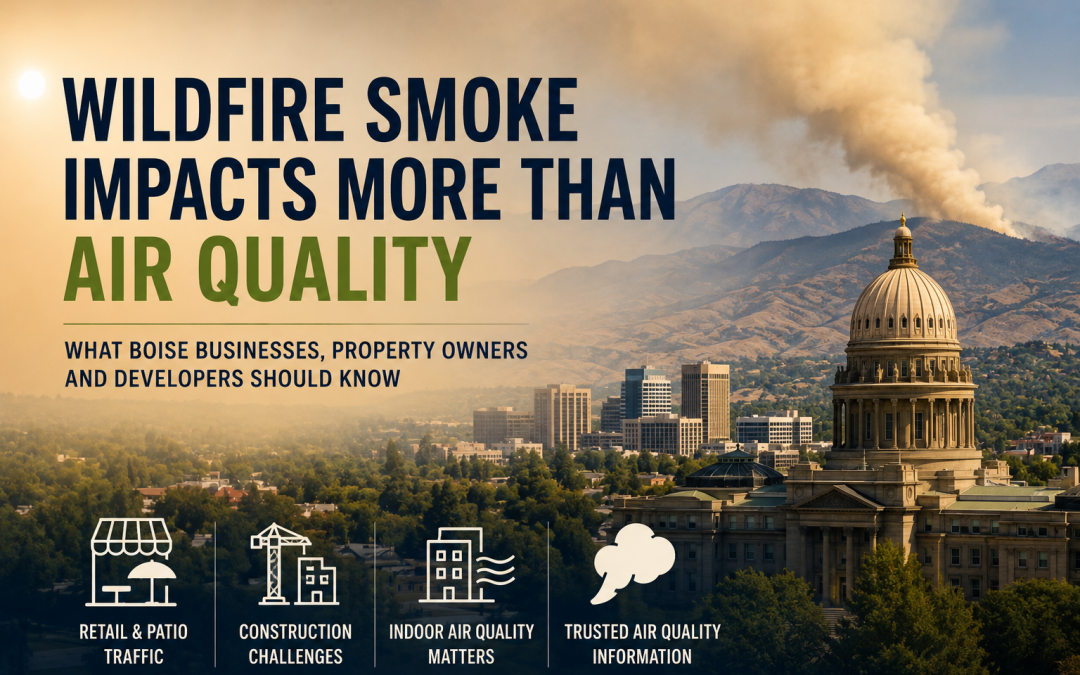
Wildfire Smoke Is Becoming a Boise Commercial Real Estate Consideration
Wildfire smoke may seem like an environmental or public health issue, but for Boise businesses and property owners, it can also become an operational issue.
When smoke settles into the Treasure Valley, outdoor activity can slow, construction crews may face tougher working conditions, restaurants can lose patio traffic, and commercial buildings rely more heavily on their HVAC and filtration systems.
That makes Idaho’s recurring smoke season something worth watching from a Boise commercial real estate perspective.
According to reporting by IBR Staff in the Idaho Business Review, the Idaho Department of Environmental Quality is encouraging residents to rely on trusted air-quality information as wildfire smoke affects Idaho and the broader Northwest. The original Idaho Business Review article explains the state’s recommended resources for monitoring changing conditions.
Smoke Season Can Affect How Commercial Properties Operate
Air quality can change quickly during wildfire season.
Wind direction, weather and fire activity can shift conditions in a matter of hours. The Idaho DEQ says that can also produce conflicting information because different apps and websites don’t necessarily rely on the same monitoring equipment or forecasting methods.
DEQ’s own forecasts incorporate monitoring stations, weather information, wildfire smoke projections and local conditions. The agency contrasts that approach with some third-party services that may rely more heavily on automated forecasts or individual lower-cost sensors.
For the average person, the difference might determine whether it’s a good day for a hike.
For a business, it can influence staffing, outdoor operations, customer traffic and even building management.
Think about the variety of Treasure Valley businesses with meaningful outdoor exposure: restaurants with patios, construction companies, landscaping businesses, recreation operators, outdoor events, car dealerships and retailers that depend on pedestrian traffic.
Poor air quality doesn’t necessarily shut those businesses down, but repeated smoke events can disrupt normal patterns.
That makes reliable information increasingly important.
Why Boise Property Owners and Developers Should Pay Attention
Wildfire smoke also raises a less obvious real estate question: How well does the building handle outside air conditions?
Commercial buildings constantly manage the relationship between indoor and outdoor air.
HVAC equipment, filtration systems, building envelopes, doors, windows and ventilation strategies all play a role. When outside air contains wildfire smoke, those systems become much more noticeable to occupants.
For landlords, this can turn indoor air quality into a tenant-experience issue.
Office employees may be reluctant to work in a building where they can smell smoke indoors. Fitness facilities and medical users may have greater concerns about air quality. Restaurants and retailers can face different challenges when doors regularly open throughout the day.
For Boise development, it is another reason to think beyond the basic construction cost of mechanical systems.
The cheapest HVAC solution isn’t always the best long-term solution.
Buildings that provide better filtration, modern controls and properly maintained mechanical equipment may have an advantage as tenants become more aware of indoor environmental quality.
For investors considering older Boise commercial real estate, HVAC condition and replacement costs should also remain an important part of property due diligence.
Smoke Can Influence Retail, Office and Construction Differently
The commercial real estate effects aren’t the same for every property type.
Retail and restaurants may feel the impact through customer behavior. Smoky conditions can reduce patio use and discourage people from spending extended periods outdoors. Businesses built around outdoor experiences can be particularly exposed.
Office properties face a different challenge. Indoor air quality and employee comfort can become part of the workplace conversation, especially as companies compete to bring employees back into physical offices.
Medical and wellness tenants may place even greater emphasis on filtration and air quality because of the populations they serve.
And construction projects can face another set of complications. Persistent smoke and poor air conditions can affect outdoor working environments and potentially complicate project schedules.
No single smoky week is likely to change the direction of the Boise commercial real estate market. But repeated environmental conditions can gradually change what tenants expect from their buildings.
Trusted Air-Quality Information Matters for Businesses
The Idaho DEQ recommends several resources for monitoring wildfire smoke and air quality.
The agency’s own website provides current conditions, forecasts and advisories throughout Idaho. Its AIR Idaho mobile app provides location-specific information, forecasts and alerts.
The EPA’s Fire and Smoke Map combines information from several types of monitoring equipment with wildfire and smoke data. AirNow also provides nationwide air-quality conditions, forecasts and related guidance.
For employers managing outdoor crews or businesses dependent on outdoor activity, having a consistent source of information can help with day-to-day operating decisions.
It can also help property managers communicate with tenants when conditions deteriorate.
Local Insight: Indoor Air Quality Could Become a Bigger Leasing Issue
From a Boise commercial real estate standpoint, I think the larger story is how expectations for buildings continue to change.
Tenants used to focus primarily on rent, location, parking and visibility.
Those things still matter.
But operating costs, HVAC quality, energy efficiency and indoor environmental conditions are becoming increasingly relevant when businesses compare locations.
Wildfire smoke adds another reason for tenants to ask questions about mechanical systems.
What type of filtration does the building have? How old are the HVAC units? How frequently are filters replaced? How well sealed is the building? Who pays for maintenance and replacement under the lease?
Those questions can have real financial consequences.
A landlord with modern, well-maintained systems may be able to offer tenants more predictable operating conditions. An investor purchasing an older property, meanwhile, should understand whether outdated mechanical equipment could require significant capital improvements.
Developers should be thinking about this as well.
As Boise development continues across Meridian, Nampa, Caldwell, Kuna, Star and Eagle, designing buildings for Idaho’s actual environmental conditions could become another competitive advantage.
Boise’s Growth Needs Buildings Designed for Idaho Conditions
Wildfire smoke isn’t new to Idaho, and it isn’t going away simply because the Treasure Valley continues to grow.
That means commercial real estate needs to adapt to the environment in which it operates.
For landlords, that means maintaining HVAC and filtration systems.
For tenants, it means understanding building systems before signing a lease.
For investors, it means including mechanical equipment and indoor air quality considerations in due diligence.
And for developers, it means recognizing that the long-term value of a commercial building depends on more than its appearance and location.
Boise’s next generation of commercial properties will need to perform well during hot summers, cold winters and periods of wildfire smoke.
Those aren’t separate environmental issues. They are part of the operating reality of owning and occupying commercial property in Idaho.
Mike Gioioso (joy-OH-so) has for 16+ years been helping companies of all sizes buy, build, and lease perfect places for business in greater Boise, Idaho and beyond.
www.streetsmartidaho.com mike@streetsmartidaho.com 208-209-9166
Tags: #boisecommercialrealestate, #boisedevelopment, #idahocommercialrealestate, #wildfiresmokeidaho, #boiseairquality, #treasurevalleycommercialrealestate, #commercialhvac, #indoorairquality, #boiseofficespace, #retailleasingboise, #commercialpropertymanagement, #boiseinvestmentproperty, #treasurevalleydevelopment, #idahodeq, #commercialrealestateinvestment