
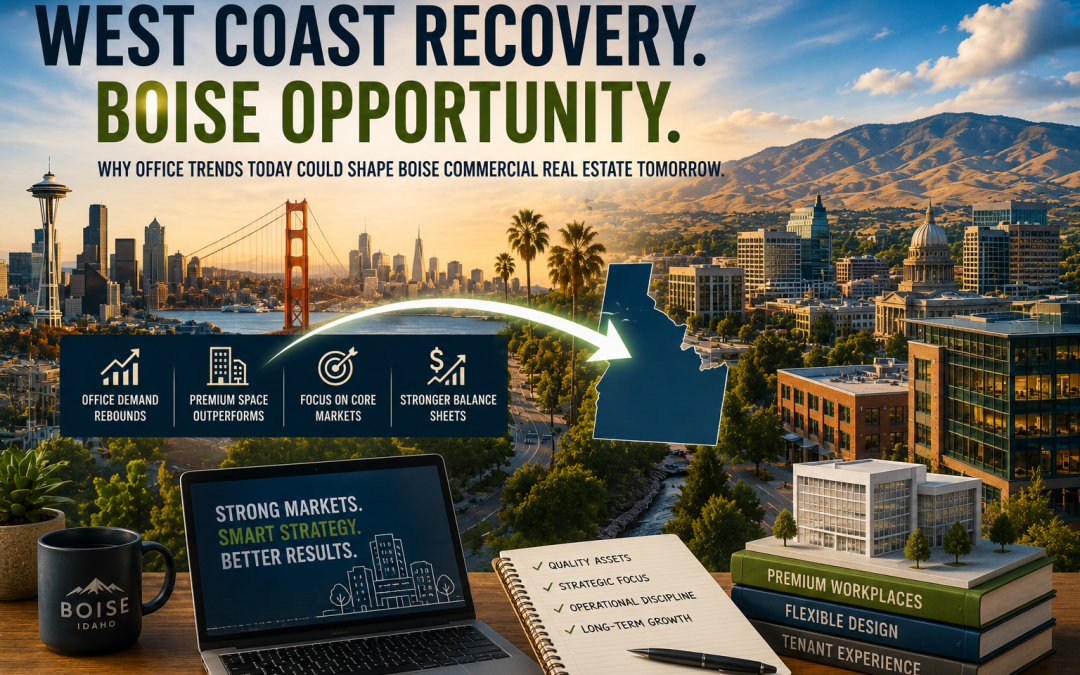
Why West Coast Office Recovery Could Matter More for Boise Commercial Real Estate Than Many Investors Realize
The office market may finally be showing signs of stabilization — and Boise commercial real estate professionals should probably pay attention.
For the past several years, office headlines have focused heavily on rising vacancies, remote work disruption, and distressed buildings in major coastal cities. But some large office landlords are now signaling something different: demand for high-quality workspace may be returning faster than expected in certain western markets.
According to reporting by CoStar News reporter Katie Burke in this article from CoStar News, Hudson Pacific Properties is restructuring parts of its business while doubling down on premium office assets as leasing momentum improves across major West Coast cities.
The company is trimming weaker studio operations and redirecting resources toward office properties in stronger-performing urban markets like Seattle and San Francisco.
That may sound like a story focused only on larger gateway cities — but the broader implications could eventually ripple into Boise development and the Treasure Valley office market.
Premium Office Space Is Still Winning
One of the biggest takeaways from the report is that not all office space is struggling equally.
High-quality buildings in desirable locations continue attracting tenants, especially companies looking to improve workplace experience, retain employees, and encourage in-person collaboration.
Hudson Pacific executives noted rising tenant tours, expanding leasing pipelines, and growing occupancy levels throughout parts of their portfolio.
Nationally, companies signed nearly 120 million square feet of office leases during the first quarter — the strongest quarterly leasing volume since 2018, according to CoStar research referenced in the report.
At the same time, many companies are leasing somewhat smaller spaces than they did before the pandemic.
That combination is reshaping office demand nationwide.
Instead of pursuing massive footprints, many tenants now prioritize:
- Better amenities
- Higher-quality environments
- Flexible layouts
- Lifestyle-oriented locations
- Strong employee experience
Those trends increasingly matter for Boise commercial real estate as well.
Boise Could Benefit From the “Flight to Quality”
The same “flight to quality” trend happening in Seattle, San Francisco, and Los Angeles could continue influencing Boise office leasing activity.
Companies relocating or expanding into Idaho are often more selective than they were several years ago.
Many now look for:
- Walkability
- Modern design
- Nearby restaurants and retail
- Flexible floorplans
- Wellness-oriented environments
- Mixed-use districts
- Parking convenience
- Employee lifestyle appeal
That creates opportunities for newer Boise development projects that can offer upgraded office experiences instead of traditional commodity office space.
In many cases, smaller but better-designed offices are outperforming larger outdated buildings.
That dynamic could become increasingly important across:
- Downtown Boise
- Meridian
- Eagle
- The Boise Spectrum area
- Mixed-use suburban corridors
Cost Cutting Is Becoming a Major Real Estate Strategy
Another important part of the Hudson Pacific story is operational discipline.
The company is reducing exposure to weaker-performing studio assets while preserving liquidity and strengthening its balance sheet.
That reflects a broader trend across commercial real estate right now.
Many landlords and developers are:
- Cutting non-core operations
- Delaying speculative projects
- Refinancing debt carefully
- Focusing capital on top-performing assets
- Prioritizing operational efficiency
For Boise investors, this matters because disciplined ownership often creates stronger long-term positioning during market transitions.
The companies making careful adjustments today may ultimately emerge stronger when leasing conditions improve further.
Why This Matters for Boise Investors
Boise remains a much smaller market than Seattle or San Francisco, but western office trends often flow downstream into secondary growth markets over time.
If major West Coast companies continue stabilizing and regaining confidence, Boise could benefit from:
- Expansion demand
- Satellite office strategies
- Hybrid workplace models
- Relocation activity
- Entrepreneurial spillover
- Tech and professional service growth
At the same time, Boise landlords may continue facing pressure to modernize older office inventory as tenant expectations evolve.
The office market is not disappearing.
It is simply becoming more selective.
My Take
The biggest office opportunities in Boise commercial real estate may not come from building the largest projects.
Instead, the winners could be the landlords and developers who best understand how workplace expectations have changed.
Employees increasingly want flexibility, convenience, and better environments. Employers want efficiency, recruiting advantages, and spaces that support collaboration.
That means the future of office leasing Boise may revolve less around square footage totals and more around experience quality.
The Hudson Pacific story is another reminder that even after years of disruption, office demand still exists — especially for properties that align with where the workforce is heading next.
Mike Gioioso (joy-OH-so) has for 16+ years been helping companies of all sizes buy, build, and lease perfect places for business in greater Boise, Idaho and beyond.
www.streetsmartidaho.com mike@streetsmartidaho.com 208-209-9166
Tags: #boisecommercialrealestate, #boiserealestate, #boisedevelopment, #officeleasing, #commercialrealestate, #idahocommercialrealestate, #treasurevalleyrealestate, #officemarket, #retailleasingboise, #mixedusedevelopment, #workplacestrategy, #officespace, #flighttoquality, #realestateinvestment, #boisebusiness