
What Seattle’s Affordability Challenges Could Mean for Boise Commercial Real Estate
Real estate markets don’t operate in isolation.
What happens in Seattle, Portland, Salt Lake City, and other western U.S. cities often creates ripple effects that eventually reach Boise.
A recent report suggests one of the Pacific Northwest’s largest economies may be facing renewed affordability pressure. According to reporting by Elliott Krivenko of CoStar Analytics, wage growth in the Seattle area has recently fallen behind inflation, reducing purchasing power for many households and potentially creating challenges for the region’s apartment market. The original CoStar article can be found here: https://product.costar.com/home/news/1826532472
While the report focuses on Seattle, the bigger question for Boise commercial real estate professionals is whether shifting economic conditions in larger West Coast markets could influence future migration, housing demand, and investment activity in Idaho.
A Changing Economic Picture in Seattle
For much of 2024 and 2025, workers in the Seattle region experienced a favorable trend.
Paychecks were growing faster than consumer prices, helping many households recover from earlier inflationary pressures.
That trend appears to be reversing.
According to the report:
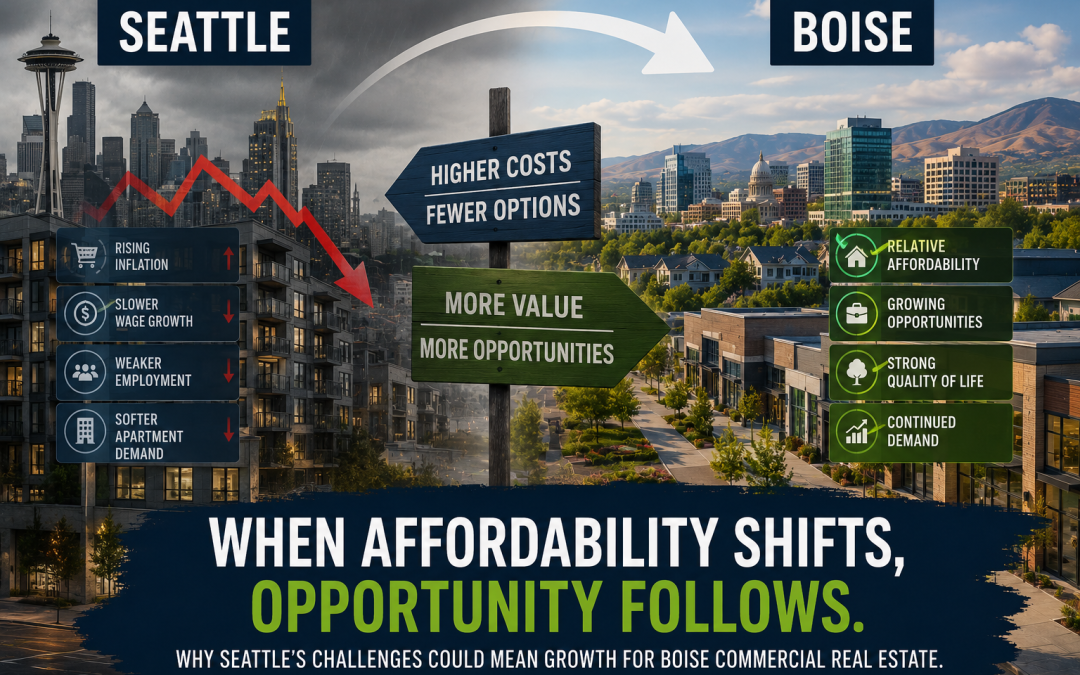
- Inflation has approached 5%
- Wage growth has slowed to below 3%
- Employment has declined slightly year-over-year
- Apartment demand has softened compared to prior periods
When living expenses increase faster than incomes, households often begin making financial adjustments.
Those adjustments can affect spending patterns, housing decisions, household formation, and relocation choices.
For apartment owners, that typically means more resistance to rent increases and potentially slower leasing activity.
Why Boise Investors Should Pay Attention
Boise has spent years benefiting from migration from higher-cost West Coast markets.
Although migration patterns fluctuate, affordability remains one of the strongest drivers behind relocation decisions.
When residents of larger metropolitan areas face increasing pressure from housing costs, taxes, and inflation, secondary markets often become more attractive.
Boise continues to offer advantages that many households and businesses find appealing:
- Lower business costs
- Lower housing costs than major coastal cities
- Growing employment opportunities
- Business-friendly environment
- Strong quality of life
If affordability pressures continue in larger markets, Boise development could continue benefiting from both residential and commercial demand.
Multifamily Markets Often Tell the Story First
One of the more interesting aspects of the CoStar analysis is its focus on apartment demand.
Multifamily performance is often one of the earliest indicators of broader economic trends.
When consumers feel confident about their financial future, apartment demand tends to strengthen.
When budgets become tighter, renters often:
- Delay household formation
- Seek roommates
- Move to less expensive units
- Reduce discretionary spending
These behavioral shifts can influence occupancy rates, rental growth, and development decisions.
For Boise multifamily investors, watching trends in larger regional markets can provide valuable insight into where future demand may be heading.
The Boise Advantage: Relative Affordability
Boise is certainly not the bargain market it was a decade ago.
Home prices, rents, and development costs have all increased significantly.
However, affordability is relative.
Compared with many major West Coast cities, Boise remains a more attainable option for both residents and businesses.
That relative affordability continues to support:
- Population growth
- Office demand
- Retail leasing activity
- Industrial expansion
- Housing development
As long as Boise maintains a meaningful cost advantage over larger markets, the Treasure Valley may continue attracting both employers and households seeking alternatives.
What This Could Mean for Retail and Commercial Real Estate
Housing affordability impacts far more than apartment owners.
When consumers spend a larger share of their income on housing and necessities, discretionary spending often declines.
That affects retailers, restaurants, entertainment venues, and service providers.
The opposite can also be true.
Markets that attract new residents and maintain stronger affordability often see healthier consumer spending patterns.
For retail leasing Boise professionals, migration remains one of the most important long-term demand drivers.
More residents generally translate into more customers, which supports retail expansion and future commercial development.
Local Insight
One lesson from the Seattle report is that strong markets can change direction surprisingly quickly.
Just a year ago, wage growth was helping many households regain purchasing power. Today, inflation is once again becoming a concern.
For Boise investors and developers, this serves as a reminder that competitive advantages matter.
Markets that offer affordability, business-friendly policies, workforce growth, and a high quality of life tend to attract attention when larger metropolitan areas become more expensive.
I’m not suggesting Boise will automatically benefit every time Seattle experiences economic pressure.
But history shows that migration patterns often follow affordability.
If the gap between incomes and living costs continues widening in larger West Coast markets, Boise could remain well-positioned to capture future residents, businesses, and investment capital.
For Boise commercial real estate, that may be one of the most important long-term trends to watch over the next several years.
Mike Gioioso (joy-OH-so) has for 16+ years been helping companies of all sizes buy, build, and lease perfect places for business in greater Boise, Idaho and beyond.
www.streetsmartidaho.com mike@streetsmartidaho.com 208-209-9166
Tags: #boisecommercialrealestate, #boisedevelopment, #seattlerealestate, #multifamilyhousing, #apartmentmarket, #economicdevelopment, #boiserealestate, #commercialrealestate, #migrationtrends, #populationgrowth, #retailleasingboise, #investmentproperty, #housingaffordability, #treasurevalleyrealestate, #commercialdevelopment