
What Skanska’s Leadership Transition Says About the Future of Construction and Commercial Real Estate Growth
Major construction firms don’t change leadership in a vacuum.
When one of the world’s largest builders makes key executive moves, it often reflects broader trends shaping development pipelines, project delivery, and long-term investment strategies.
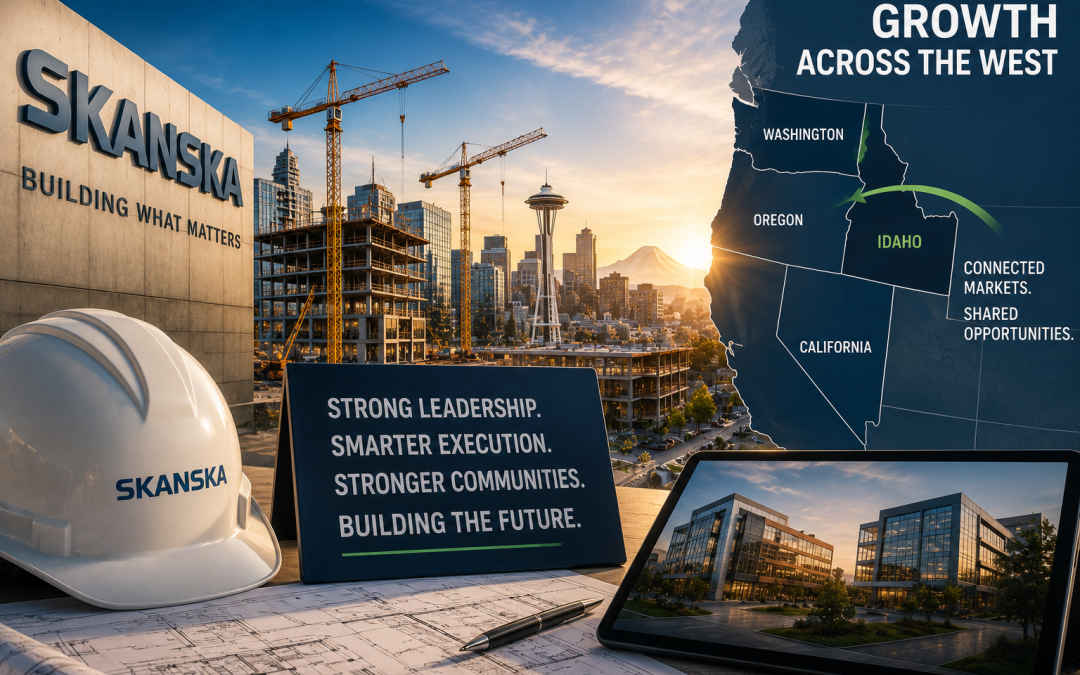
A recent leadership announcement from Skanska provides an interesting example of how large construction companies are positioning themselves for the next phase of growth across the western United States.
According to reporting by Nazifa Rahman of CoStar News, Skanska has promoted Don Kowalchuk to executive vice president and general manager of its Washington operations, while former Washington leader Lew Guerrette moves into a larger regional role overseeing the company’s West region. The original CoStar article can be found here: https://product.costar.com/home/news/949710424
While the announcement centers on Seattle, the implications extend beyond Washington and offer insight into trends affecting commercial real estate development throughout the Northwest, including Boise.
Why Leadership Changes Matter in Construction
Commercial real estate often focuses on tenants, landlords, and investors.
But behind every office tower, industrial facility, healthcare campus, or mixed-use development is a construction industry responsible for bringing projects to life.
When companies like Skanska elevate experienced leaders, it typically reflects confidence in future project activity and a desire to strengthen operations as markets continue evolving.
Don Kowalchuk brings more than three decades of construction experience to the role and has been with Skanska since the early 1990s. His background includes field operations, quality control, equipment management, and workforce development.
Those areas are becoming increasingly important as construction projects grow more complex and labor challenges continue across many markets.
The Growing Importance of Execution
One of the most significant themes in today’s commercial real estate environment is execution.
Developers are facing:
- Higher construction costs
- Longer project timelines
- Labor shortages
- More complicated financing structures
- Greater pressure on project returns
As a result, experienced construction leadership has become a competitive advantage.
The ability to deliver projects efficiently can significantly impact development feasibility, tenant occupancy schedules, and investment performance.
This is particularly relevant in markets experiencing ongoing growth, where demand for industrial, healthcare, education, multifamily, and infrastructure projects remains active.
What This Means for Boise Commercial Real Estate
Although this leadership change occurred in Seattle, Boise commercial real estate professionals should pay attention to broader regional trends.
The Pacific Northwest remains highly interconnected.
Construction firms, subcontractors, investors, developers, and institutional capital frequently operate across multiple states, including Washington, Oregon, California, and Idaho.
As major construction companies strengthen leadership teams and expand operational oversight, it can signal expectations for continued project activity throughout the region.
Boise development continues to benefit from:
- Population growth
- Business expansion
- Healthcare investment
- Industrial development
- Infrastructure improvements
- Educational facility growth
Many of these projects depend on the same construction expertise and industry resources that serve larger West Coast markets.
Regional Growth Continues to Drive Demand
One interesting aspect of the announcement is the expanded regional structure covering Washington, Oregon, and California.
Large construction firms increasingly view western markets as interconnected growth corridors rather than isolated geographic regions.
That perspective mirrors what many commercial real estate investors are seeing today.
Companies evaluating expansion opportunities often compare Boise alongside larger metropolitan areas because of factors such as:
- Lower operating costs
- Workforce availability
- Quality of life
- Business-friendly policies
- Long-term growth potential
As capital continues flowing throughout the West, Boise remains positioned to benefit from companies seeking alternatives to higher-cost coastal markets.
Local Insight
From a Boise commercial real estate perspective, this story is less about one executive promotion and more about confidence in future development activity.
Construction companies do not invest heavily in leadership succession and regional expansion unless they expect opportunities ahead.
The commercial real estate industry depends on experienced builders to transform development plans into completed projects. As Idaho continues attracting employers, residents, and investment capital, strong construction leadership will play a major role in determining how quickly new projects move from concept to reality.
For investors, developers, landlords, and tenants, that’s an encouraging signal.
The long-term growth story across the Northwest remains active, and Boise continues to be part of that conversation.
Mike Gioioso (joy-OH-so) has for 16+ years been helping companies of all sizes buy, build, and lease perfect places for business in greater Boise, Idaho and beyond.
www.streetsmartidaho.com mike@streetsmartidaho.com 208-209-9166
Tags: #boisecommercialrealestate, #commercialrealestate, #constructionindustry, #boisedevelopment, #skanska, #commercialconstruction, #pacificnorthwest, #economicdevelopment, #industrialdevelopment, #officedevelopment, #healthcareconstruction, #commercialproperty, #realestateinvesting, #constructionmanagement, #developmenttrends