
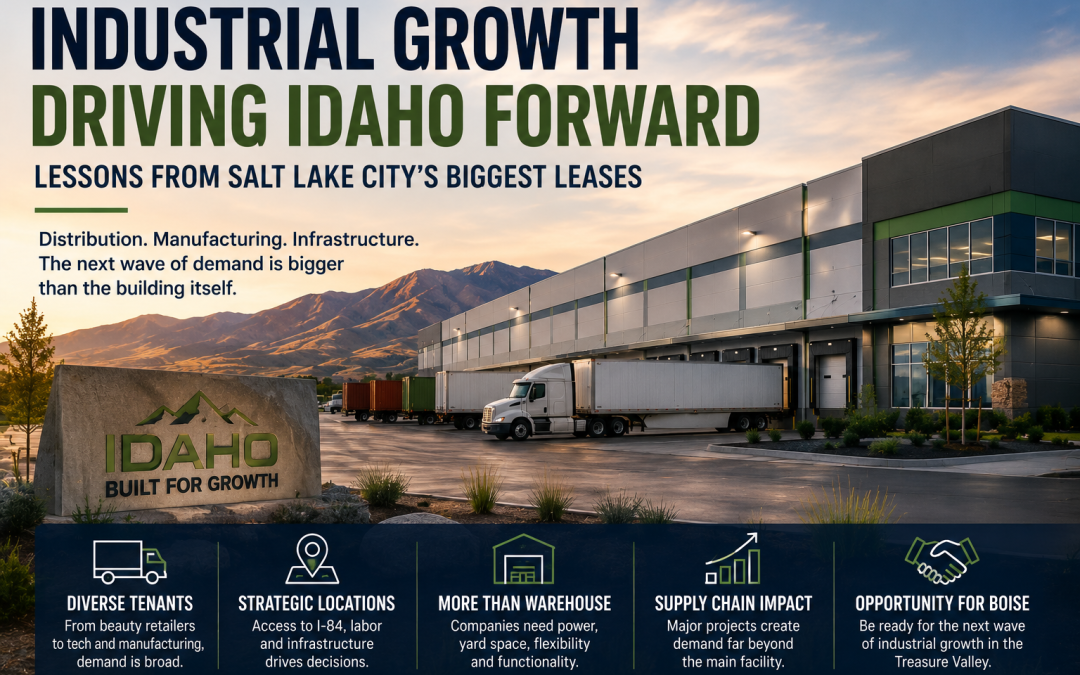
Salt Lake City’s Biggest Industrial Leases Offer a Road Map for Boise’s Next Growth Cycle
Industrial real estate demand is becoming about much more than moving boxes from one warehouse to another.
A group of major Salt Lake City-area leases shows just how broad the sector has become. Beauty-product distribution, data center construction, manufacturing, communications technology and printing all contributed to some of the region’s biggest industrial commitments during the second quarter of 2026.
Together, five recognized transactions accounted for more than 1.24 million square feet of leased industrial space.
According to reporting by CoStar Research, leases involving Ulta Beauty, Cupertino Electric, Biovation Labs, Motorola Solutions and Quad were selected among Salt Lake City’s second-quarter 2026 Power Broker Quarterly Deal Award winners.
You can read the original CoStar News article for the complete transaction and broker details.
These aren’t Boise deals. But Salt Lake City is one of the most useful regional markets to watch when thinking about Boise commercial real estate because both cities sit along major western growth corridors and compete for distribution, manufacturing and expanding businesses.
The Salt Lake transactions offer some clues about what could drive the next phase of industrial demand in the Treasure Valley.
Industrial Demand Is Coming From Several Directions
The largest recognized lease was enormous.
Ulta Beauty committed to 394,800 square feet in a newly built cross-dock distribution facility in Farr West, Utah.
The property is the first building in Ben Lomond Business Park and provides access to Interstate 15.
But distribution was only one part of the story.
Cupertino Electric leased 328,332 square feet in Salt Lake City. According to CoStar, the electrical engineering and construction company plans to use the facility for equipment storage, prefabrication and workforce mobilization connected with fast-moving data center projects in Utah.
Biovation Labs took another 253,231 square feet for its manufacturing operation.
Motorola Solutions committed to 164,988 square feet in a logistics development scheduled for completion this year.
And Quad leased 103,600 square feet, with operations expected to begin later in 2026.
That’s an unusually diverse tenant group.
It also highlights something Boise industrial real estate investors and developers should pay attention to:
Modern industrial demand isn’t one industry.
It can come from retail distribution.
Manufacturing.
Construction.
Technology infrastructure.
Consumer products.
Energy.
Printing.
Logistics.
And increasingly, businesses that combine several of these activities under one roof.
Data Centers Can Create Industrial Demand Beyond the Data Center
The Cupertino Electric transaction may be the most interesting of the five from a Boise development perspective.
The company isn’t simply leasing space for a traditional warehouse operation.
CoStar reported that the facility will support electrical equipment storage, prefabrication and workforce operations tied to data center construction in Utah.
That’s significant because it demonstrates the secondary real estate impact large infrastructure projects can create.
When people think about data centers, they naturally focus on the data center building itself.
But a major project requires a supply chain.
Electrical contractors need space.
Equipment suppliers need space.
Construction companies need staging areas.
Manufacturers and fabricators may need nearby facilities.
Maintenance operations need space.
Logistics companies move materials into and out of the market.
That means one large technology or infrastructure investment can create demand across multiple industrial properties.
Why Boise Should Watch This Trend
The Treasure Valley is already familiar with large-scale technology investment.
As Idaho continues attracting semiconductor, technology, energy and infrastructure projects, the commercial real estate impact may extend far beyond the campuses where those investments occur.
That’s where Boise industrial real estate could benefit.
A contractor working on a large project might not need a massive manufacturing plant.
It may need 20,000 square feet of flex-industrial space with a yard.
A supplier could need 50,000 square feet near Interstate 84.
Another company may need warehouse space with heavy power.
An equipment business might require outdoor storage.
Those secondary users can add up.
For developers, the challenge is understanding those needs before simply building another generic warehouse.
Location and Transportation Still Drive Industrial Real Estate
There is another common thread in the Salt Lake City transactions:
Access matters.
Ulta Beauty’s distribution facility benefits from proximity to I-15.
Quad’s new operation places the company closer to major customers.
Other recognized properties sit within Salt Lake City’s established industrial and logistics corridors.
The same principle applies to Boise.
For industrial users, a few extra minutes can matter when trucks make the same trip hundreds or thousands of times each year.
That’s why I-84 remains such an important part of the Treasure Valley industrial story.
Boise, Meridian, Nampa and Caldwell each offer different advantages along that corridor.
Nampa and Caldwell may offer larger parcels and potentially lower land costs.
Meridian provides a central Treasure Valley location.
Boise offers proximity to the region’s largest employment center and Boise Airport.
The right choice depends on what the tenant actually does.
Distribution companies care about transportation.
Manufacturers may prioritize power and utilities.
Contractors may need outside storage.
Technology-related users may need unusual electrical capacity.
A single definition of “industrial space” doesn’t work anymore.
Bigger Isn’t Always Better for Boise Development
Salt Lake City’s recognized deals are huge.
Four of the five exceeded 160,000 square feet, and three exceeded 250,000 square feet.
That doesn’t mean Boise developers should immediately start building 300,000-square-foot speculative warehouses.
Salt Lake City is a larger industrial market with a different transportation network, tenant base and regional reach.
Boise needs to build for Boise demand.
That’s especially important when construction and financing costs remain significant.
A large speculative industrial building can create major leasing risk if the market doesn’t have enough users requiring that exact size.
Smaller and mid-sized industrial spaces may sometimes offer broader tenant demand.
That could include:
- Contractors
- Building suppliers
- Regional distributors
- Light manufacturers
- Service businesses
- E-commerce operators
- Technology suppliers
- Food and beverage companies
- Automotive businesses
- Equipment companies
- Medical suppliers
For Boise development, flexibility can be valuable.
A building that can accommodate one 100,000-square-foot tenant but also divide efficiently for several smaller users may provide better downside protection than a highly specialized facility.
What Investors Should Look for in Boise Industrial Property
Industrial has been one of commercial real estate’s strongest sectors for years.
That popularity can create its own risks.
Investors still need to distinguish between a good industrial building and a good industrial investment.
The Salt Lake City transactions highlight several features worth considering.
Transportation access: How quickly can tenants reach I-84 and other major routes?
Clear height and loading: Can the property accommodate modern distribution requirements?
Power: Is enough electrical capacity available for manufacturing or technology-intensive users?
Outside storage: Is there usable yard space, and is it permitted?
Building flexibility: Can the property be divided for smaller tenants if necessary?
Labor access: Can companies realistically hire employees in the surrounding area?
Trailer and vehicle circulation: Does the site actually function for the intended user?
Future supply: How much competing industrial space is planned nearby?
These factors can matter more than simply buying at the lowest price per square foot.
Manufacturing Could Be an Important Part of Idaho’s Industrial Story
Biovation Labs’ 253,231-square-foot Salt Lake City lease is another transaction worth watching.
The company manufactures dietary supplements and provides services including formulation, encapsulation and packaging.
That is fundamentally different from basic warehouse distribution.
Manufacturing space can have more complicated requirements involving power, utilities, ventilation, loading and production layouts.
But manufacturing users can also create sticky occupancy.
Moving a warehouse is disruptive.
Moving an entire production operation can be much harder.
For Idaho, attracting more manufacturing could strengthen industrial demand while also broadening the state’s employment base.
And every new manufacturer can create additional demand from suppliers and service providers.
That creates another multiplier effect for commercial real estate.
Local Insight: Boise’s Industrial Opportunity May Be in the Supply Chain
From a Boise commercial real estate perspective, I think one of the biggest opportunities is looking beyond the headline project.
When a major employer announces a new facility, everyone focuses on that building.
But the more interesting long-term question can be:
Who needs to locate near it?
A major manufacturing facility needs suppliers.
A data center needs contractors and equipment.
A large retailer needs distribution.
A growing population needs food distributors, building suppliers, service contractors and last-mile logistics.
Those businesses need industrial real estate.
This is where Boise, Meridian, Nampa and Caldwell could see additional opportunity.
The Treasure Valley doesn’t necessarily need to compete with Salt Lake City for every 300,000-square-foot tenant.
It can capture companies that support Idaho’s growing economy.
Some may need 10,000 square feet.
Others may need 50,000.
A few could eventually need several hundred thousand.
The key is having the right inventory available when those companies arrive.
What Boise Industrial Landlords Should Be Watching
For existing landlords, these trends reinforce the value of functional industrial property.
A basic building with good loading, sufficient power, usable yard space and quick interstate access may be more valuable to certain tenants than a visually impressive property with operational limitations.
Owners should understand what their buildings can realistically support.
Can the electrical service be upgraded?
Can additional loading doors be installed?
Is outdoor storage allowed?
Could the property accommodate manufacturing?
Can a large suite be divided?
What are the truck circulation limitations?
Knowing those answers can make marketing much more effective.
Instead of simply advertising “industrial space available,” landlords can target the industries that actually fit the building.
Salt Lake City Offers Boise a Preview
The five industrial leases highlighted by CoStar show how diverse industrial demand has become.
A national beauty retailer needs distribution.
An electrical contractor needs space to support data centers.
A manufacturer needs production capacity.
A communications technology company needs logistics space.
A printing and marketing company wants to be closer to customers.
Different businesses. Different missions.
Same underlying need:
functional industrial real estate in the right location.
That’s the takeaway for Boise.
Population growth will continue creating industrial demand, but the next wave may increasingly come from businesses supporting manufacturing, technology, construction and infrastructure.
For developers, that means understanding tenant requirements before building.
For landlords, it means knowing what their properties can support.
For investors, it means looking beyond cap rates and studying the physical functionality of the asset.
And for Boise commercial real estate overall, the Salt Lake City deals are another reminder that industrial growth can spread much further than the warehouse itself.
Source: This article is based on transaction information and reporting published by CoStar Research on August 3, 2026. The Salt Lake City-area lease details and broker information originated from CoStar’s Power Broker Quarterly Deal Awards coverage. The Boise commercial real estate, industrial leasing, investment and development analysis above represents independent commentary and should not be considered original reporting.
Mike Gioioso (joy-OH-so)
has for 16+ years been helping companies of all sizes buy, build, and lease perfect places for business in greater Boise, Idaho and beyond.
www.streetsmartidaho.com mike@streetsmartidaho.com 208-209-9166
Tags: #boisecommercialrealestate, #boiseindustrialrealestate, #boiseindustrialleasing, #boisedevelopment, #saltlakecityindustrialrealestate, #idahocommercialrealestate, #treasurevalleyindustrial, #nampaindustrialrealestate, #caldwellindustrialrealestate, #meridiancommercialrealestate, #boiseinvestmentproperty, #industrialdevelopment, #datacenterrealestate, #idahomanufacturing, #i84industrialcorridor, #treasurevalleycommercialrealestate