
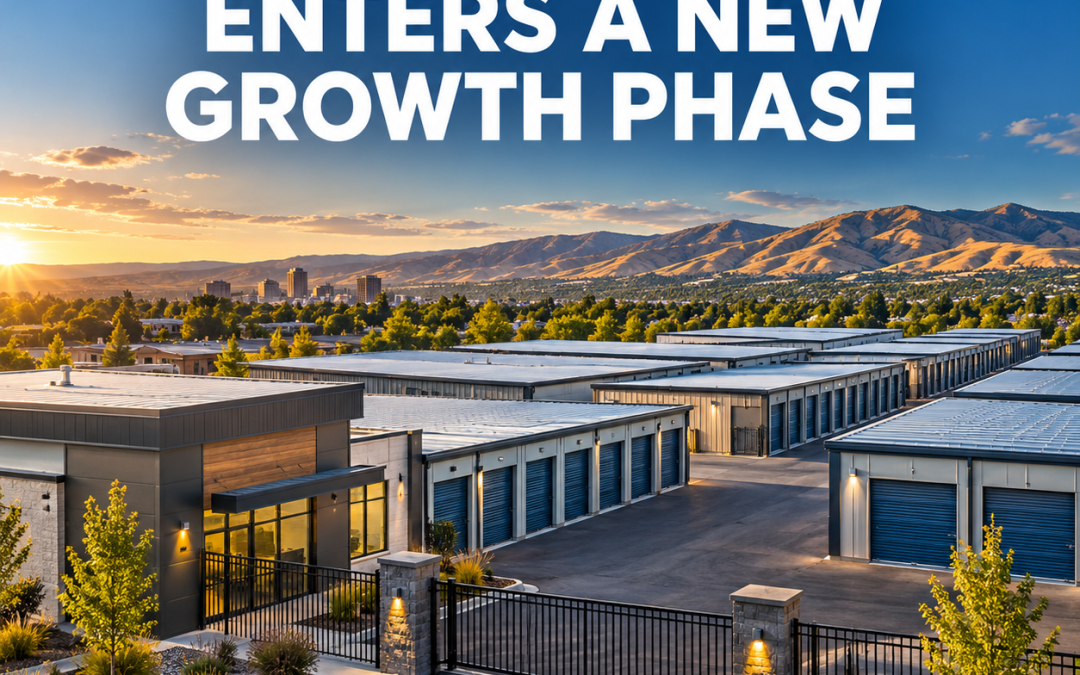
Self-Storage Consolidation Creates New Opportunities for Boise Investors
The self-storage industry is entering a new phase. After several slower years, large operators are buying again—and they are targeting Northwest markets with strong population growth and limited development opportunities.
For Boise commercial real estate investors, this trend is worth watching. The same forces attracting institutional capital to Washington and Oregon are also present across Boise and the Treasure Valley.
According to reporting by Randyl Drummer for CoStar News, Public Storage recently purchased 14 self-storage properties in Washington and Oregon for $151 million. The transaction expands the company’s already significant Pacific Northwest portfolio and points to continued consolidation across the industry.
Large Operators Are Returning to Acquisition Mode
The acquired portfolio includes Money Saver Mini Storage facilities in several Washington communities, including Kirkland, Woodinville, Olympia, Tumwater, Lacey, Arlington, Anacortes, and Mukilteo.
Five additional properties are located in the Oregon communities of Portland, Gresham, and Oregon City.
The deal comes as Public Storage pursues aggressive expansion in the United States and Canada. The company already owns more than 160 properties in Washington and recently agreed to acquire National Storage Affiliates for $10.5 billion.
Public Storage is also entering Canada through a separate acquisition involving 68 facilities. That portfolio stretches across Toronto, Vancouver, Montreal, Calgary, and Ottawa and is valued at approximately $1.2 billion.
Together, these moves suggest that major self-storage owners believe current market conditions offer an opportunity to gain scale before the next period of stronger growth.
Smaller operators have faced several challenges in recent years:
- Slower customer demand following the pandemic-era surge
- New supply in some markets
- Higher borrowing costs
- Weaker rent growth
- Reduced property values
- A slower housing market that limited moving activity
As these pressures affected smaller owners, well-capitalized companies gained an opportunity to purchase portfolios that may not have been available during the market’s strongest years.
Technology and Scale Are Changing Property Performance
Self-storage is often viewed as a simple commercial property type. Build the units, lease them, and collect monthly rent.
Modern storage operations are more complicated.
Large companies can use pricing software, customer data, digital advertising, automated leasing, call centers, and centralized management to improve property performance. They may also be able to spread marketing and operating expenses across hundreds or thousands of facilities.
That scale can help institutional owners increase occupancy, adjust rental rates more quickly, and reduce the cost of attracting new customers.
A smaller operator may own a good property in a strong location but lack the technology or capital needed to maximize its income. A large buyer may see an opportunity to improve that same facility without making major physical changes.
That operational upside is one reason established storage platforms may be able to justify acquisitions that do not appear inexpensive based only on current income.
Financing conditions are also beginning to improve. Lower borrowing costs can help deals pencil again while giving highly leveraged owners a chance to sell before facing additional financial pressure.
For investors, this means self-storage values may increasingly reflect both real estate fundamentals and the buyer’s ability to operate the business efficiently.
What This Means for Boise Self-Storage Real Estate
Boise and the Treasure Valley share several characteristics with the Northwest markets Public Storage is targeting.
The region has experienced population growth, apartment development, smaller residential lots, and rising construction costs. Many newer apartments provide limited storage inside individual units. Smaller homes and townhouses may also lack the garages, sheds, and extra rooms found in older suburban properties.
Those trends can support long-term storage demand.
At the same time, Boise development has become more difficult in many established locations. Land costs, zoning, neighborhood concerns, impact fees, and construction expenses can make new facilities harder to build.
That creates a potential advantage for existing properties with good access, strong visibility, and limited nearby competition.
For Boise commercial real estate investors, several factors deserve close attention:
- Existing and proposed storage supply within the trade area
- Population and household growth
- Apartment and multifamily development
- Traffic counts and customer access
- Unit mix and climate-controlled inventory
- Physical and economic occupancy
- Current rents compared with nearby competitors
- Opportunities to improve management and digital marketing
- Expansion potential on excess land
- Local zoning restrictions and entitlement risk
Investors should not assume that every growing community needs another storage facility. Self-storage demand is highly local, and too much construction can pressure occupancy and rental rates.
However, an existing facility in a strong growth corridor may become more valuable when barriers to new construction increase.
Local Insight: Boise’s Independent Owners Could Become Acquisition Targets
My take is that institutional buyers will continue searching for storage properties that can be added to larger operating platforms.
In the Boise market, the most attractive targets may not be the largest facilities. A smaller property can still be valuable if it has good visibility, convenient access, strong occupancy, and little nearby land available for competing development.
Independent owners should begin preparing before a buyer approaches. Clean financial statements, accurate rent rolls, documented operating expenses, unit-level occupancy data, and organized property records can help establish value and make a future sale easier.
Owners should also understand the difference between selling real estate and selling an operating business. A self-storage property’s value depends on the site and improvements, but it is also shaped by management quality, customer retention, pricing, and operating systems.
For buyers, the opportunity may be in properties that are physically sound but operationally behind. Better websites, online leasing, automated access, improved signage, professional management, and more responsive pricing can produce meaningful gains.
Public Storage’s Pacific Northwest expansion is a reminder that large investors often become most active when a property sector is beginning to stabilize—not after the recovery is obvious to everyone.
That does not mean Boise investors should chase every storage listing. It means they should watch the market closely, study each trade area, and be ready when a well-located facility with operational upside becomes available.
Mike Gioioso (joy-OH-so) has for 16+ years been helping companies of all sizes buy, build, and lease perfect places for business in greater Boise, Idaho and beyond.
www.streetsmartidaho.com mike@streetsmartidaho.com 208-209-9166
Tags: #boisecommercialrealestate, #boiseselfstorage, #boisestoragefacilities, #boiseinvestmentproperty, #boiserealestateinvesting, #treasurevalleycommercialrealestate, #idahocommercialrealestate, #idahoselfstorage, #selfstorageinvestment, #selfstoragepropertiesforsale, #selfstorageconsolidation, #storagefacilityacquisition, #commercialpropertyinvestment