
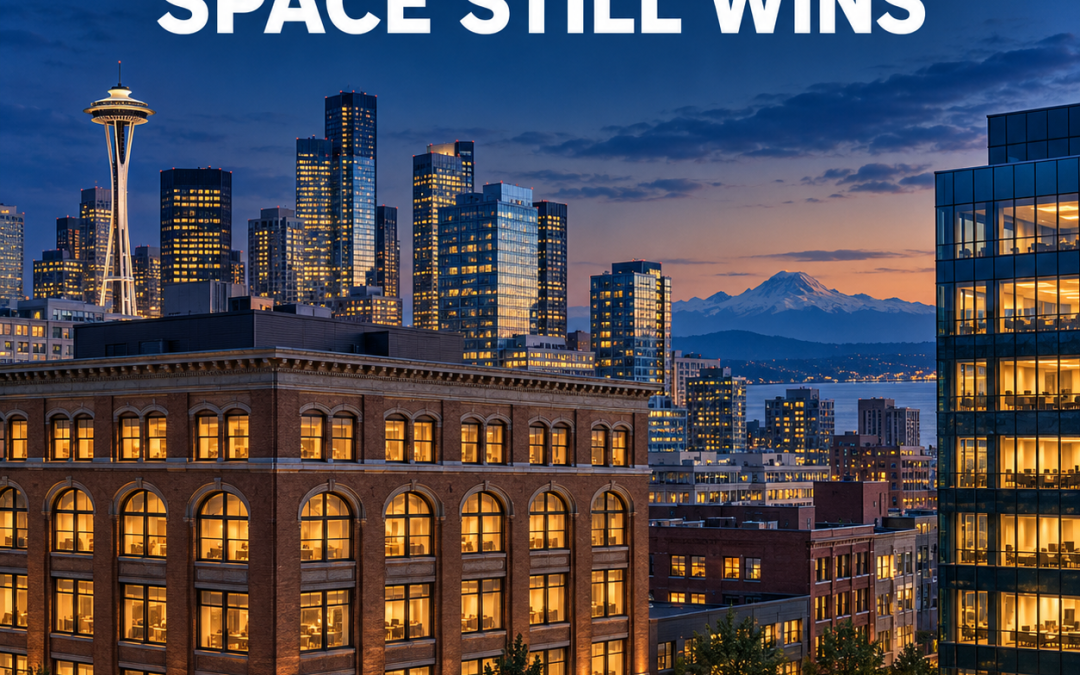
Seattle Office Leasing Offers Boise Landlords a Timely Lesson: Quality Space Still Wins
A major office lease in downtown Seattle is sending a useful message to commercial real estate markets across the Northwest: companies may be more selective about office space, but they have not stopped leasing it.
According to reporting by Katie Burke for CoStar News, online lending company LendingTree has agreed to relocate its Seattle-area operation to 83 King, a renovated historic office building in Pioneer Square.
The move will not reduce Seattle’s high office vacancy overnight. However, it shows what can happen when a landlord combines a distinctive building, a strong location, modern amenities, and meaningful property improvements.
A Major Commitment Without a Major Expansion
LendingTree is leasing more than 39,000 square feet at 83 King. The company will move from its existing office at 157 Yesler Way, which is only a few blocks away.
Its QuoteWizard affiliate has reportedly occupied approximately 33,455 square feet at the current location for nearly two decades. That means the new agreement represents a modest increase in occupied space rather than a major corporate expansion.
Even so, the lease is important.
Seattle has spent several years watching companies shrink their offices, move to newer suburban buildings, or leave downtown locations altogether. Keeping an established employer in Pioneer Square provides the area with stability at a time when downtown office vacancy remains extremely high.
The new lease will also make LendingTree one of the primary occupants of 83 King. The historic, eight-story property contains approximately 186,600 square feet and sits near Seattle’s ferry terminal.
Renovations Are Helping Older Buildings Compete
Hudson Pacific Properties, the owner of 83 King, has invested in restoring and upgrading the building. Improvements include a fitness facility, rooftop deck, bicycle storage, and electric vehicle charging.
Those features helped the building secure LendingTree, according to the landlord.
This reflects a larger shift in office leasing. Many tenants no longer choose space based only on rent and square footage. They are looking for buildings that can help attract employees, support workplace culture, and make the commute feel worthwhile.
A well-located older building can still compete, but it usually needs more than historic charm. Tenants want modern systems, attractive common areas, flexible layouts, useful amenities, and a clear sense that the property is being actively managed.
That lesson applies directly to Boise commercial real estate.
Downtown Boise has its own collection of older office properties with strong character and desirable locations. Some can compete very well against newer Boise development projects, especially when ownership makes targeted improvements. Updated entrances, shared meeting rooms, outdoor areas, secure bike facilities, showers, better lighting, and improved technology can change how tenants view a building.
The goal does not always need to be a complete redevelopment. Strategic improvements can reposition a property without removing the character that makes it special.
Seattle’s Recovery Is Still Early—but Demand Is Broadening
Seattle’s downtown office vacancy rate has reached approximately 31.5%, according to CoStar data cited in the article. That is a dramatic change from the beginning of the decade, when vacancy reportedly stood below 2%.
One lease cannot solve a vacancy problem of that size. Still, market activity may be moving in a better direction.
Landlords have reported more property tours and lease negotiations. Several notable companies—including Anthropic, DocuSign, and Stripe—have recently committed to substantial blocks of office space in downtown Seattle and South Lake Union.
Just as important, demand is not limited to large corporate headquarters. Much of the recent activity involves companies seeking roughly 10,000 to 30,000 square feet.
That middle portion of the market matters because a recovery built around many medium-sized leases can be more sustainable than one based on a few headline-making transactions.
Why This Matters for Boise Office Owners and Tenants
Boise is not Seattle, and the two office markets should not be treated as if they face identical conditions. Boise has a smaller inventory, different employment drivers, shorter commute patterns, and its own supply-and-demand pressures.
However, the basic tenant behavior is similar: companies are becoming more careful about where they lease space.
For Boise landlords, the Seattle deal offers several practical takeaways:
- Tenants will commit when a building offers a clear advantage.
- Existing buildings need to compete on experience, not just rental rate.
- Amenities should solve real employee needs.
- Mid-sized tenants can provide an important source of leasing activity.
- Historic character becomes more valuable when paired with modern functionality.
- A tenant relocating within the same submarket can still be a meaningful win.
For tenants evaluating Boise office leasing opportunities, today’s softer conditions may create more negotiating power. Companies may be able to pursue tenant improvements, flexible commencement dates, expansion options, signage rights, or other concessions that were harder to obtain in a tighter market.
However, the lowest-priced space is not always the best value. Businesses should also consider parking, visibility, employee access, building condition, operating expenses, and the landlord’s willingness to maintain the property.
Local Insight: Boise Buildings Need a Clear Story
My take is that office properties now need a stronger identity.
A building cannot simply be “available office space.” It needs to offer a reason for a company to choose it over working remotely, leasing in the suburbs, or moving into a newly constructed project.
In downtown Boise, that reason might be walkability, nearby restaurants, historic architecture, access to government offices, or a stronger connection to the city’s business community. In Meridian or Eagle, the advantage might be convenient parking, shorter employee commutes, newer construction, or proximity to growing residential areas.
The strongest leasing strategy starts by understanding which tenants will value those advantages. Ownership can then focus improvements, marketing, and lease terms around that audience.
The LendingTree lease does not prove that every downtown office market has recovered. It does show that companies will still make long-term workplace commitments when the location, property, amenities, and overall experience fit their needs.
That is an encouraging signal for Boise office landlords willing to invest in their buildings—and for tenants prepared to use current market conditions to secure better space and stronger lease terms.
Mike Gioioso (joy-OH-so) has for 16+ years been helping companies of all sizes buy, build, and lease perfect places for business in greater Boise, Idaho and beyond.
www.streetsmartidaho.com mike@streetsmartidaho.com 208-209-9166
Tags: #boisecommercialrealestate, #boiserealestate, #boiseofficemarket, #boiseofficeleasing, #boiseofficespace, #downtownboiserealestate, #boisedevelopment, #commercialpropertyboise, #officebuildingsboise, #idahocommercialrealestate, #treasurevalleycommercialrealestate, #retailleasingboise, #tenantimprovements, #officevacancyrates, #commercialrealestatetrends