
Idaho Innovation Extends Beyond Boise: What INL Technology Says About the State’s Growing Business Economy
When people talk about Idaho’s economy, agriculture, construction, population growth, and Boise’s technology sector usually get much of the attention.
But some of the state’s most interesting innovation is happening several hours east of the Treasure Valley.
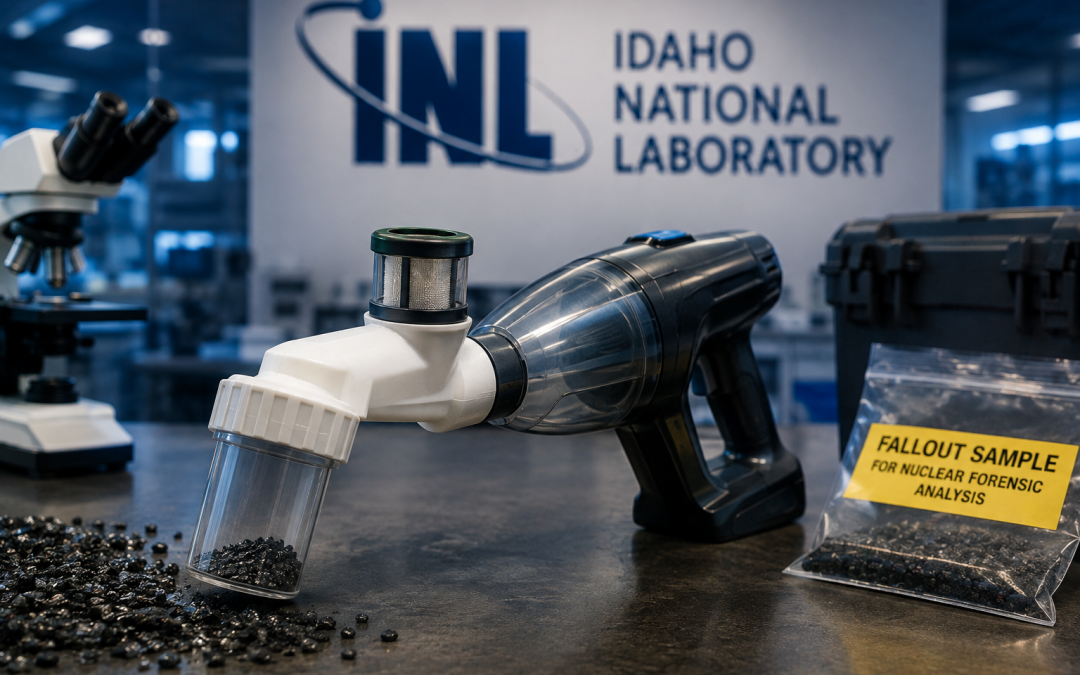
Researchers at Idaho National Laboratory have developed a surprisingly simple tool with a highly specialized purpose: helping investigators collect material after a nuclear event more quickly and safely.
The invention itself is fascinating. From a Boise commercial real estate perspective, however, there is another story here — Idaho continues to build an ecosystem where research, advanced manufacturing, private industry, and government investment intersect.
According to reporting provided by Cory Hatch and Sarah Lusk of INL Communications and published by the Idaho Business Review, the Idaho National Laboratory team developed an attachment that works with commercially available handheld vacuums to collect material for nuclear forensic analysis.
You can read the original Idaho Business Review article for the full technical story.
For Idaho’s business and commercial property markets, the larger takeaway is how research like this can move from a laboratory to private-sector production — all within Idaho.
From Idaho Research Lab to Idaho Manufacturing
The basic concept behind INL’s invention is relatively straightforward.
After a nuclear detonation, debris can become part of the radioactive material that eventually returns to the ground. Investigators need to collect samples so scientists can analyze them and potentially determine information about the source of the nuclear material.
Historically, collecting those samples could involve basic tools and require significant handling by responders.
INL researchers saw an opportunity to improve that process.
Rather than design an entirely new vacuum system, the team created an adapter for certain existing cordless handheld vacuums.
The attachment directs collected particles into a removable specimen container. A filtration system helps keep the collected material from moving farther into the vacuum.
The concept dates back to 2017, when early prototypes were produced with an in-house 3D printer. Researchers continued modifying the design based partly on feedback from training exercises.
The result is a tool designed around a few practical priorities: portability, durability, speed, and ease of use while wearing protective equipment.
According to the Idaho Business Review report, the improved process can reduce a collection exercise that previously took around 15 minutes to roughly five.
The technology received a patent in 2024 and continues to undergo refinement and field testing.
The Commercial Real Estate Story Behind Advanced Manufacturing
One detail should stand out to anyone following Idaho commercial real estate.
Production did not necessarily have to leave the state.
Once INL needed a stronger version of the attachment, manufacturing was moved to a private company in American Falls, Idaho, where commercial-grade 3D printing could produce a more durable product.
That connection between research and private manufacturing is important.
A national laboratory can generate intellectual property and technical expertise, but bringing an idea into physical production requires a much broader ecosystem.
Companies need industrial space.
They need power.
They need transportation access.
They need skilled workers.
They need suppliers and equipment.
And as companies grow, they often need increasingly specialized real estate.
This is where advanced manufacturing can become particularly interesting for Idaho commercial real estate investors and developers.
Traditional industrial demand may revolve around warehousing, distribution, construction, and logistics. Advanced manufacturing can require a different type of building — one that combines production, engineering, testing, office, laboratory, and secure storage space.
That can create opportunities for flexible industrial properties capable of supporting several functions under one roof.
Why Boise Should Pay Attention to Innovation Across Idaho
Idaho National Laboratory is located in eastern Idaho, but its economic influence does not stop at the edge of the Idaho Falls market.
Technology developed around INL can contribute to a larger statewide ecosystem involving engineering firms, manufacturers, government contractors, technology companies, universities, and specialized service providers.
Boise can benefit from that ecosystem.
The Treasure Valley already has a strong base of technology companies, semiconductor activity, construction businesses, professional services, manufacturing, and distribution.
As Idaho attracts additional investment, there may be opportunities for Boise-area companies to participate in supply chains connected to research and advanced manufacturing elsewhere in the state.
For Boise development, that could translate into demand for several types of commercial property:
- Flex industrial buildings
- Advanced manufacturing facilities
- Research and development space
- Engineering offices
- Secure warehouse facilities
- Specialized production buildings
- Contractor and supplier space
- Technology-focused business parks
The Treasure Valley’s growing population and business base make it a logical location for companies that want access to Idaho’s workforce while serving clients throughout the state and Intermountain West.
Small Technology Can Create a Bigger Economic Chain
Another interesting part of the INL story is the simplicity of the solution.
Not every major innovation requires an enormous factory or a completely new piece of equipment.
INL’s researchers identified a specific problem and designed an attachment around a product that already existed.
That matters from a business standpoint.
Smaller innovations can still generate intellectual property, manufacturing contracts, supplier relationships, specialized jobs, and eventually new companies.
This is one reason research institutions can have economic effects far beyond their campuses.
A successful technology may begin with researchers, move to prototyping, then require testing, outside manufacturing, suppliers, distribution, and ongoing improvements.
Each stage can involve private businesses.
And private businesses need real estate.
Advanced Manufacturing Could Be an Opportunity for Boise Industrial Real Estate
Boise industrial real estate has grown considerably as the Treasure Valley has expanded.
Much of the market’s attention has understandably focused on warehouses, logistics, construction suppliers, and distribution facilities.
But advanced manufacturing deserves attention too.
These tenants may prioritize different building characteristics than traditional warehouse users.
Reliable electrical capacity can be critical. So can climate control, clean production environments, secure areas, higher-quality office components, fiber connectivity, loading capabilities, and room for research or testing.
Developers who understand these requirements may be able to position future Boise industrial projects for a broader range of tenants.
Existing landlords can also look at whether older industrial or flex buildings could be upgraded to accommodate higher-value manufacturing and technology users.
That does not mean every Boise warehouse should become a research facility.
It means the industrial market should remain flexible enough to serve the increasingly diverse businesses entering Idaho.
Local Insight: Idaho’s Research Economy Is a Real Estate Story
The nuclear forensics application makes this particular invention unusual, but the commercial real estate lesson is much more ordinary.
Innovation eventually needs physical space.
Someone has to design the product.
Someone has to prototype it.
Someone has to manufacture it.
Someone has to test it.
Someone has to store and distribute it.
That chain creates demand for offices, laboratories, flex buildings, manufacturing facilities, and industrial properties.
For Boise commercial real estate investors and developers, Idaho National Laboratory is worth watching for that reason.
The direct real estate demand generated by a single invention may be small. The ecosystem surrounding decades of federally supported research is another matter.
Idaho has an opportunity to connect its research institutions, universities, skilled workforce, private manufacturers, and growing cities into a stronger statewide innovation economy.
Boise and the Treasure Valley can play an important role in that growth.
As we think about the next phase of Boise development, the opportunity isn’t simply building more warehouse space. It’s creating commercial properties flexible enough to support the kinds of companies Idaho’s economy may produce next.
Sometimes that next company starts with something as complicated as nuclear science.
And sometimes it starts with something as simple as an attachment for a vacuum.
Mike Gioioso (joy-OH-so)
has for 16+ years been helping companies of all sizes buy, build, and lease perfect places for business in greater Boise, Idaho and beyond.
www.streetsmartidaho.com mike@streetsmartidaho.com 208-209-9166
Tags: #boisecommercialrealestate, #idahocommercialrealestate, #boiseindustrialrealestate, #boisedevelopment, #idahodevelopment, #idahonationallaboratory, #inl, #idahoinnovation, #idahotechnology, #advancedmanufacturingidaho, #boiseadvancedmanufacturing, #boiseindustrialdevelopment, #idahomanufacturing, #boiseflexspace, #researchanddevelopmentrealestate