
Bed Bath & Beyond’s Headquarters Move Signals a Bigger Shift in Retail Real Estate
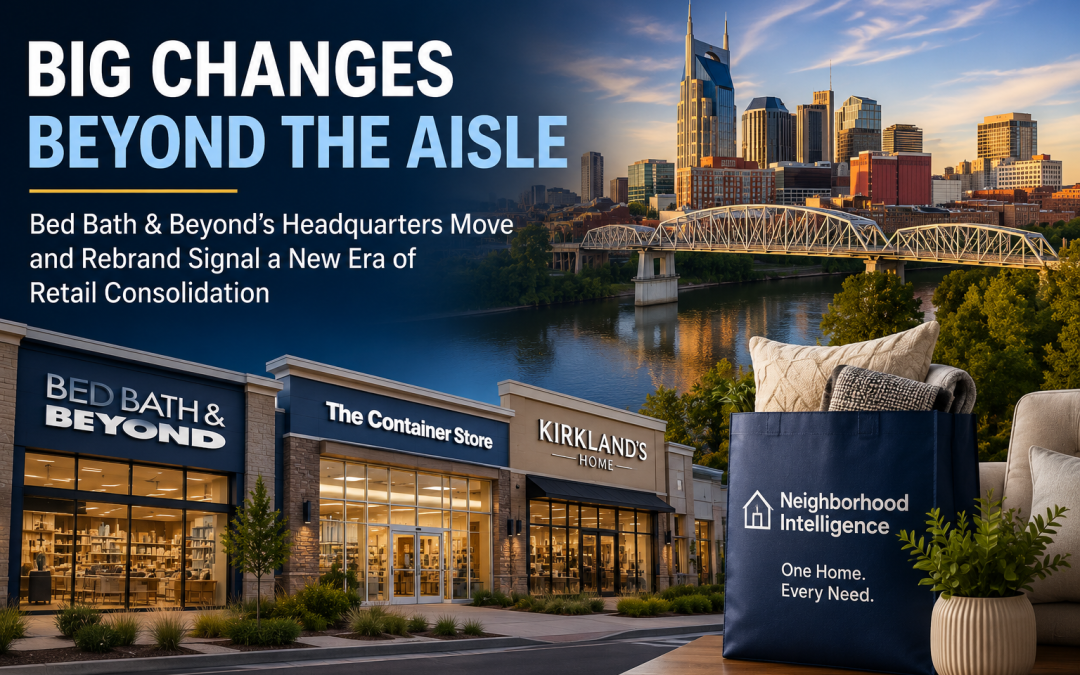
Bed Bath & Beyond is moving its corporate headquarters, changing its parent company’s name and combining several major retail brands under one operating platform.
On the surface, this is a corporate restructuring story. From a commercial real estate perspective, however, it points to something bigger: large retailers are taking a much harder look at how much real estate they actually need.
According to reporting by Linda Moss for CoStar News, Bed Bath & Beyond’s parent company plans to relocate its headquarters from Utah to Nashville, Tennessee, while consolidating operations across a portfolio that now includes Bed Bath & Beyond, The Container Store, Kirkland’s, Buy Buy Baby and other brands.
You can read the original CoStar News article for the underlying reporting.
For those of us watching Boise commercial real estate, retail leasing and office demand, the more important question is what this strategy tells us about where national retailers are headed next.
Retail Consolidation Is Becoming a Real Estate Strategy
Bed Bath & Beyond today looks very different from the retailer consumers knew several years ago.
CEO Marcus Lemonis has assembled a group of home-focused brands that includes Bed Bath & Beyond, Overstock, Buy Buy Baby, Kirkland’s and Kirkland’s Home, The Container Store and Closet Works.
Now those businesses are being brought closer together.
The parent company is being renamed Neighborhood Intelligence, with its shares scheduled to begin trading on Nasdaq under the ticker NXH on Aug. 17.
The corporate headquarters will also move to Nashville from Murray, Utah.
Earlier this summer, the company placed its Utah headquarters space at 433 Ascension Way on the sublease market while considering Nashville, Dallas and Florida for its next home.
The decision ultimately landed in Tennessee.
But the physical headquarters move may only be one piece of the real estate story.
Management is looking for more than $50 million in annualized savings as the businesses are integrated over the coming year. Part of that strategy involves eliminating overlapping infrastructure, services and locations.
That means leases are likely to come under scrutiny.
And that’s where this story becomes particularly interesting for commercial property owners.
The Store Isn’t Disappearing—Its Job Is Changing
The restructuring doesn’t mean physical retail is going away.
In fact, the company is experimenting with ways to make its existing stores work harder.
Bed Bath & Beyond merchandise is being introduced inside The Container Store locations. The companies opened their first combined store concept in Fort Worth, Texas, in May.
Think about what that represents from a commercial real estate standpoint.
Instead of maintaining completely separate store networks for every brand, retailers can potentially put several concepts under one roof.
One location.
One lease.
One operating platform.
Multiple brands and customer groups.
That could become increasingly important as retailers try to reduce overhead without abandoning physical stores.
For retail leasing in Boise, landlords should pay attention.
The question for a national retailer may increasingly shift from:
“How many stores should we operate?”
to:
“How much revenue can we generate from each location?”
That changes how retailers evaluate square footage, store layouts, trade areas and lease economics.
What This Could Mean for Boise Commercial Real Estate
The Treasure Valley has benefited from years of population growth and national retailer expansion.
Boise, Meridian, Nampa, Caldwell and Eagle continue to attract brands looking for access to growing households and expanding commercial corridors.
But growth doesn’t mean every retailer will automatically want more locations.
Companies are becoming more disciplined about occupancy costs.
That creates several issues Boise landlords, investors and developers should watch.
First, existing stores may become more important.
A retailer with a strong Boise-area location might prefer to expand merchandise or introduce another brand within that store instead of opening another location nearby.
Second, larger spaces may become more flexible.
Retailers could increasingly look for locations capable of supporting several product categories, concepts or brands.
That could make adaptable floor plans more valuable.
Third, corporate consolidation can create vacancy.
When companies merge operations, duplicate offices, warehouses and stores can become unnecessary. Bed Bath & Beyond’s Utah headquarters being marketed for sublease is a good example.
This can create challenges for landlords—but opportunities for tenants looking for second-generation space.
Fourth, lease flexibility may become increasingly important.
Retailers trying new concepts may place greater value on expansion rights, contraction options, assignment provisions and other lease terms that give them flexibility as their businesses evolve.
For landlords, understanding the retailer’s larger corporate strategy becomes just as important as understanding the individual store.
Boise Developers Should Watch the Omnichannel Model
There’s another takeaway here for Boise development.
Retailers aren’t necessarily separating physical stores from e-commerce anymore.
They’re trying to make the two systems work together.
A physical store can be a showroom, pickup point, return center, fulfillment location and traditional retail space at the same time.
That means site selection could increasingly depend on more than traffic counts and demographics.
Retailers may also consider:
- Convenient customer access
- Parking and pickup areas
- Delivery access
- Storage capacity
- Flexible floor plans
- Proximity to major population centers
- Ability to support multiple brands or concepts
That could favor well-located retail centers along major Treasure Valley transportation corridors.
A property that allows a retailer to serve several functions from one location may have an advantage over a building designed strictly around yesterday’s shopping patterns.
Local Insight: Follow the Occupancy Costs
The biggest takeaway for me is that retail restructuring and commercial real estate are becoming increasingly connected.
When a company talks about eliminating duplicate systems, integrating businesses and reducing annual expenses, commercial leases are often somewhere in that conversation.
Real estate is one of the largest fixed expenses many retailers have.
That means landlords should understand what’s happening at the corporate level with their tenants.
Is the company expanding?
Is it acquiring competitors?
Is it combining brands?
Is it shrinking its store base?
Could an existing location support several concepts?
Those questions can help property owners anticipate what happens next instead of waiting for a renewal notice.
For investors looking at Boise investment property, tenant credit should also involve more than simply recognizing the name above the door.
A nationally known brand can still change its store strategy quickly.
Understanding the tenant’s broader business model, lease obligations and role within its corporate portfolio is becoming increasingly important when evaluating retail assets.
At the same time, consolidation can create opportunities.
A retailer closing one location may expand another.
A large box may be divided for several tenants.
A traditional store may become an omnichannel location.
And second-generation retail space can provide growing businesses with an alternative to increasingly expensive ground-up construction.
The lesson for Boise isn’t that retail space is becoming less important.
It’s that retailers expect every square foot to do more.
For Boise landlords, developers and investors, properties that offer strong locations, flexible layouts and reasonable occupancy costs should be better positioned as national retailers continue adjusting how they use physical real estate.
Source: Linda Moss, CoStar News, Aug. 4, 2026. This article provides commentary and analysis based on CoStar’s reporting and is not presented as independent reporting of Bed Bath & Beyond or Neighborhood Intelligence.
Mike Gioioso (joy-OH-so)
has for 16+ years been helping companies of all sizes buy, build, and lease perfect places for business in greater Boise, Idaho and beyond.
www.streetsmartidaho.com mike@streetsmartidaho.com 208-209-9166
Tags: #boisecommercialrealestate, #boiserealestate, #boiseretailrealestate, #boiseretailleasing, #retailleasingboise, #boisedevelopment, #boiseretaildevelopment, #boiseinvestmentproperty, #boisecommercialproperty, #boiseshoppingcenters, #treasurevalleycommercialrealestate, #treasurevalleyretail, #idahocommercialrealestate, #idahoretailrealestate, #idahocommercialdevelopment