
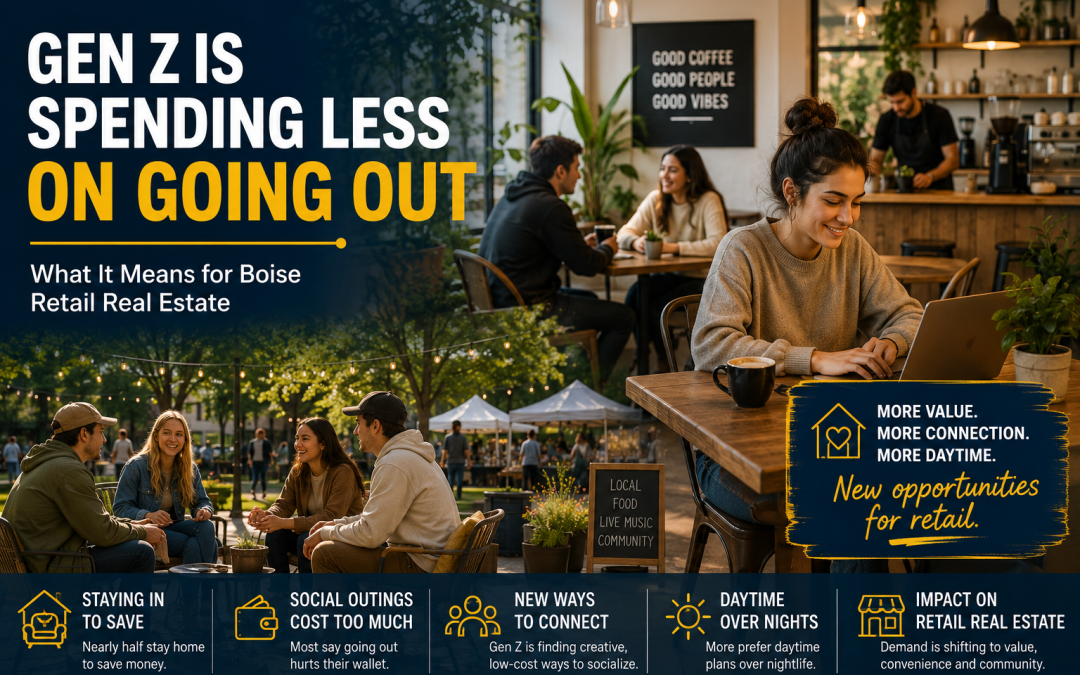
Gen Z Is Spending Less on Going Out—What That Could Mean for Boise Retail Real Estate
What happens to restaurants, bars, shopping centers and entertainment concepts when a generation decides a night out costs too much?
That’s a question commercial real estate owners should be asking.
New survey data suggests many Gen Z adults aren’t necessarily losing interest in socializing. Instead, they’re changing where, when and how much they’re willing to spend to do it.
According to reporting by IBR Staff in the Idaho Business Review, a Harris Poll of more than 4,100 adults found that nearly half of Gen Z respondents said staying home helps them save money. Even more said the financial hit from going out can make the experience feel less worthwhile.
You can read the original Idaho Business Review article for the underlying reporting.
For Boise commercial real estate, this isn’t just an interesting generational trend. It could influence restaurant demand, retail leasing, entertainment concepts and the kinds of places younger consumers choose to visit.
Gen Z Still Wants to Socialize—Just Differently
The headline numbers from the survey are striking.
About 49% of Gen Z adults surveyed said staying home helps them save money, while 68% indicated that going out can be too hard on their finances.
Another 62% said staying in helps them avoid regretting what they spent afterward.
But there’s another side of the survey that may be even more important for commercial real estate.
Gen Z hasn’t given up on social interaction.
In fact, 85% said they have found creative ways to spend time with other people without spending heavily.
That includes gathering at someone’s home, attending free community events and looking for discounts.
About 79% pointed toward simply spending time together as an affordable alternative, while 76% favored environments that are quieter and less intense.
More than half—54%—preferred socializing during the day rather than at night.
That’s not the disappearance of social demand.
It’s a change in social demand.
And commercial property owners should understand the difference.
The Opportunity Could Shift From Nightlife to “Third Places”
For years, the traditional social formula was pretty predictable.
Dinner.
Drinks.
Bars.
Clubs.
Movies.
Maybe some shopping.
But younger consumers facing high housing costs, food prices and other expenses are becoming more selective about discretionary spending.
That could create opportunities for what planners sometimes call third places—places outside someone’s home and workplace where people can comfortably spend time.
Think coffee shops, parks, food halls, patios, bookstores, fitness concepts, farmers markets, community events and mixed-use developments.
For retail leasing in Boise, these uses can be especially interesting because they create reasons for people to visit commercial properties without requiring a traditional night-out budget.
A coffee shop where customers spend several hours talking may serve a very different social function than a traditional restaurant.
A walkable retail district with inexpensive food, public seating and outdoor gathering areas may attract customers who aren’t interested in an expensive evening downtown.
Even fitness and wellness concepts can become social destinations when customers build communities around them.
This is where landlords need to think beyond rent per square foot.
What role does a tenant play in the customer’s life?
That question could become increasingly important.
Boise Retail May Need to Win More Daytime Visits
The preference for daytime socializing also caught my attention.
If younger customers increasingly choose coffee, lunch, fitness, outdoor recreation and community activities over expensive late-night entertainment, traffic patterns could shift.
That’s relevant across the Treasure Valley.
Downtown Boise has historically benefited from a strong restaurant, bar and entertainment environment.
But growing areas of Meridian, Eagle, Nampa and other communities are creating their own social destinations.
The Village at Meridian is one example of how shopping, restaurants, entertainment and public gathering spaces can work together.
Future Boise development may benefit from incorporating more reasons for customers to stay at a property even when they aren’t spending heavily.
Outdoor seating.
Shade.
Landscaping.
Public gathering areas.
Walkability.
Events.
Coffee.
Affordable food.
Those features can create dwell time.
And dwell time can create opportunities for surrounding tenants.
Affordability Could Become Part of Site Selection
One of the biggest commercial real estate implications is the growing importance of value.
If consumers are thinking twice about spending money before leaving home, businesses have to work harder to earn the trip.
That doesn’t necessarily mean everything needs to be cheap.
It means customers need to believe they’re getting enough value from the experience.
For restaurants, that could mean promotions, happy hours, shareable food or loyalty programs.
For entertainment businesses, it might mean group pricing or memberships.
For shopping centers, it could mean adding businesses that give customers several reasons to visit during the same trip.
And for developers, it means understanding the economics of the tenants they’re trying to attract.
High rents ultimately flow through to the consumer.
If occupancy costs become too expensive, businesses either have to accept smaller margins or raise prices.
Neither option is particularly attractive when customers are already watching their wallets.
That’s something landlords should remember when negotiating Boise retail leases.
The highest possible rent isn’t always the healthiest long-term rent.
A sustainable tenant can ultimately be worth more than a tenant stretched to its financial limit.
There’s a Bigger Social Opportunity Hidden in the Data
There’s another interesting part of the survey.
About 60% of respondents said they would rather spend time with friends face-to-face than online.
And 62% reportedly wished online friendships would turn into in-person meetups.
Yet nearly half said they don’t have enough friends available to regularly meet in person.
That suggests there may be unmet demand for places that make casual social interaction easier.
This could create opportunities for businesses built around community.
Coffee concepts.
Social sports.
Run clubs.
Fitness studios.
Craft concepts.
Board-game cafés.
Food halls.
Community events.
Markets.
Classes.
Experiential retail.
Not every concept will work in every location, of course.
But businesses that give people a reason to interact—not simply purchase something—could become increasingly valuable parts of shopping centers and mixed-use developments.
Local Insight: Retail Real Estate Has to Compete With the Couch
My biggest takeaway from the survey is simple:
The competition isn’t always another shopping center anymore. Sometimes it’s staying home.
For landlords, developers and retailers, that changes the equation.
A consumer sitting at home can stream movies, order dinner, shop online and talk with friends without leaving the house.
Commercial real estate has to provide something the living room can’t.
That might be community.
It might be atmosphere.
It might be convenience.
It might be entertainment.
Or it might simply be an enjoyable place to spend a few inexpensive hours with friends.
For Boise commercial real estate investors, I think that makes tenant mix and placemaking increasingly important.
A shopping center consisting entirely of businesses customers visit for ten minutes may behave differently from one where people routinely stay for two hours.
The second property has more opportunities for cross-shopping, repeat visits and spontaneous spending.
For Boise developers, this is also another argument for thinking carefully about common areas rather than treating every square foot outside a tenant suite as wasted space.
Sometimes the courtyard, patio or gathering area is what makes the surrounding commercial space more valuable.
Gen Z isn’t necessarily saying, “We don’t want to go out.”
The survey suggests something more nuanced:
Give us a good enough reason to leave home—and make sure we can afford it.
For Boise retailers, landlords and developers, that’s a trend worth watching.
Source: IBR Staff, Idaho Business Review, Aug. 5, 2026, reporting on Harris Poll survey findings. This article provides commentary and commercial real estate analysis based on that reporting and is not presented as independent reporting of the survey.
Mike Gioioso (joy-OH-so)
has for 16+ years been helping companies of all sizes buy, build, and lease perfect places for business in greater Boise, Idaho and beyond.
www.streetsmartidaho.com mike@streetsmartidaho.com 208-209-9166
Tags: #boisecommercialrealestate, #boiserealestate, #boiseretailrealestate, #boiseretailleasing, #retailleasingboise, #boisedevelopment, #boiseretaildevelopment, #boiseinvestmentproperty, #boiseshoppingcenters, #boiserestaurants, #boiseretailtrends, #boiseconsumertrends, #downtownboiseretail, #downtownboiserestaurants, #treasurevalleycommercialrealestate, #treasurevalleyretail