
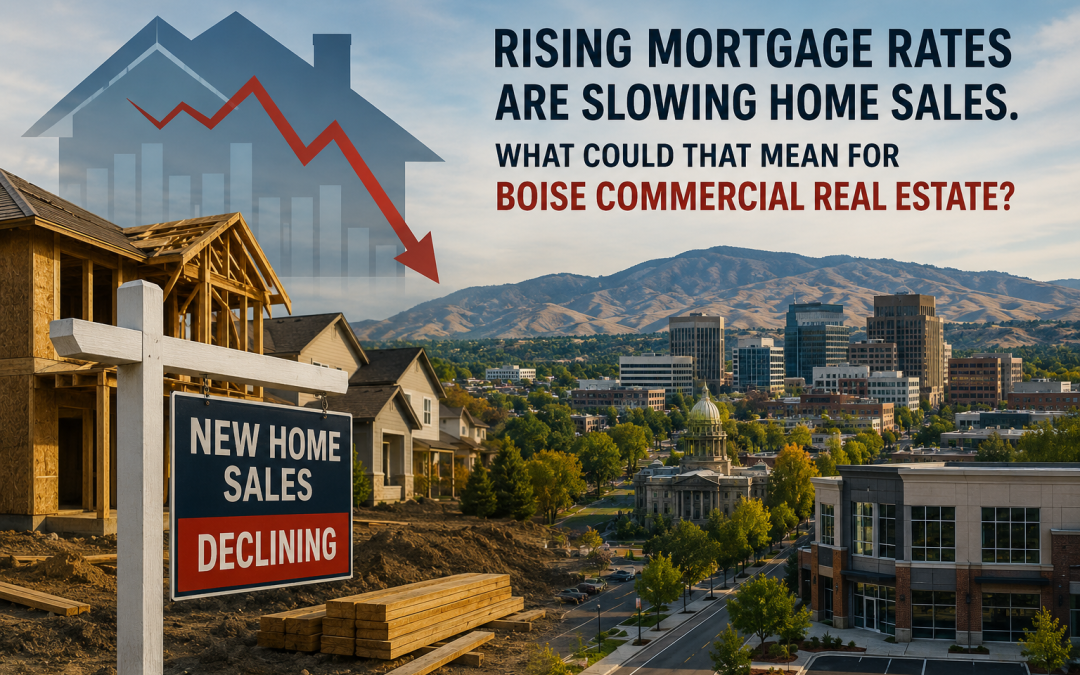
Rising Mortgage Rates Are Slowing Home Sales Nationwide. What Could That Mean for Boise Commercial Real Estate?
The housing market often acts like an early warning system for broader real estate trends.
When homebuyers pull back, builders adjust plans, lenders become more cautious, and developers start paying closer attention to future demand. While Boise commercial real estate operates differently from the residential market, the two are more connected than many people realize.
According to reporting by Lucia Mutikani in the Idaho Business Review, citing data from the U.S. Census Bureau and Commerce Department, sales of new single-family homes across the United States declined in April as mortgage rates moved higher and housing inventory continued to build. The original Idaho Business Review article can be found here: https://idahobusinessreview.com/2026/05/28/us-new-home-sales-fall-april-mortgage-rates/
While the headline focuses on residential housing, the underlying trends may have important implications for Boise development, retail leasing, construction activity, and long-term commercial real estate demand throughout the Treasure Valley.
Key Housing Market Takeaways
Several national indicators shifted during April:
- New home sales fell 6.2% month-over-month
- Sales were down 11.3% compared to the prior year
- New housing inventory rose to 489,000 homes
- The average 30-year mortgage rate climbed to 6.51%
- Months of supply increased to 9.4 months
- Median new home prices rose to approximately $422,500
The combination of higher borrowing costs and growing inventory suggests many buyers remain cautious despite continued demand for housing.
Why Mortgage Rates Matter Beyond Housing
Most people think rising mortgage rates only affect homebuyers.
In reality, borrowing costs influence nearly every segment of the real estate industry.
When financing becomes more expensive, consumers often delay major purchases. Developers may slow new projects. Builders can become more selective about land acquisitions. Investors frequently adjust underwriting assumptions to account for higher capital costs.
For markets like Boise, where population growth and development activity have been closely tied together over the past decade, shifts in housing demand can ripple throughout the broader economy.
New neighborhoods create future customers for retail centers, restaurants, healthcare providers, fitness operators, and service businesses. If residential construction slows, commercial development timelines sometimes follow.
That does not necessarily mean growth stops. It simply means the pace of expansion may become more measured.
What This Could Mean for Boise Development
The Treasure Valley continues to benefit from long-term population growth, business relocations, and employment expansion.
However, developers are increasingly operating in a different environment than they were just a few years ago.
Higher financing costs create additional pressure on project feasibility. Construction costs remain elevated. Insurance expenses have increased. Labor shortages continue to challenge builders in many sectors.
As a result, developers may prioritize projects with stronger pre-leasing commitments, proven demand, and lower risk profiles.
For Boise commercial real estate, that could mean:
- Greater focus on build-to-suit projects
- More phased development strategies
- Increased scrutiny of speculative construction
- Stronger emphasis on mixed-use projects with diversified revenue streams
- Slower delivery of some planned residential communities
The days of assuming unlimited housing demand at any price point appear to be fading, at least for now.
Why Retail Leasing Boise Could Still Benefit
Interestingly, slower housing activity does not automatically translate into weaker retail demand.
Many retailers make expansion decisions based on long-term demographic trends rather than short-term housing sales numbers.
The Treasure Valley continues to attract new residents, employers, and investment capital. Major employers remain committed to growth throughout the region, and population forecasts still point toward continued expansion.
Retailers evaluating Boise, Meridian, Eagle, Kuna, Star, Nampa, and Caldwell typically focus on factors such as:
- Population growth
- Household income trends
- Traffic counts
- Daytime employment
- Future residential development pipelines
While housing sales may fluctuate from month to month, the broader growth story remains intact.
In fact, some retailers may find opportunities if residential developers slow future construction, as available land, labor, and construction resources could become somewhat less constrained.
Inventory Growth Could Change Builder Behavior
One of the most notable data points from the report is the increase in available housing inventory.
When inventories rise and homes take longer to sell, builders often become more cautious about launching additional projects.
Nationally, single-family housing starts and building permits both declined during April.
If that trend continues, future housing supply growth could slow.
For commercial real estate professionals, this is worth watching because residential development often serves as the foundation for future retail corridors, neighborhood centers, and service-oriented commercial projects.
Areas that were expected to receive rapid housing growth could experience a longer timeline before reaching critical mass for additional commercial development.
My Take: Boise’s Growth Story Is Still Strong, But Discipline Matters
The biggest takeaway is not that Boise’s growth is ending.
The takeaway is that the market is becoming more selective.
Over the past several years, many projects moved forward in an environment defined by historically low interest rates and strong buyer demand. Today’s market requires more discipline.
Developers must pay closer attention to absorption rates. Investors need realistic underwriting assumptions. Tenants should expect landlords to evaluate deals more carefully before committing capital to improvements and expansions.
For Boise commercial real estate, this shift may actually create healthier long-term conditions.
Markets that grow too quickly can create oversupply and instability. A more balanced environment often leads to stronger projects, better site selection, and more sustainable growth patterns.
The Treasure Valley remains one of the most closely watched growth markets in the western United States. The challenge moving forward is not whether growth continues, but how efficiently developers, investors, landlords, and tenants adapt to a higher-rate environment.
Mike Gioioso (joy-OH-so) has for 16+ years been helping companies of all sizes buy, build, and lease perfect places for business in greater Boise, Idaho and beyond.
www.streetsmartidaho.com mike@streetsmartidaho.com 208-209-9166
Tags: #boisecommercialrealestate, #boisedevelopment, #boiserealestate, #treasurevalleyrealestate, #commercialrealestate, #retailleasingboise, #investmentproperty, #realestateinvesting, #mortgagerates, #housingmarket, #residentialdevelopment, #mixedusedevelopment, #commercialdevelopment, #economicdevelopment, #idahorealestate