
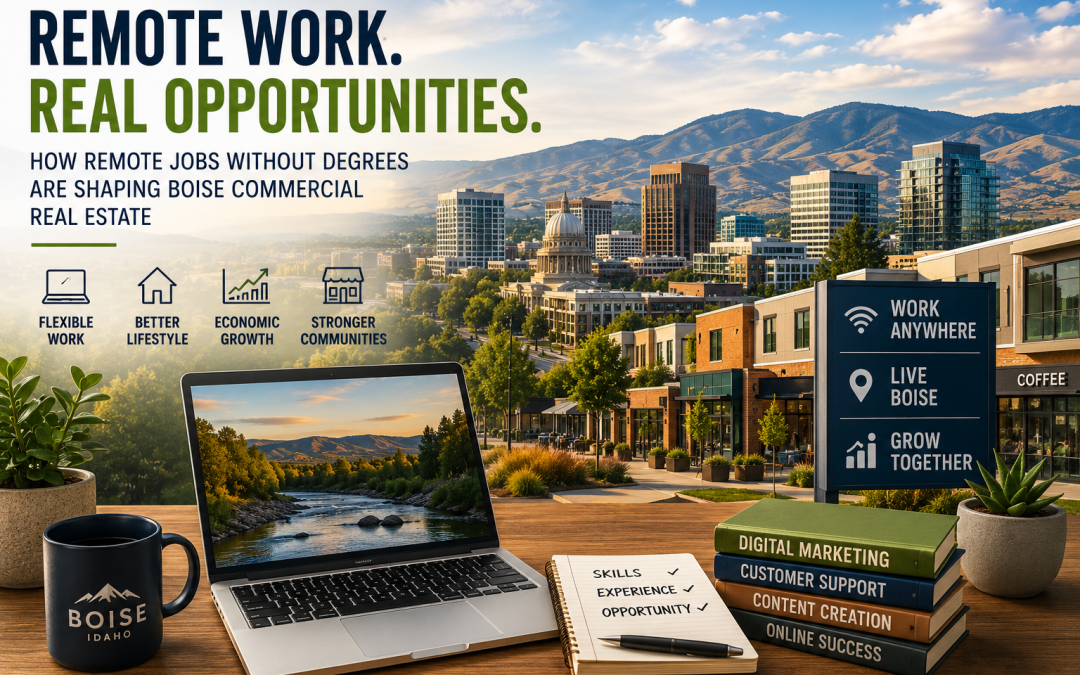
Why the Rise of Remote Jobs Without Degrees Could Reshape Boise Commercial Real Estate
The relationship between work and commercial real estate keeps evolving — and Boise is right in the middle of the shift.
For years, office demand was tied closely to traditional career paths, daily commutes, and centralized workplaces. But a growing number of companies are now hiring remote employees based on skills and experience instead of college degrees.
That trend could have long-term implications for Boise commercial real estate, workforce migration, housing demand, and even retail leasing across the Treasure Valley.
According to reporting by the Idaho Business Review and IBR Staff in this article from Idaho Business Review, remote jobs that do not require formal higher education credentials are becoming increasingly common both in Idaho and nationwide.
The report, citing research from FlexJobs, highlights a growing number of well-paying remote positions where employers are prioritizing practical skills over traditional degrees.
For Boise developers, landlords, business owners, and investors, this shift matters more than many people realize.
Boise’s Workforce Is Becoming More Flexible
One of the biggest themes emerging across the economy is flexibility.
Workers increasingly want:
- Remote or hybrid work options
- Lower commuting costs
- Affordable living environments
- Better quality of life
- Career paths outside traditional college systems
That trend fits naturally with many of the advantages Boise already offers.
Compared to larger coastal markets, Boise continues attracting residents looking for:
- Lower business costs
- Outdoor lifestyle access
- Family-oriented communities
- Growing job opportunities
- Relative affordability compared to West Coast cities
As remote work expands, more people may choose where they want to live first — then find work second.
That reverses the old economic model where workers moved primarily for office jobs.
Why This Matters for Boise Commercial Real Estate
The continued rise of remote work creates both challenges and opportunities across Boise development.
Traditional office demand could continue evolving as companies reduce large centralized footprints and seek more flexible layouts. At the same time, remote work can indirectly increase demand in other property sectors.
More remote workers living in Boise can support:
- Neighborhood retail growth
- Coffee shops and restaurants
- Flexible coworking concepts
- Mixed-use developments
- Smaller office suites
- Residential demand near lifestyle amenities
In many cases, retail leasing Boise trends are becoming increasingly tied to daytime population patterns instead of traditional commuter traffic.
That creates opportunities for suburban retail corridors, live-work-play projects, and community-centered developments throughout the Treasure Valley.
Skills-Based Hiring Could Expand Idaho’s Talent Pool
One of the more important details in the report is the growing emphasis on skills-based hiring.
Employers are increasingly valuing:
- Work experience
- Technical ability
- Self-taught skills
- Alternative education paths
- Real-world problem solving
That could help broaden Idaho’s workforce participation over time.
The article noted that remote positions such as technical support specialists, digital marketing specialists, recruiting coordinators, content moderators, virtual assistants, and graphic designers are seeing healthy wage growth without requiring traditional four-year degrees.
Many of those roles now offer salaries exceeding $50,000 annually.
That matters because workforce accessibility often influences long-term economic growth.
The more career paths available to Idaho residents, the more stable local consumer spending and business activity can become.
And stronger consumer spending ultimately supports retail leasing, restaurant growth, housing demand, and service-oriented commercial real estate.
Boise Could Benefit From “Lifestyle Migration”
Boise continues benefiting from what many in commercial real estate call lifestyle migration.
Remote workers often prioritize:
- Cost of living
- Recreation access
- Safety
- Community feel
- Work-life balance
The Treasure Valley checks many of those boxes.
As remote employment opportunities expand nationally, Boise could continue attracting workers who bring outside income into the local economy while increasing demand for:
- Housing
- Retail space
- Entertainment venues
- Medical office
- Fitness concepts
- Service businesses
This dynamic has already helped fuel growth across many suburban nodes in Meridian, Eagle, Kuna, Star, and Nampa.
My Take
Remote work is no longer simply a temporary pandemic trend.
It is becoming part of the long-term structure of the American workforce.
For Boise commercial real estate professionals, the biggest opportunity may not come from massive downtown office towers. Instead, it could come from the ripple effects remote workers create throughout the broader local economy.
As more people gain access to higher-paying remote jobs without needing traditional degrees, Boise may continue attracting residents seeking flexibility, affordability, and quality of life.
That population growth and spending power could continue supporting Boise development across retail, mixed-use, multifamily, and smaller flexible office environments for years to come.
Mike Gioioso (joy-OH-so) has for 16+ years been helping companies of all sizes buy, build, and lease perfect places for business in greater Boise, Idaho and beyond.
www.streetsmartidaho.com mike@streetsmartidaho.com 208-209-9166
Tags: #boisecommercialrealestate, #boiserealestate, #boisedevelopment, #remotework, #remotejobs, #workforcedevelopment, #retailleasingboise, #commercialrealestate, #idahocommercialrealestate, #treasurevalleyrealestate, #boisebusiness, #mixedusedevelopment, #officeleasing, #flexibleofficespace, #economicdevelopment