
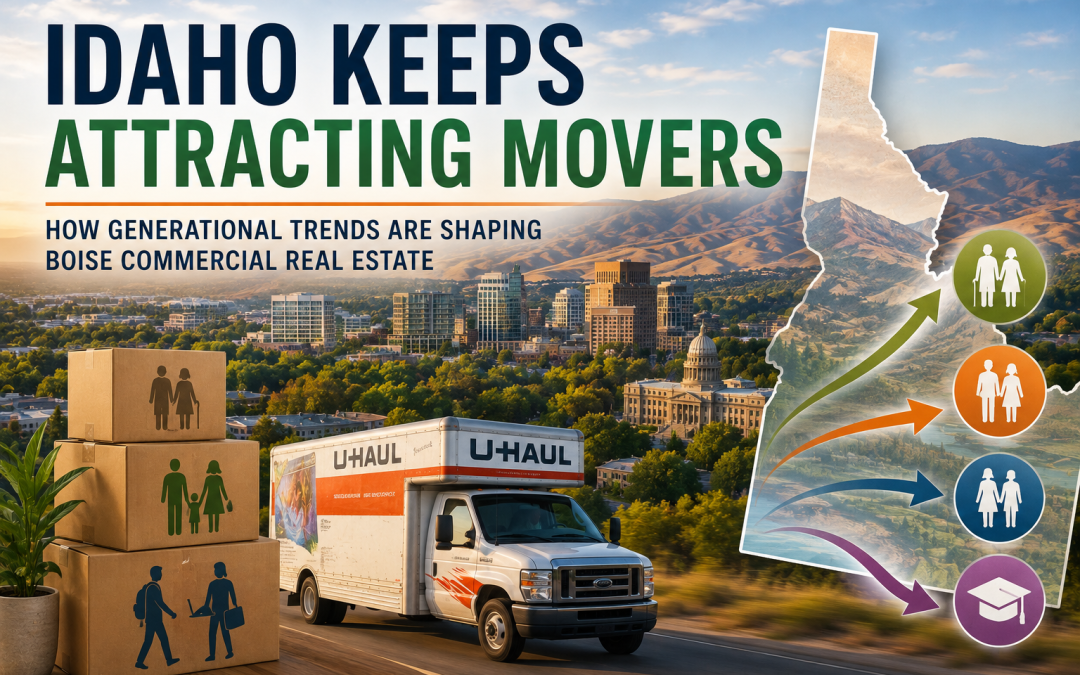
Idaho Keeps Attracting Movers — and the Generational Mix Matters for Boise Real Estate
Migration has been one of the biggest forces shaping the Treasure Valley for years. But the next chapter of Boise’s growth may not simply be about how many people move here.
It may be about who is moving here.
New migration data shows Idaho attracting several generations at the same time, including Baby Boomers, Generation X and Millennials. For Boise commercial real estate, that mix can influence everything from restaurant demand and medical space to housing, offices, childcare and neighborhood retail.
According to reporting by Maria Francis of the USA TODAY Network/Delaware News Journal, distributed through Reuters Connect and published by the Idaho Business Review, U-Haul analyzed a year’s worth of one-way customer moves, including the first half of 2026, to see which states and metropolitan areas were gaining residents from different age groups.
The original Idaho Business Review article provides the complete generational breakdown.
For Idaho, one finding stands out: the state appears among the leading destinations for three different generations.
Idaho Isn’t Attracting Just One Type of Resident
The U-Haul results show very different migration patterns across the country.
Baby Boomers strongly favored the Southeast, with South Carolina, North Carolina and Florida leading the way.
Generation X gravitated toward states including Florida, Texas, South Carolina and Tennessee.
Millennials also favored Florida and Texas but showed a wider geographic spread that included California and several Midwest markets.
Generation Z looked different again, favoring states containing major metropolitan areas and employment or educational opportunities, including Texas, California, New York and Illinois.
Idaho didn’t dominate any one category.
Instead, it showed surprising consistency.
According to the report, Idaho ranked:
- No. 8 for Baby Boomer net gains
- No. 7 for Generation X
- No. 5 for Millennials
Idaho did not make the top 10 for Generation Z.
That combination may tell us something important about the type of growth supporting Boise real estate.
The Treasure Valley isn’t relying exclusively on retirees, young professionals or families. It continues to appeal to people across multiple stages of life.
And different generations create different types of real estate demand.
Why the Generational Mix Matters for Boise Commercial Real Estate
Think about what happens when a 65-year-old moves to the Treasure Valley compared with a 35-year-old.
They may both buy houses, but their commercial real estate needs can look very different.
Older residents can increase demand for health care, specialty medical services, restaurants, financial services, wellness concepts and other convenience-oriented businesses.
Generation X households may have established careers, children at home and higher household spending. That can support grocery stores, restaurants, fitness centers, entertainment, medical services and neighborhood retail.
Millennials can drive another layer of demand. Many are now well into their home-buying, career-building and family-raising years. Their needs increasingly include childcare, restaurants, fitness, professional services, health care and family-oriented businesses.
That’s why demographic analysis matters so much in retail leasing Boise and throughout the Treasure Valley.
A growing population is good.
But understanding the age, income, household size and lifestyle of that population is much more useful when deciding what businesses a particular commercial project can support.
Boise’s Suburban Growth Corridors Could Benefit
This generational diversity may be particularly important for Meridian, Nampa, Caldwell, Star, Kuna and Eagle.
These communities have added significant residential development, creating new rooftops that eventually need commercial services.
A subdivision may arrive first.
Then comes demand for coffee, daycare, medical care, dental offices, restaurants, fitness, automotive services, grocery stores and other everyday businesses.
That’s one reason residential growth and Boise commercial real estate are so closely connected.
Retailers don’t simply look for “fast-growing cities.” They study trade areas.
They want to know how many households live nearby, how much those households earn, how quickly the population is growing and what types of consumers live there.
When multiple generations are moving into the same region, it can broaden the range of businesses a trade area can support.
For developers, that can make mixed-use and neighborhood commercial projects more interesting.
For landlords, it can expand the potential tenant pool.
For investors, it may create opportunities to identify growing trade areas before commercial development fully catches up with residential expansion.
Millennials May Be Especially Important for Boise’s Next Growth Phase
Idaho’s fifth-place showing among Millennial movers deserves particular attention.
Millennials are no longer simply the young adults often portrayed in discussions about urban apartments.
The generation includes people born from 1981 through 1996. That puts Millennials roughly in their early 30s through mid-40s in 2026.
Many are now business owners, managers, parents and homeowners.
That matters for Boise development.
A Millennial household moving to Meridian or Star might need childcare today, youth sports tomorrow, orthodontics later, and restaurants, grocery stores, medical providers and professional services throughout the entire process.
Some of those same residents will also start companies, lease offices, rent industrial space or open storefronts.
U-Haul also reported that Millennials generated the largest share of its one-way rental activity.
If Idaho continues attracting this generation, the impact can go beyond residential real estate and directly into business formation and commercial occupancy.
What About Generation Z?
Idaho’s absence from the Generation Z top 10 is also worth watching.
The youngest adult movers favored places such as Texas, California, New York, Illinois and Colorado.
According to the reporting, younger movers appear more interested in larger population centers where they can find colleges, apartments, entry-level employment and career opportunities.
That presents a different challenge for Boise.
The Treasure Valley has been highly successful at attracting established households and working-age adults. Long-term economic growth, however, also depends on attracting and retaining younger workers.
Employers need entry-level talent.
Restaurants and retailers need employees.
Growing companies need future managers.
Downtown Boise, Boise State University and the region’s employment base give the market some advantages, but housing affordability and wage growth will likely remain important factors.
If young workers can’t afford to establish themselves in the Treasure Valley, employers may eventually feel the pressure.
That’s a commercial real estate issue because workforce availability is one of the factors companies evaluate when choosing locations.
Local Insight: Follow the Demographics, Not Just the Population Count
For Boise commercial real estate, the U-Haul report reinforces something I believe is important when evaluating growing areas of the Treasure Valley:
Don’t stop at population growth.
Two trade areas can each add thousands of residents and still create very different commercial opportunities.
If one area attracts families with children, childcare, restaurants, grocery, medical, fitness and entertainment could perform well.
An area attracting older households may create stronger opportunities for health care, wellness, financial services and convenience-oriented retail.
A younger population could increase demand for apartments, entertainment, restaurants and employment-oriented services.
The best commercial sites are often located where several favorable trends overlap: population growth, household income, traffic, housing construction, employment and underserved consumer demand.
That’s why the Idaho rankings are encouraging.
Idaho isn’t showing up as a destination for only one narrow demographic group. It ranked among the leading states for Boomers, Generation X and Millennials.
For landlords and developers, that can help create a broader customer base.
For retailers and service businesses, it can mean multiple sources of consumer demand.
And for investors looking at Boise investment property, it provides another reason to pay close attention to the commercial corridors following Treasure Valley residential growth.
Migration may continue to shape Boise for years.
The opportunity is figuring out where those new residents will live, work, shop, eat and spend their money next.
Mike Gioioso (joy-OH-so) has for 16+ years been helping companies of all sizes buy, build, and lease perfect places for business in greater Boise, Idaho and beyond.
www.streetsmartidaho.com mike@streetsmartidaho.com 208-209-9166
Tags: #boisecommercialrealestate, #boiserealestate, #boisedevelopment, #idahomigration, #treasurevalleygrowth, #retailleasingboise, #idahocommercialrealestate, #boiseinvestmentproperty, #meridiancommercialrealestate, #nampadevelopment, #staridahodevelopment, #treasurevalleycommercialrealestate, #boiseretailrealestate, #idahopopulationgrowth, #millennialmigration