
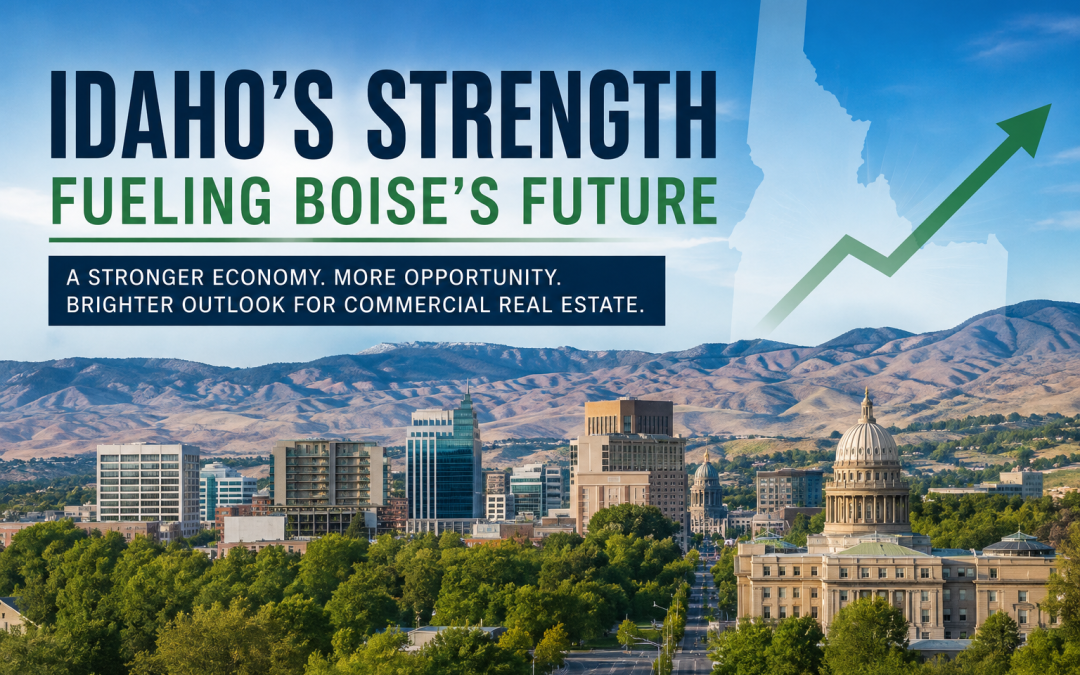
Idaho’s Strong National Ranking Adds Fuel to Boise’s Commercial Real Estate Story
Idaho continues to build a national reputation as a place where businesses, workers, and investment can grow. That matters beyond bragging rights. For Boise commercial real estate, a strong state economy can help support everything from retail leasing and office demand to industrial development and long-term investment.
According to reporting by IBR Staff in the Idaho Business Review, Idaho ranked No. 7 overall in the 2026 U.S. News & World Report Best States rankings. Even more notable for the commercial real estate industry, Idaho’s economy ranked third in the country, while the state finished sixth for fiscal stability.
The original Idaho Business Review article provides the broader national rankings and category results.
Idaho’s Economy May Be the Bigger Story
A top-10 overall ranking is good publicity, but Idaho’s No. 3 economic ranking may be the more important number for business owners and real estate investors.
The U.S. News study evaluates states using dozens of measurements across major categories such as the economy, education, health care, infrastructure, fiscal stability, opportunity, natural environment, and public safety. Idaho performed particularly well in areas tied to its business environment, employment, and economic growth. The state also ranked sixth for fiscal stability and eighth for crime and corrections.
Those numbers help reinforce a story that people involved in Boise development have been watching for years: Idaho isn’t simply attracting new residents. It is also creating an environment where businesses are willing to expand, relocate, invest, and hire.
For commercial real estate, that’s an important distinction.
Population growth creates demand for housing. Economic growth creates demand for places to do business.
That can mean storefronts, restaurants, medical offices, warehouses, professional offices, service businesses, entertainment concepts, and development land.
What This Could Mean for Boise Commercial Real Estate
State rankings don’t automatically translate into higher rents or property values. Commercial real estate is still driven by individual locations, tenant demand, construction costs, financing, supply, and local demographics.
But Idaho’s broader economic position can strengthen several trends already important to the Treasure Valley.
Business recruitment and expansion: Companies comparing markets look at workforce availability, taxes, infrastructure, economic conditions, operating costs, and quality of life. Strong national rankings can help Idaho remain part of those conversations.
Retail and service demand: Continued employment and population growth can create opportunities for restaurants, fitness operators, medical providers, childcare businesses, personal services, and other neighborhood-focused tenants. That can support retail leasing in Boise as well as Meridian, Nampa, Caldwell, Eagle, Kuna, and Star.
Industrial demand: A growing economy needs distribution, storage, manufacturing, contractor space, and service facilities. That creates opportunities for industrial developers and investors, particularly along major transportation corridors.
Development activity: Strong economic fundamentals can encourage developers to pursue projects when they believe future tenant and buyer demand will justify today’s land and construction costs.
The key is that these factors can reinforce one another. More households attract businesses. More businesses create jobs. More jobs support additional households and consumer spending.
That’s the cycle commercial real estate investors want to see.
Boise Still Has to Solve the Growth Equation
Strong rankings also come with challenges.
Growth puts additional pressure on roads, utilities, housing, labor, schools, and development infrastructure. It can also push land prices higher and make commercial projects harder to pencil.
That’s especially important in fast-growing Treasure Valley communities.
A site may sit in an excellent growth corridor but still face expensive utility extensions, road improvements, entitlement requirements, or construction costs. A retailer may love the demographics but struggle with occupancy costs. An industrial tenant may want to expand but find limited appropriately zoned land near its workforce.
So the opportunity isn’t simply “Idaho is growing.”
The bigger question is whether Boise-area communities can continue providing the infrastructure and commercial space necessary to support that growth.
Idaho Is Competing With Other High-Growth States
Idaho wasn’t alone near the top of the rankings.
Utah finished first overall for the fourth consecutive year, followed by South Dakota, Minnesota, North Dakota, and Nebraska. New Hampshire ranked sixth, immediately ahead of Idaho, while Florida, Washington, and Vermont completed the top 10.
That comparison matters.
Boise isn’t just competing with nearby cities for employers and investment. Businesses considering expansion may compare Idaho with Utah, Texas, Arizona, Colorado, Florida, and other growing markets.
Interestingly, Texas ranked only 26th overall but finished first in the economic and growth categories, according to the Idaho Business Review’s summary of the rankings.
That’s a useful reminder that no single ranking determines where investment goes.
For Boise commercial real estate, the advantage comes from combining economic growth with livability, workforce availability, business conditions, and a market large enough to support continued expansion.
Local Insight: Watch Where the Businesses Follow the Rooftops
From a Boise commercial real estate perspective, the ranking is another positive indicator—but the most useful information is found at the local level.
I would continue watching the areas where residential growth, household income, infrastructure investment, and commercial development are converging.
That includes major growth corridors throughout Meridian, Nampa, Caldwell, Star, Kuna, and Eagle, along with established Boise submarkets.
For retail leasing Boise-wide, new rooftops can create opportunities for restaurants, medical users, fitness concepts, childcare, automotive services, and neighborhood retail.
For industrial real estate, continued business formation and expansion can support demand for smaller flex buildings, contractor space, warehouses, and distribution facilities.
For investors, the opportunity may increasingly come down to identifying properties that sit in the path of growth before the surrounding commercial demand fully matures.
That’s where a statewide ranking becomes more than a headline.
Idaho’s seventh-place finish and third-ranked economy don’t guarantee that every commercial property will perform. But they do provide another piece of evidence that the broader economic foundation supporting Boise development remains competitive nationally.
For landlords, tenants, developers, and investors, the next step is figuring out exactly where that growth will translate into real estate demand.
Mike Gioioso (joy-OH-so) has for 16+ years been helping companies of all sizes buy, build, and lease perfect places for business in greater Boise, Idaho and beyond.
www.streetsmartidaho.com mike@streetsmartidaho.com 208-209-9166
Tags: #boisecommercialrealestate, #boiserealestate, #boisedevelopment, #idahocommercialrealestate, #retailleasingboise, #boiseinvestmentproperty, #treasurevalleycommercialrealestate, #meridiancommercialrealestate, #nampadevelopment, #idahoeconomy, #boiseindustrialrealestate, #commercialrealestateinvestment, #idahobusinessgrowth, #treasurevalleydevelopment