
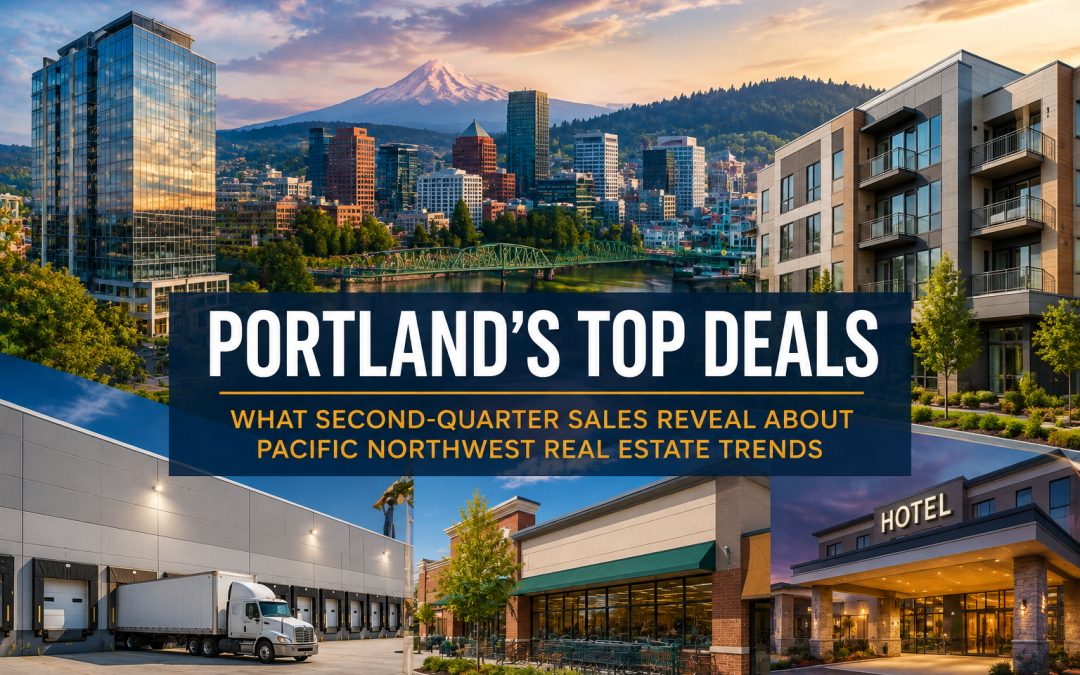
Portland’s Biggest CRE Deals Show Where Pacific Northwest Investors Are Putting Their Money
Big commercial real estate transactions can tell us much more than what a building is worth.
They show where institutional investors are comfortable putting capital, which property types are attracting buyers and where companies are willing to make long-term commitments.
Portland’s second-quarter sales provide an interesting snapshot for anyone watching Boise commercial real estate and the broader Pacific Northwest.
According to reporting and research by CoStar Research, Portland-area transactions recognized in its second-quarter 2026 Power Broker Quarterly Deal Awards included major investments in multifamily, industrial, hospitality and necessity-based retail. The original CoStar News report details the individual transactions and brokers involved.
The numbers are Portland-specific, but several investment themes have direct relevance for Boise, Meridian, Nampa and the rest of the Treasure Valley.
Multifamily Capital Is Still Hunting for Opportunity
Apartments were a major part of Portland’s largest second-quarter transactions.
The biggest recognized sale was Ladd Towers in downtown Portland. Guardian Real Estate Services and PCCP acquired the 21-story property for $63.3 million.
Another major multifamily transaction took place in Gresham, where MG Properties purchased a two-property portfolio containing 337 units for $60.8 million.
Grant Park Village Quimby in Portland traded for $30.7 million, while a four-property apartment portfolio totaling 137 units sold for $22 million.
The Habitat, another Portland multifamily property, changed hands for $18.85 million.
Together, these transactions show that experienced multifamily investors are still willing to make significant acquisitions in the Pacific Northwest when they see the right combination of location, pricing and future upside.
That matters for Boise investment property.
The Treasure Valley has been working through a wave of new apartment construction, and higher interest rates have made both development and acquisitions more challenging. But Portland’s activity is a reminder that capital hasn’t abandoned multifamily.
Instead, investors have become more selective.
Buyers are looking harder at existing rents, replacement cost, financing, operating expenses and the ability to improve performance over time.
That same discipline is increasingly important in Boise multifamily.
Industrial Buyers Are Thinking About Operations, Not Just Yield
Two of Portland’s notable sales highlight very different reasons for owning industrial real estate.
In Wilsonville, DCI International acquired a 204,158-square-foot industrial property for $31 million. According to CoStar, the dental equipment manufacturer plans to use the facility to bring operations together and increase manufacturing capacity.
That’s an owner-user decision rather than a purely financial investment.
Another industrial transaction took place in Cornelius, where a newly completed and fully occupied facility sold for $29.75 million to a group that included Urban Evolution Development and private investors.
Those two transactions illustrate the strength of industrial real estate from both sides of the market.
Investors want stabilized properties with durable tenants.
Businesses want buildings that give them greater control over their operations.
We’re seeing the same motivations influence Boise commercial real estate.
Industrial users throughout Boise, Meridian, Nampa and Caldwell are increasingly forced to consider whether leasing or owning makes more sense over the long term.
For growing companies, owning can provide control over future occupancy costs and the ability to customize a facility.
But construction costs, land prices and financing can make that decision difficult.
That makes existing industrial buildings particularly valuable when they offer the right mix of clear height, loading, yard area, power, parking and freeway access.
Hotels and Necessity Retail Continue to Attract Capital
The Portland transactions also demonstrate that investors aren’t focused exclusively on apartments and industrial buildings.
Hospitality generated several significant deals.
A two-hotel portfolio in Salem sold for $29.5 million to Eternal Hotels. Another transaction involved the Residence Inn by Marriott Portland Clackamas, with an allocated portfolio value of approximately $21.5 million.
Retail also made the list.
A roughly 92,800-square-foot Oregon City property was part of a larger portfolio acquisition involving AmCap and Almanac Realty Investors, with approximately $29 million allocated to the asset.
The investment strategy behind that transaction is especially relevant.
The buyers specialize in grocery-anchored and necessity-oriented retail.
That’s a segment worth watching closely in retail leasing Boise.
For several years, investors have been separating retail into very different categories.
Traditional discretionary retail can carry more uncertainty.
But shopping centers anchored by grocery stores, restaurants, medical providers, fitness concepts and everyday services can have a very different demand profile.
Consumers still need groceries. They still visit dentists. They still pick up food, take children to activities and use neighborhood services.
That has helped well-located open-air retail remain attractive to investors.
In the Treasure Valley, continued residential development can strengthen that story.
As rooftops expand in Meridian, Kuna, Star, Nampa and Caldwell, demand follows for grocery stores and neighborhood retail services.
For developers, identifying where population growth is getting ahead of commercial supply can create opportunities.
What Portland’s Deals Tell Boise Investors
Portland and Boise are very different markets, so these transactions shouldn’t be treated as direct comparable sales.
But capital movement throughout the Pacific Northwest is still useful to watch.
Several themes stand out.
Multifamily remains investable. Buyers haven’t disappeared, but underwriting has become more disciplined.
Industrial demand has multiple drivers. Investors want income, while operating businesses want control over strategically important facilities.
Necessity retail remains attractive. Grocery and service-oriented centers continue to benefit from everyday consumer demand.
Hospitality capital is active. Experienced hotel investors are still expanding through targeted acquisitions and portfolio transactions.
Outside capital continues to cross state lines. Buyers involved in Portland’s major transactions came from Oregon, California, Connecticut, New York, Georgia and elsewhere.
That last point may be especially important for Boise.
Commercial real estate capital doesn’t stop at state borders.
Investors comparing Western markets are constantly evaluating Portland, Seattle, Boise, Salt Lake City, Phoenix, Denver and other growth markets against one another.
Boise isn’t competing only with other Idaho cities for investment.
It’s competing with the West.
Local Insight: Boise’s Size Can Be an Advantage
Portland’s second-quarter transactions ranged from roughly $19 million to more than $63 million.
Boise doesn’t generate that volume of institutional-scale transactions as consistently, but that doesn’t necessarily make it less attractive.
In some ways, the smaller market creates opportunity.
A private investor may struggle to compete for a $60 million apartment complex in Portland but could potentially acquire a meaningful multifamily, industrial or retail property in the Treasure Valley at a much lower total basis.
The same applies to owner-users.
A company looking for industrial property may find Boise, Meridian or Nampa more manageable than larger West Coast markets while still gaining access to a growing population and regional transportation network.
The challenge is pricing.
Strong population growth doesn’t automatically make every Boise investment property a good deal.
Investors still need to look closely at replacement cost, rents, tenant credit, lease terms, future supply, operating expenses and financing.
The properties that perform best will generally be the ones where the real estate fundamentals work even without aggressive assumptions about future appreciation.
That’s one reason I watch major transactions in neighboring Pacific Northwest markets.
They provide another window into what sophisticated buyers value.
And right now, the message coming from Portland is fairly clear: investors still want commercial real estate, but they’re choosing assets where they can identify a specific reason to own them.
For Boise investors and developers, that’s a useful standard.
Don’t buy simply because the Treasure Valley is growing.
Buy because you understand exactly how that growth translates into demand for your particular property.
Mike Gioioso (joy-OH-so) has for 16+ years been helping companies of all sizes buy, build, and lease perfect places for business in greater Boise, Idaho and beyond.
www.streetsmartidaho.com mike@streetsmartidaho.com 208-209-9166
Tags: #boisecommercialrealestate, #boiseinvestmentproperty, #boisedevelopment, #idahocommercialrealestate, #pacificnorthwestcommercialrealestate, #portlandcommercialrealestate, #boisemultifamily, #boiseindustrialrealestate, #retailleasingboise, #boiseretailrealestate, #meridiancommercialrealestate, #nampacommercialrealestate, #treasurevalleycommercialrealestate, #commercialrealestateinvestment, #commercialpropertysales