
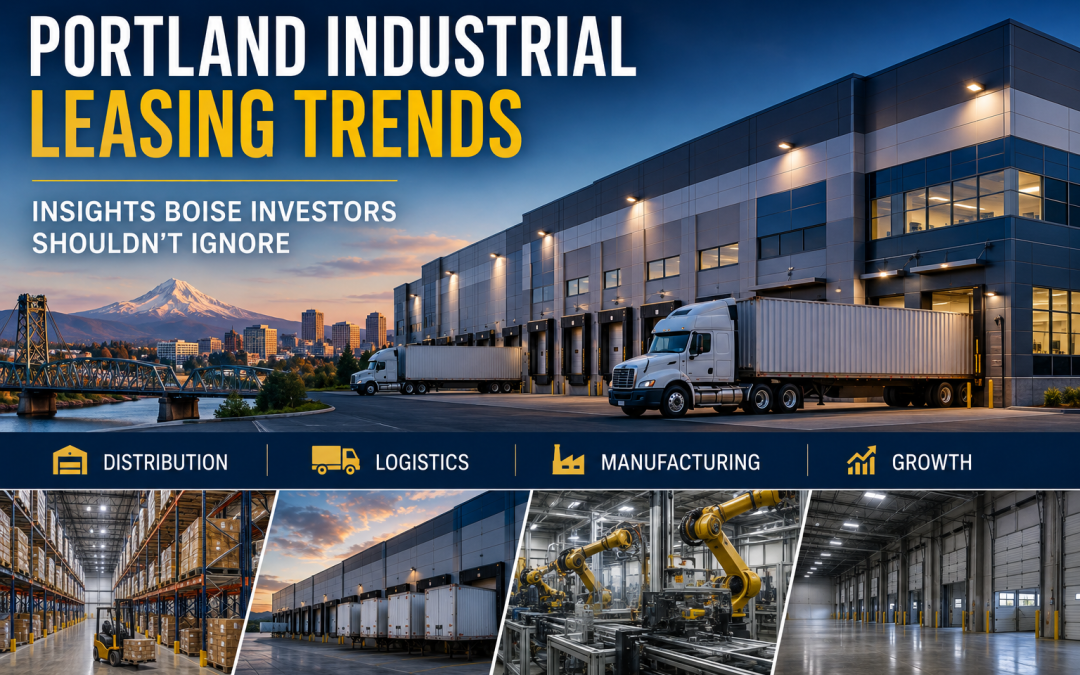
Portland’s Biggest Industrial Leases Reveal Trends Boise Investors Should Watch
The latest major industrial leases in Portland tell a bigger story than simply who rented the most warehouse space.
Distributors are taking hundreds of thousands of square feet. Existing industrial users are renewing large facilities. Subleases are giving companies another path to expansion. And technology, aerospace, electric vehicles, and advanced manufacturing are competing alongside traditional logistics companies for industrial buildings.
Those trends have direct relevance to Boise commercial real estate.
According to reporting by CoStar Research, Portland’s leading industrial transactions during the second quarter of 2026 included leases involving Consolidated Supply Co., Bridgetown Enterprises, CTDI, Ferguson, Rivian, Ross Dress for Less, and several other major users.
The original CoStar News article includes the complete list of transactions and the brokers recognized in CoStar’s quarterly awards.
For Boise industrial real estate owners and developers, the Portland deals provide a useful look at where industrial demand may be heading across the Pacific Northwest and Intermountain West.
Distribution Is Still Driving Big Industrial Deals
The size of Portland’s largest transactions immediately stands out.
Consolidated Supply Co. signed a new lease for 276,092 square feet in Woodland, Washington. The plumbing, waterworks, and heating-products distributor is taking an entire warehouse near important regional transportation routes.
Bridgetown Enterprises committed to 238,385 square feet in Portland’s Rivergate area through a renewal. The logistics company uses industrial real estate to support trucking, warehousing, and fulfillment operations.
CTDI also renewed its 210,000-square-foot facility in Fairview. The company provides engineering, repair, and logistics services to telecommunications companies and equipment manufacturers.
These aren’t speculative startup tenants experimenting with warehouse space. They are established businesses using large industrial facilities as essential parts of their operations.
That’s an important reminder for the Boise industrial market.
Industrial demand ultimately follows the movement of products, equipment, materials, and people.
As the Treasure Valley grows, businesses need more space to supply that population.
Construction materials need to be distributed. Plumbing and HVAC products need warehouses. Retail inventory needs regional distribution. Manufacturers need components. Service companies need storage and repair facilities.
Population growth creates industrial demand even when consumers rarely see the buildings producing it.
Subleases Are Becoming a Useful Expansion Tool
Two recognized Portland transactions were subleases.
Ferguson took approximately 117,000 square feet in Ridgefield, Washington, to support its Pacific Northwest distribution operations.
Piping Rock Health Products leased nearly 91,000 square feet through another sublease. Its Portland location is intended to help the company serve West Coast customers more efficiently.
That is worth watching in Boise.
Industrial sublease space is sometimes viewed negatively because it can indicate that an existing tenant took too much space or changed its operations.
But sublease availability can also help growing companies enter a market.
A tenant may be able to occupy a modern warehouse faster than it could through ground-up construction. Depending on the deal, existing improvements can also reduce upfront costs.
For landlords and investors, sublease activity can provide useful information about where supply and demand are moving.
Too much sublease space can create downward pressure on rents.
A healthy amount can provide flexibility and help accommodate businesses that need space immediately.
That flexibility becomes particularly important in a growing market like the Treasure Valley.
Industrial Tenants Are Becoming More Specialized
One of the most interesting themes in Portland’s latest deals is the variety of businesses occupying industrial space.
This isn’t just a warehouse story.
PCC Structurals leased more than 64,000 square feet in Milwaukie to support aerospace-related manufacturing and logistics.
Electric vehicle manufacturer Rivian leased 60,000 square feet in Beaverton for service and regional operations.
AscendArc, an aerospace startup developing satellite technology, took almost 50,000 square feet in Tigard for engineering and scalable production.
Those businesses need more than four walls and a loading dock.
Advanced industrial users may require:
- Heavy electrical capacity
- Higher clear heights
- Dock-high and grade-level loading
- Manufacturing areas
- Engineering and office space
- Strong internet connectivity
- Specialized ventilation or mechanical systems
- Secure storage
- Flexible production layouts
That creates an important opportunity for Boise industrial development.
The Treasure Valley’s industrial market has historically served construction, warehousing, manufacturing, agriculture, and distribution users.
Those categories will remain important.
But Idaho’s expanding technology and advanced manufacturing economy could bring a wider range of requirements.
Developers who build flexible industrial properties may be better positioned to capture those tenants.
Location Still Wins in Industrial Real Estate
Almost every major transaction on CoStar’s Portland list has something in common: transportation access.
The Consolidated Supply facility benefits from access to major regional routes.
Bridgetown’s warehouse sits near port infrastructure.
Piping Rock’s location provides access to Interstate 84 and Portland International Airport.
Ross Dress for Less occupies space with convenient Interstate 5 connectivity.
Rivian selected a location near Highway 217.
That’s not a coincidence.
For industrial tenants, transportation costs can easily outweigh relatively small differences in rent.
A warehouse that saves trucks time every day can create significant operating savings over the life of a lease.
The same principle applies to Boise commercial real estate.
In the Treasure Valley, Interstate 84 remains the backbone of the industrial market.
That helps explain the continued importance of industrial corridors in Boise, Meridian, Nampa, and Caldwell.
Properties with efficient freeway access, good truck circulation, appropriate loading, and proximity to growing population centers should remain attractive to industrial users.
Renewals Show the Value of Keeping Good Tenants
Another notable feature of Portland’s quarterly deals is how many were renewals.
Bridgetown Enterprises stayed in its existing facility.
CTDI renewed its Fairview location.
Suddath renewed approximately 84,000 square feet in Wilsonville.
Ross Dress for Less also renewed more than 61,000 square feet of industrial space in Ridgefield.
That matters for landlords.
The headline-grabbing transaction is usually the big new lease. But from an investment perspective, retaining a strong tenant can sometimes be even more valuable.
A renewal can reduce vacancy exposure, tenant improvement costs, leasing commissions, and downtime.
Industrial buildings can also be highly customized to an occupant’s operation.
Once a company has installed equipment, built out offices, established shipping procedures, trained employees around a location, and integrated the facility into its supply chain, moving can become expensive.
That can make functional industrial real estate surprisingly sticky.
For Boise industrial landlords, tenant retention should be treated as an investment strategy, not simply a leasing task.
What Portland’s Activity Could Mean for Boise
Portland and Boise are very different industrial markets.
Portland has a major port, a larger population base, and a much deeper inventory of large distribution facilities.
Boise should not expect to replicate Portland’s leasing activity square foot for square foot.
But the types of tenants are worth watching.
Portland’s transactions include plumbing and HVAC distribution, logistics, telecommunications support, consumer-product distribution, aerospace manufacturing, retail distribution, electric vehicles, and satellite technology.
Several of those sectors have clear potential in Idaho.
As Boise, Meridian, Nampa, Caldwell, and the surrounding Treasure Valley continue to grow, industrial demand should become increasingly diverse.
The next generation of Boise industrial tenants may not simply be looking for warehouse space.
They may need a combination of warehouse, manufacturing, service, engineering, and office functions.
That changes how buildings should be designed.
Local Insight: Boise Should Build Industrial Space for Tomorrow’s Tenant
The biggest lesson from Portland isn’t that Boise needs enormous warehouses everywhere.
It’s that industrial real estate is becoming more specialized.
A distribution company has different requirements than an aerospace startup.
An electric vehicle service operation has different requirements than a retailer’s distribution center.
A manufacturer may prioritize power.
A logistics company may prioritize dock doors.
A service business may need a combination of warehouse and customer-facing space.
That means flexibility has value.
For Boise commercial real estate developers, I would pay particular attention to buildings that can accommodate multiple uses over their lifespan.
Good clear heights, strong power, efficient loading, usable office components, flexible bay configurations, and convenient I-84 access can expand the potential tenant pool.
For investors, functional buildings in strong industrial locations may also have an advantage when leasing conditions soften because they can appeal to more types of businesses.
And for tenants, planning ahead matters.
Companies expecting to grow should evaluate not only today’s square footage but also power, loading, yard requirements, employee access, and future expansion.
Portland’s latest industrial leases reinforce a simple point:
Industrial real estate is no longer just about storing boxes.
It is becoming the physical infrastructure behind logistics, manufacturing, technology, retail, transportation, and the modern economy.
As the Treasure Valley grows, that makes Boise industrial real estate one of the most important property sectors to watch.
Mike Gioioso (joy-OH-so)
has for 16+ years been helping companies of all sizes buy, build, and lease perfect places for business in greater Boise, Idaho and beyond.
www.streetsmartidaho.com mike@streetsmartidaho.com 208-209-9166
Tags: #boisecommercialrealestate, #boiseindustrialrealestate, #boiseindustrialleasing, #boisedevelopment, #boiseinvestmentproperty, #idahocommercialrealestate, #treasurevalleycommercialrealestate, #treasurevalleyindustrial, #nampaindustrialrealestate, #caldwellindustrialrealestate