
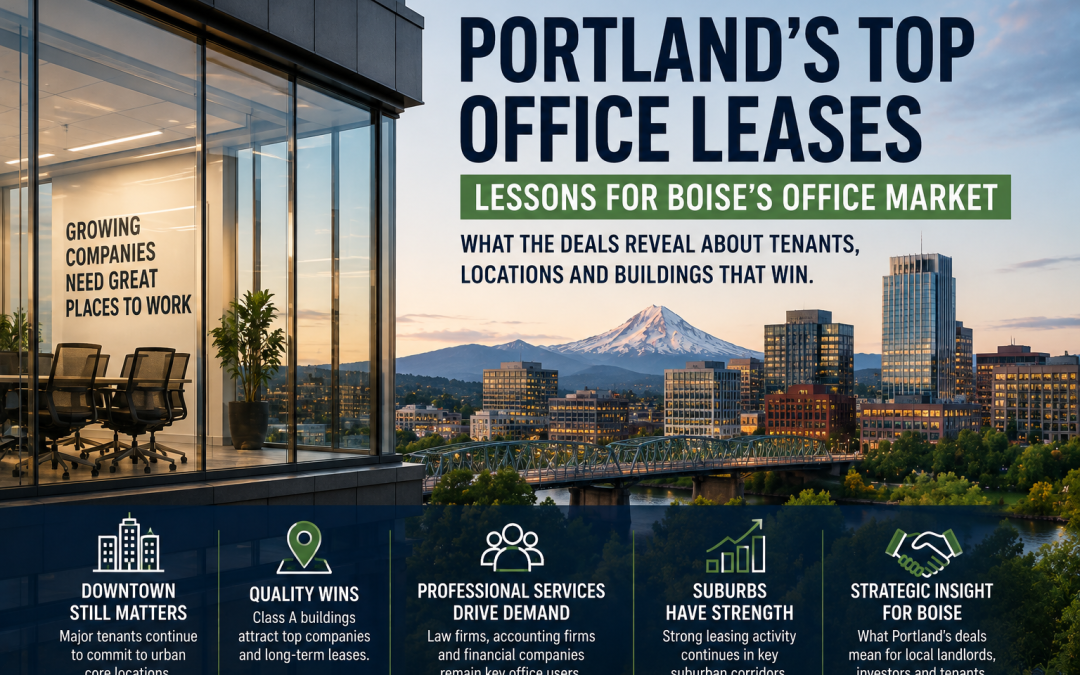
Portland’s Major Office Leases Show What Still Wins Tenants—and Boise Should Pay Attention
Portland’s office market has faced plenty of difficult headlines. Yet companies are still signing substantial leases—and some of the largest commitments are happening right in the urban core.
That makes Portland worth watching from Boise.
CoStar Research’s second-quarter 2026 Power Broker Quarterly Deal Awards highlighted 10 Portland-area office transactions ranging from roughly 8,700 square feet to more than 100,000 square feet. Together, the recognized deals represent nearly 284,000 square feet of leasing activity.
More important than the total square footage is the pattern behind the deals: established employers are committing to quality buildings, professional-service firms remain important office users, and downtown Portland is still attracting significant tenants.
According to reporting by CoStar Research, companies including Cambia Health Solutions, Merrill, Perkins & Co., Geffen Mesher and Schrödinger were among the tenants involved in the quarter’s recognized transactions.
You can read the original CoStar News article for the complete transaction details and broker recognition.
For Boise commercial real estate, Portland provides a useful case study of what office demand can look like even in a market going through major change.
Downtown Office Demand Hasn’t Disappeared
The headline transaction was substantial.
Cambia Health Solutions committed to 101,365 square feet at 200 SW Market Street in downtown Portland. The regional health insurer and parent of Regence BlueCross BlueShield maintained a major headquarters presence in the Class A tower.
But Cambia wasn’t alone.
Merrill took 34,800 square feet at the Pacwest Center.
Accounting firm Perkins & Co. leased 30,000 square feet at 100 SW Main Street.
Geffen Mesher, another accounting and advisory company, committed to 29,928 square feet at 200 SW Market.
Software and life sciences company Schrödinger took 16,554 square feet at One Main Place.
IMA Financial Group added another 8,666 square feet at 200 SW Market.
Those six transactions alone represent more than 221,000 square feet of recognized leasing activity in Portland’s urban core.
That’s worth thinking about.
Office demand may have changed, but major employers have not universally abandoned downtown environments.
Instead, tenants appear to be making more deliberate decisions about where—and how much—space they occupy.
That distinction matters for Downtown Boise.
Quality Buildings Are Capturing Attention
There’s another clear theme in CoStar’s list.
Many of these transactions involved higher-quality office properties.
Class A buildings appeared repeatedly. OneApp selected Field Office, a LEED Platinum-certified property in Portland’s Northwest district. Other recognized leases involved prominent downtown towers with established amenities and professional environments.
This supports a trend we’re seeing across commercial real estate:
Tenants may need less office space, but many still want better office space.
That’s an important difference.
A company reducing its footprint doesn’t necessarily want the cheapest available suite.
It may instead use the savings from occupying fewer square feet to move into a stronger location or higher-quality building.
For landlords, that creates both an opportunity and a warning.
Well-positioned buildings can compete for tenants that still value physical workplaces.
Older properties without strong amenities, parking, modern systems or attractive common areas may have a harder time.
Professional Services Are Helping Drive the Market
Look at the tenant mix behind Portland’s notable transactions.
Health insurance.
Wealth management.
Accounting.
Business consulting.
Insurance and risk management.
Technology.
Life sciences.
Equipment financing.
Engineering.
Government.
These aren’t businesses that fit neatly into the idea that everyone can simply work remotely forever.
Many need conference rooms, client meetings, employee collaboration, training, technology infrastructure or a professional address.
That’s particularly relevant for Boise office leasing.
Boise has a significant professional-services economy, and those users can continue providing demand even as hybrid work changes how companies use their offices.
Law firms, accounting firms, financial advisers, insurance companies, engineering businesses and other professional organizations may not require the same amount of space per employee that they once did.
But many still need space.
The challenge for landlords is making sure their buildings provide what these companies now expect.
What Boise Landlords Can Learn From Portland
Portland is a much larger market than Boise, so the transaction volumes aren’t directly comparable.
But tenant behavior provides useful clues.
The first lesson is simple:
Don’t compete on rent alone.
Look at the features being emphasized in some of these Portland buildings.
One property offers modern sustainability credentials and contemporary amenities.
Another provides substantial parking, valet service and secure indoor bicycle facilities.
Other properties offer prominent downtown locations and professional Class A environments.
Those features help answer an important question:
Why should an employee come to this building instead of working from home?
That question didn’t carry the same weight before hybrid work.
Today, it should be near the top of the list for office owners.
For a Boise landlord, improvements don’t necessarily have to be extravagant.
Depending on the building, value could come from better common areas, upgraded lighting, improved conference facilities, outdoor gathering areas, showers, bicycle storage, better signage or more flexible suites.
Sometimes the competitive advantage is even simpler: easy parking.
The right improvements depend on the tenant.
One Building Winning Multiple Deals Is Worth Watching
Perhaps the most interesting detail in CoStar’s Portland list is what happened at 200 SW Market Street.
Three of the recognized leases occurred in the same building:
- Cambia Health Solutions — 101,365 SF
- Geffen Mesher — 29,928 SF
- IMA Financial Group — 8,666 SF
That’s nearly 140,000 square feet across three highlighted transactions.
This illustrates something important about office real estate.
Even when the broader market is challenging, individual properties can outperform.
That’s why market-wide office statistics don’t tell the entire story.
A city might have elevated vacancy while certain buildings remain competitive.
One property might struggle while another nearby signs multiple tenants.
For Boise commercial real estate investors, that means underwriting office assets requires going much deeper than the metro vacancy rate.
You have to understand the building’s competitive position.
The Suburbs Still Have Their Place
Not every recognized Portland-area transaction happened downtown.
Dext Capital renewed 22,647 square feet in Lake Oswego.
Sun Steel renewed 12,742 square feet in Vancouver, Washington.
The Oregon Department of Transportation leased 10,300 square feet near Clackamas Town Center in Happy Valley.
These transactions show the continued importance of suburban office locations.
That’s especially relevant to Meridian.
The Treasure Valley’s population has spread outward, and many employees no longer live close to Downtown Boise.
For some companies, Meridian or another suburban location may reduce commute times while providing convenient parking and easier freeway access.
That means Boise and Meridian don’t necessarily have to compete for exactly the same tenant.
Downtown Boise can offer walkability, restaurants, visibility, government access and an urban environment.
Meridian can offer convenience, newer buildings, parking and proximity to a growing suburban workforce.
Both can work.
The key is matching the property with the tenant’s priorities.
What This Could Mean for Boise Office Investors
Portland’s leasing activity reinforces why office investments need to be evaluated differently than they were several years ago.
Buying an office building simply because it’s inexpensive compared with its previous sale price isn’t enough.
Investors need to understand the building’s ability to compete for actual tenants.
That means examining factors such as:
- Remaining lease terms
- Tenant credit
- Upcoming expirations
- Tenant improvement requirements
- Leasing commissions
- Building amenities
- Parking
- Floor plate flexibility
- Competing vacancy
- Location and accessibility
- Replacement cost
- Potential alternative uses
The tenant improvement question is particularly important.
An apparently inexpensive office acquisition can become expensive very quickly if several floors need major improvements before they can be leased.
That makes capital reserves and realistic leasing assumptions critical.
Local Insight: The Office Market Is Splitting Into Winners and Losers
From a Boise commercial real estate perspective, I think we’re moving away from talking about “the office market” as though every building is experiencing the same thing.
Increasingly, there may be two office markets.
There are buildings tenants actively want.
And there are buildings tenants will occupy only when the economics become compelling enough.
That difference matters.
Portland’s recognized transactions show that even in a market that has experienced major office challenges, companies will still make substantial commitments to the right properties.
That should be encouraging for Boise landlords with competitive buildings.
But it should also push owners to think critically about where their property sits in the market.
If a building has excellent parking, good access, efficient suites and a strong location, emphasize those advantages.
If it’s older but structurally sound, targeted improvements may help reposition it.
If the property has fundamental disadvantages that can’t easily be corrected, price may have to do more of the work.
Investors should make the same distinction.
The opportunity isn’t necessarily “buy office because office is cheap.”
The opportunity is finding office properties that can still win tenants at a basis that makes financial sense.
That’s a much more selective strategy.
What Boise Developers Should Take Away
There is also a message here for Boise development.
New office construction remains challenging when existing buildings already have vacant space.
Construction costs, financing and tenant improvement packages can push the rents required for new development well above existing inventory.
That doesn’t mean Boise won’t need new office buildings.
It means future development may need a stronger reason to exist.
A major tenant commitment could justify a project.
A unique location could create an advantage.
Medical, corporate headquarters or specialized office users could support certain developments.
Mixed-use projects may also create office environments that stand apart from traditional standalone buildings.
But speculative office construction without a clearly defined tenant base deserves careful underwriting.
The question should not be:
Will Boise continue growing?
It probably will.
The better question is:
Will the specific companies growing in Boise need this type of office space at the rent required to build it?
That’s the question that determines whether development works.
Portland Offers a Useful Signal for Boise
The office sector is clearly different than it was before remote and hybrid work became widespread.
But different doesn’t mean irrelevant.
Portland’s second-quarter transactions show large companies still signing leases, professional-services firms still choosing downtown buildings and suburban office locations still retaining tenants.
The lesson for Boise isn’t that office demand is returning to its old form.
It’s that demand is becoming more selective.
Tenants are choosing buildings based on quality, location, convenience and how well the workplace supports their business.
For landlords, that raises the importance of reinvestment.
For investors, it raises the importance of property-level underwriting.
For developers, it raises the bar for new construction.
And for companies evaluating Boise office space, today’s market may provide opportunities to secure better locations and better buildings than they could have accessed several years ago.
Office isn’t disappearing.
But the buildings that earn tenants’ attention may increasingly separate themselves from everything else.
Source: This article is based on transaction information and reporting published by CoStar Research on August 3, 2026. The Portland-area lease details and broker information originated from CoStar’s Power Broker Quarterly Deal Awards coverage. The Boise commercial real estate analysis, leasing observations and investment and development implications above represent independent commentary and should not be considered original reporting.
Mike Gioioso (joy-OH-so)
has for 16+ years been helping companies of all sizes buy, build, and lease perfect places for business in greater Boise, Idaho and beyond.
www.streetsmartidaho.com mike@streetsmartidaho.com 208-209-9166
Tags: #boisecommercialrealestate, #boiseofficemarket, #boiseofficeleasing, #portlandcommercialrealestate, #portlandofficemarket, #boisedevelopment, #downtownboiseoffice, #meridianofficespace, #idahocommercialrealestate, #treasurevalleycommercialrealestate, #boiseinvestmentproperty, #commercialrealestateinvestment, #officeinvestment, #classaoffice, #meridiancommercialrealestate, #pacificnorthwestcommercialrealestate