
When Tech Growth Meets Multifamily Development
In fast-growing tech corridors across the western United States, housing development often follows job expansion. One recent multifamily project in Oregon highlights how collaboration between cities and private developers can reshape neighborhoods while supporting workforce growth.
According to reporting by Brian Yermal Jr. and Chris Sangiuliano in CoStar News (read the original article here: https://product.costar.com/home/news/1663422169), a large apartment development in Hillsboro, Oregon is drawing attention not only for its scale but also for the partnership behind it.
The project — known as Astral and Revel by Alta — was recently recognized as a major multifamily development in the Portland region.
Although this project sits hundreds of miles from Idaho, it reflects development trends that increasingly affect Boise commercial real estate, Boise development patterns, and multifamily investment across the Mountain West.
What Makes This Multifamily Project Stand Out
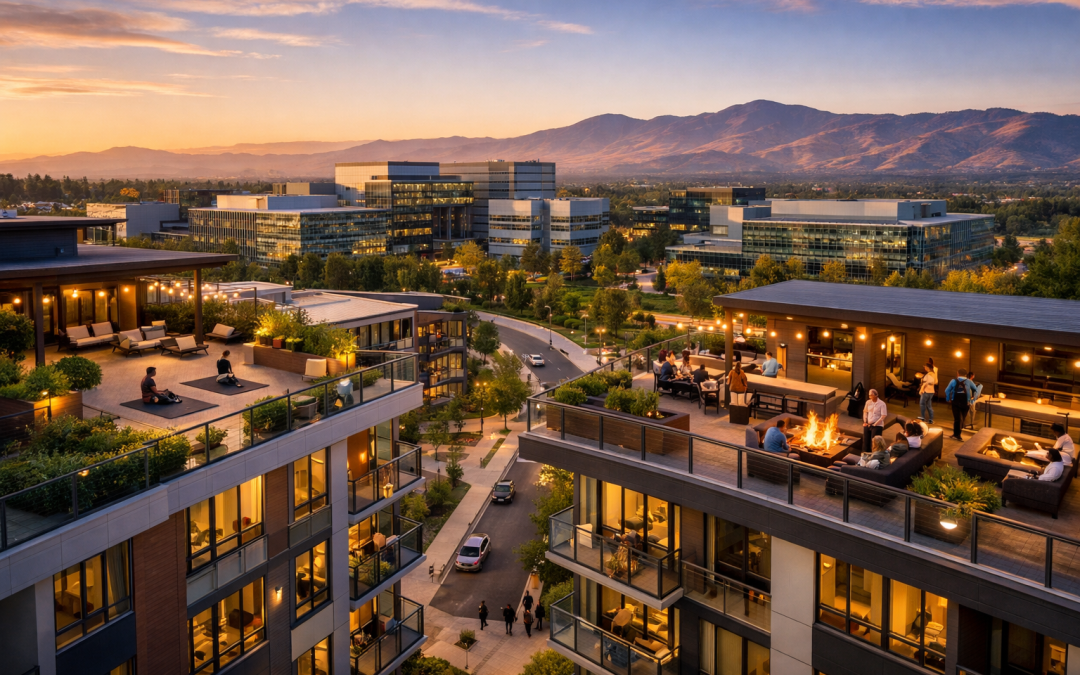
The Hillsboro development consists of 594 apartment units spread across more than 300,000 square feet. The property was completed in September 2025 and sits in an area often referred to as Oregon’s “Silicon Forest,” a technology hub home to companies such as Intel and Nvidia.
Developed by Wood Partners, the community was designed with a focus on lifestyle amenities and proximity to major employers.
Key highlights from the project include:
• Nearly 600 residential units
• One- and two-bedroom apartment mix
• Extensive shared amenities designed around two lifestyle themes
• Close proximity to large technology employers
The property’s amenities are organized around two different living styles.
One side emphasizes wellness and health, with features such as fitness areas, yoga spaces, spa facilities, and outdoor relaxation zones.
The other side leans toward social and entertainment experiences, offering coworking areas, recreation spaces, and community gathering spots.
The result is a multifamily community designed to appeal to a wide range of residents while still functioning as a single cohesive property.
Infrastructure Improvements Played a Key Role
One of the most interesting elements of the project is how it came together.
The development involved a public-private partnership between the city of Hillsboro and the developer.
As part of the collaboration, the city invested in new streets and pedestrian infrastructure surrounding the project.
These improvements helped support increased traffic and density in an area already experiencing significant residential growth.
In many growing technology corridors, infrastructure upgrades like these are necessary before large housing projects can move forward.
That type of cooperation between cities and developers is becoming increasingly common in rapidly expanding regions.
Why Tech Job Growth Drives Multifamily Demand
The location of this project is not accidental.
Hillsboro sits within one of the Pacific Northwest’s most important technology employment clusters.
Large employers in the area include:
• semiconductor manufacturers
• software companies
• research and development facilities
When job centers expand, housing demand typically follows.
Multifamily projects built near employment hubs help shorten commutes and provide housing options for workers relocating to the area.
This dynamic is increasingly visible across many Western U.S. cities.
Why This Matters for Boise Development
The lessons from this project translate directly to Boise’s real estate market.
Like the Portland region, the Treasure Valley has experienced rapid population growth tied to expanding industries, including technology, healthcare, and advanced manufacturing.
Major employers such as Micron Technology and a growing number of tech firms have strengthened the area’s economic base.
That job growth continues to drive demand for housing near employment centers.
For developers and investors in Boise commercial real estate, several trends stand out:
Amenity expectations are rising
Modern renters increasingly look for lifestyle amenities that combine wellness, social space, and remote-work flexibility.
Proximity to employers matters
Apartments located near large job centers often maintain stronger occupancy levels.
Cities may need to partner on infrastructure
Large residential developments sometimes require new roads, sidewalks, or transit improvements.
Multifamily communities are evolving into lifestyle environments
Properties now compete on experience, not just location or unit size.
Local Insight: Boise May See More Public-Private Housing Projects
Across the Mountain West, cities are experimenting with ways to support housing supply while maintaining infrastructure quality.
Public-private partnerships are one approach gaining traction.
For Boise, that could mean:
• coordinated infrastructure upgrades near new housing projects
• collaboration between developers and city planners
• housing development aligned with major employment corridors
Neighborhoods near Boise State University, Micron’s expansion areas, and major employment districts may be particularly well suited for this type of development model.
Projects that combine thoughtful design, strong amenities, and infrastructure investment could become a defining part of the region’s next growth phase.
The Hillsboro project shows how strategic partnerships can help communities expand housing supply while strengthening economic development.
As Boise continues to grow, similar development strategies could play an important role in shaping the future of the Treasure Valley housing market.
Mike Gioioso (joy-OH-so) has for 16+ years been helping companies of all sizes buy, build, and lease perfect places for business in greater Boise, Idaho and beyond.
www.streetsmartidaho.com
mike@streetsmartidaho.com
208-209-9166
Tags: #boisecommercialrealestate, #boisemultifamilydevelopment, #boisedevelopmenttrends, #treasurevalleyhousingmarket, #boiseapartmentdevelopment, #mountainwestrealestatetrends, #siliconforestoregondevelopment, #techhubhousingdemand, #multifamilydevelopmenttrends, #publicprivatepartnershipdevelopment, #boisehousingdemand, #boiserealestateinvestment