
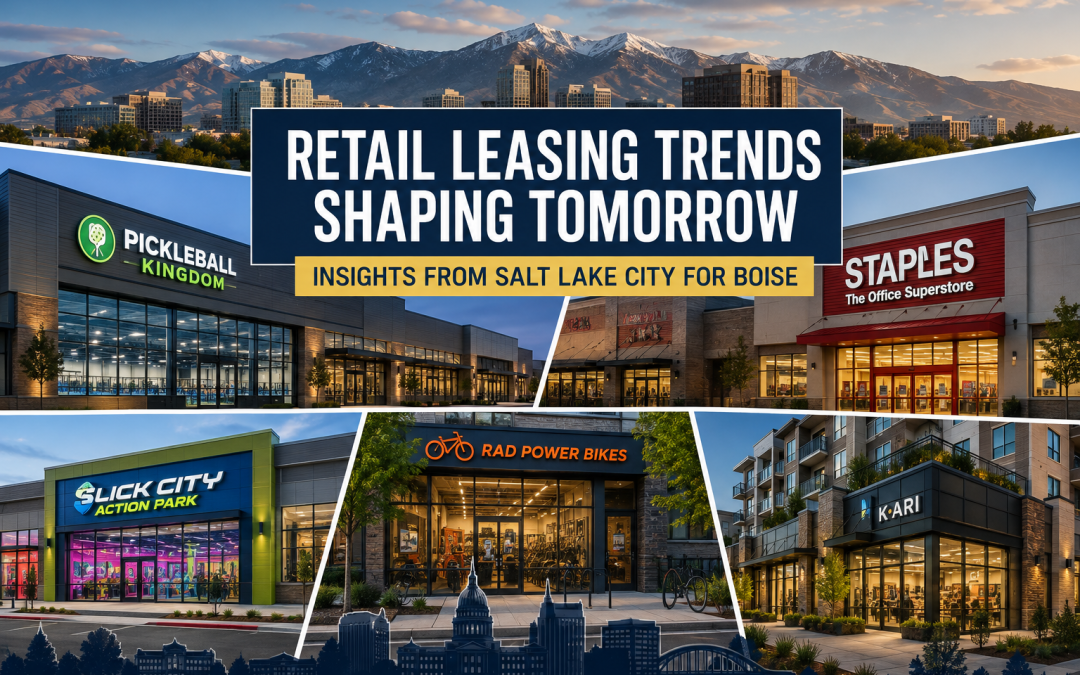
Salt Lake City Retail Leasing Offers Clues for Boise’s Next Wave of Tenant Demand
If you want clues about where Boise retail is headed, it can be useful to look a few hours south.
Salt Lake City’s latest major retail leases show a market where entertainment concepts are taking big spaces, established national retailers are still committing to physical stores, and newer specialty brands are following residential growth into suburban mixed-use projects.
Those same trends are increasingly relevant to Boise commercial real estate.
According to reporting by CoStar Research, five Salt Lake City-area transactions were recognized among the market’s leading retail leases for the second quarter of 2026. The deals ranged from an approximately 28,000-square-foot pickleball facility to a Korean-inspired beauty and lifestyle retailer opening beneath new apartments.
You can view the original CoStar News report for its complete list of recognized transactions and brokers.
Rather than looking at these deals simply as Utah leasing news, there are several lessons Boise landlords, developers, investors, and retailers can take from them.
Big Retail Boxes Are Finding New Users
Two of the largest transactions demonstrate how the definition of a retail tenant continues to expand.
Pickleball Kingdom leased 27,840 square feet in Woods Cross for an indoor sports and entertainment facility. The location offers the company enough room for multiple indoor courts and programming while maintaining access to the Interstate 15 corridor.
Slick City took another 23,046 square feet along Riverdale Road in the Ogden area.
Its business isn’t built around shelves of merchandise. Slick City operates an indoor entertainment concept centered on large slides, family recreation, parties, and group events.
That’s significant.
Not long ago, landlords trying to fill 20,000 to 30,000 square feet of retail space might have focused primarily on traditional big-box retailers.
Today, recreation and entertainment users are increasingly part of that conversation.
For Boise retail leasing, this matters because large-format spaces can be difficult to backfill with traditional retailers alone.
Entertainment concepts can offer another option.
A former grocery store, fitness facility, furniture store, or other large retail box may potentially work for concepts such as indoor sports, children’s entertainment, climbing, trampoline parks, pickleball, golf entertainment, or other experience-driven uses.
These businesses can also generate something landlords value: repeat visits.
Customers may stay for an hour or more, bring families and friends, and visit surrounding restaurants or retailers before and after their activity.
That can turn an entertainment tenant into a traffic generator for an entire shopping center.
Traditional Retail Isn’t Going Away
The second-largest transaction on CoStar’s list tells a different story.
Staples leased 27,195 square feet along Riverdale Road.
While experiential retail gets plenty of attention, Staples represents something more traditional: a national retailer making another commitment to physical space.
That’s an important reminder.
E-commerce has changed retail permanently, but physical stores continue to serve functions that are difficult to duplicate online.
Consumers still want convenience, immediate purchases, services, product assistance, returns, and physical interaction with certain products.
Retailers have also become more selective.
Instead of opening stores simply to increase their store count, many national brands now concentrate on locations with strong demographics, visibility, traffic, parking, and access.
That can benefit the best-positioned Boise retail properties.
For landlords in Boise, Meridian, Nampa, Caldwell, and Eagle, the lesson is straightforward: good real estate still matters.
Retailers may operate fewer stores than they once did, but when they choose a location, they want it to work hard.
Mixed-Use Development Is Creating New Retail Opportunities
One of the smaller leases may actually offer one of the more interesting lessons for Boise development.
K-ARI, a Korean-inspired beauty and lifestyle retailer, signed for 8,711 square feet in South Jordan.
The store will occupy ground-floor space beneath apartments being developed near the Daybreak community.
This type of deal reflects another retail trend: stores following rooftops.
As suburban communities become denser, mixed-use development can create built-in customer bases for restaurants, fitness businesses, salons, beauty concepts, medical users, coffee shops, and neighborhood services.
That has obvious parallels to the Treasure Valley.
Areas of Meridian, Eagle, Kuna, Star, and Nampa continue to add housing rapidly. As those rooftops arrive, commercial development follows.
For Boise commercial real estate developers, the challenge is getting the retail mix right.
Ground-floor retail beneath apartments looks attractive on a site plan, but not every retailer can make that format work.
Successful projects generally need the right combination of visibility, parking, signage, access, population density, and tenant mix.
K-ARI’s South Jordan lease shows how more specialized retail concepts may find opportunities within those environments as residential density increases.
Retailers Are Still Betting on Established Neighborhoods
Not every notable deal involved expansion.
Rad Power Bikes renewed approximately 9,640 square feet in Salt Lake City’s Sugar House area.
The electric bicycle company operates a showroom and service location there, combining product sales with demonstrations and maintenance.
The renewal highlights another important commercial real estate principle: sometimes staying put is the best real estate decision.
Relocating a retail business can be expensive.
There are construction costs, signage, customer disruption, permitting, moving expenses, and the risk that customers won’t follow.
If a retailer already has visibility and customer recognition in an established trade area, renewing can make sense even when newer alternatives are available.
For Boise landlords, renewals are particularly important in today’s environment.
Tenant retention can reduce downtime, leasing commissions, tenant improvement expenses, and uncertainty.
A successful existing tenant is often worth protecting.
What Salt Lake City Could Tell Us About Boise Retail
Salt Lake City is a larger market than Boise, but the two share several characteristics.
Both are growing Intermountain West markets.
Both have experienced strong suburban expansion.
Both continue to attract new residents and businesses.
And both are seeing retail development move outward alongside housing growth.
That makes Salt Lake City worth watching for brands that could eventually consider Idaho.
The latest transactions suggest several categories Boise property owners should keep on their radar:
- Indoor recreation and entertainment
- Pickleball and sports concepts
- Family-focused experiential businesses
- Beauty and lifestyle retailers
- Service-oriented national retailers
- E-bike and alternative transportation businesses
- Retail concepts suited to mixed-use developments
Not every Salt Lake City tenant will eventually enter Boise.
But expansion patterns often move through regional markets.
A brand that proves successful in Utah may eventually look north toward Idaho as it builds out the Intermountain West.
For Boise brokers and landlords, identifying those concepts early can create prospecting opportunities before they formally announce a market entry.
Local Insight: Boise Retail Is Becoming More About Experiences and Services
The biggest takeaway from these Salt Lake City leases isn’t one particular tenant.
It’s the variety.
A pickleball operator, office-supply retailer, indoor slide concept, electric bicycle company, and Korean-inspired lifestyle retailer all made CoStar’s list.
That’s a good snapshot of what modern retail leasing has become.
The strongest shopping centers are no longer necessarily filled entirely with businesses selling products.
They’re becoming combinations of shopping, entertainment, fitness, food, personal services, healthcare, and experiences.
For Boise commercial real estate owners, that creates both opportunity and complexity.
A 25,000-square-foot vacancy may no longer need another traditional retailer. An entertainment or recreation concept could potentially be the better traffic generator.
Likewise, a small mixed-use storefront may be better suited for beauty, wellness, food, or services than conventional merchandise.
The key is understanding how people actually use commercial space today.
As Boise and the Treasure Valley continue growing, retail leasing should follow the same principle: don’t just ask which stores are expanding.
Ask where consumers are choosing to spend their time.
That may tell us even more about the next generation of Boise retail real estate.
Mike Gioioso (joy-OH-so)
has for 16+ years been helping companies of all sizes buy, build, and lease perfect places for business in greater Boise, Idaho and beyond.
www.streetsmartidaho.com mike@streetsmartidaho.com 208-209-9166
Tags: #boisecommercialrealestate, #boiseretailrealestate, #boiseretailleasing, #retailleasingboise, #boisedevelopment, #boiseinvestmentproperty, #treasurevalleycommercialrealestate, #treasurevalleyretail, #saltlakecitycommercialrealestate, #saltlakecityretailmarket