
Salt Lake City’s Top CRE Sales Reveal Trends Boise Investors Should Watch
Salt Lake City’s biggest commercial real estate transactions aren’t just a Utah story.
For Boise investors and developers, Salt Lake City can serve as a useful comparison market. Both regions have experienced strong population growth, expanding suburbs, development pressure and increased interest from outside capital.
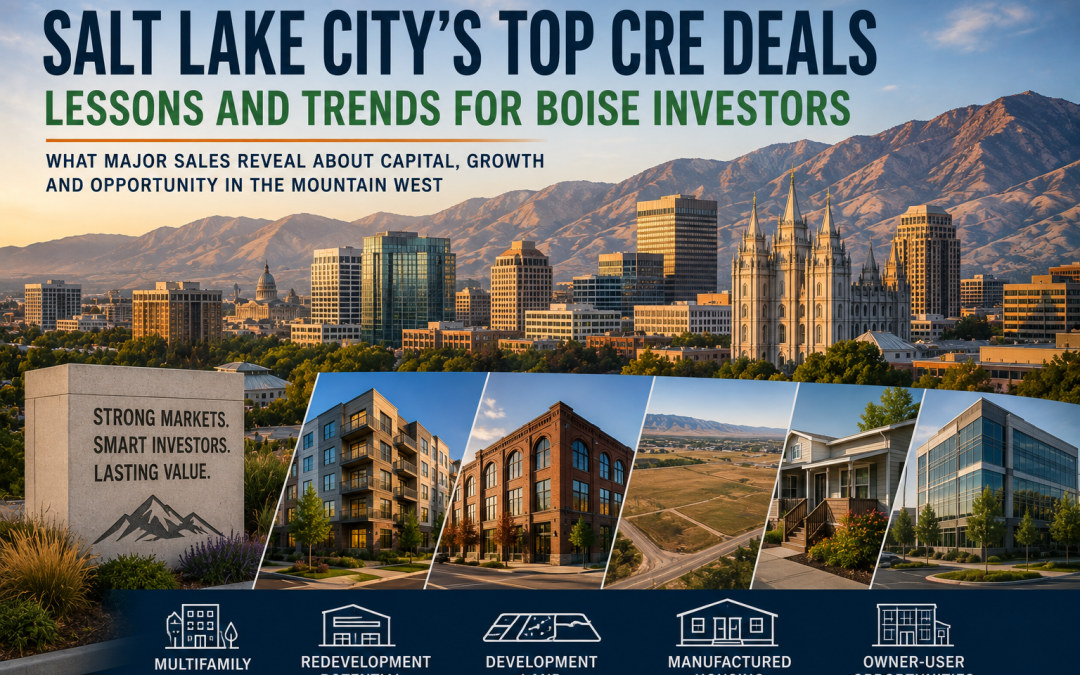
The latest major transactions show investors pursuing everything from newer apartments to development land, manufactured housing and older properties with redevelopment potential.
According to CoStar Research, these transactions were selected among the Salt Lake City winners of CoStar’s second-quarter 2026 Power Broker Quarterly Deal Awards. The original CoStar News report includes the individual properties, transaction details and brokers involved.
The deals aren’t direct Boise comparables. But they highlight several investment themes worth watching in Boise commercial real estate.
Investors Are Looking Beyond Today’s Income
One of the most interesting Salt Lake transactions involved a property that’s more than a century old.
Dart Interests acquired the historic Salt Lake Hardware property for $50 million.
The transaction included roughly 4.6 acres containing the converted industrial property, along with additional land that offers mixed-use development potential. According to CoStar, the extra acreage could potentially support approximately 340 or more residential units.
That’s important.
The buyer wasn’t necessarily purchasing only what exists today.
The property’s future development potential was also part of the equation.
That same thinking applies to Boise development.
An older office, retail or industrial property may generate acceptable income today while also sitting on land that could eventually support a much different use.
As the Treasure Valley grows, investors should increasingly ask two questions:
What does this property earn today?
And:
What could this site become tomorrow?
That second question can dramatically change how a property is valued.
Development Land Is Still Drawing Significant Capital
Another major Utah transaction involved 36.53 acres in Layton, sold by the Utah Department of Transportation through an online auction.
Wright Development Group acquired the site for $21 million.
The property was part of Layton’s Gordon Avenue-Highway 89 Town Center Master Plan, with potential for a combination of commercial, retail and residential development.
The purchase works out to roughly $575,000 per acre, based on the reported price and acreage.
That’s a substantial investment in dirt.
But developers aren’t simply buying acreage.
They’re buying future density, access, zoning, infrastructure and the ability to create a project that responds to population growth.
That is highly relevant in the Treasure Valley.
Land throughout Meridian, Nampa, Caldwell, Kuna, Star and Eagle has appreciated significantly as residential and commercial development expands outward.
Yet two pieces of land with similar acreage can have completely different values.
Entitlements matter.
Utilities matter.
Road access matters.
Traffic counts matter.
Density matters.
And allowable uses can matter more than almost anything else.
For Boise commercial real estate investors looking at development sites, understanding the entitlement path before purchasing land has become increasingly important.
Apartments and Manufactured Housing Remain on Investors’ Radar
Residential investment also played a major role in Salt Lake City’s recognized transactions.
Korda Group purchased the Lex Apartments, a 204-unit community in Tooele completed in 2023. The purchase price wasn’t disclosed.
The garden-style development includes a mix of one-, two- and three-bedroom apartments and amenities including a fitness center, pool and covered parking.
Another transaction involved the Timpanogos Village Mobile Home Park in Orem.
Investment Property Group acquired the 141-pad community from Bridge Investment Group Holdings for an undisclosed amount.
The manufactured housing community was originally developed in 1970 and occupies nearly 20 acres.
These properties are very different.
One is a recently constructed apartment project.
The other is a decades-old manufactured housing community.
But they have something important in common:
They provide housing in growing markets where creating new housing has become increasingly expensive.
That’s a theme Boise investors should watch closely.
Treasure Valley land values, construction costs, impact fees, financing costs and entitlement timelines can make new residential development difficult.
Existing housing therefore has a significant advantage.
It already exists.
That sounds obvious, but replacement cost can become one of the most important investment considerations in a growing market.
Manufactured housing is particularly interesting because new mobile home communities are difficult to develop in many markets.
That limited new supply can make established communities increasingly valuable when population and housing costs rise.
Owner-Users Are Still Part of the Market
Not every significant commercial real estate acquisition is driven by investment returns.
The Utah Department of Transportation acquired Clearwater Center, a roughly 47,000-square-foot office building in West Bountiful, for $11.2 million.
The agency purchased the property for its own use.
Prior to the transaction, the seller had reportedly invested more than $3 million in improvements to the building and its systems.
That’s a useful reminder for the Boise office market.
Office investment has received plenty of negative attention since remote and hybrid work became more common.
But owner-user demand operates differently.
A government agency, medical provider, professional firm or growing local company may purchase a building because it needs a long-term operating location—not because the property meets a traditional investor’s required cap rate.
That creates opportunities in Boise commercial real estate.
Some office properties that struggle to attract institutional investors may still be excellent candidates for owner-users.
For businesses planning to remain in Boise for many years, purchasing can offer occupancy control, potential appreciation and the ability to customize a property around their operations.
What Salt Lake City’s Deals Say About Boise Development
Salt Lake City is a larger market, so Boise shouldn’t simply copy what happens there.
But the similarities between Utah and Idaho make it worth watching.
Both markets have experienced strong migration.
Both have expanding suburban communities.
Both attract companies and investors from larger western markets.
And both are dealing with the challenges that come with rapid growth.
The second-quarter Salt Lake transactions point toward several themes that could matter for the Treasure Valley.
Land with flexibility can command a premium. Properties that allow multiple uses or higher density provide developers with more ways to respond to changing demand.
Replacement cost matters. Existing apartments, manufactured housing and improved commercial buildings may become more attractive when new construction is expensive.
Redevelopment potential creates another layer of value. An older building doesn’t necessarily mean an obsolete investment if the underlying land has a strong future.
Owner-users can create liquidity. Commercial buildings don’t always need an institutional buyer. Businesses, government agencies and nonprofit organizations can become important buyers.
Local Insight: Boise Investors Should Think in Layers
One of the biggest mistakes investors can make is looking at a commercial property from only one angle.
A property can have several layers of value.
There’s the current income.
There’s the building.
There’s the land.
There’s the zoning.
And then there’s the future use.
In a growing market like Boise, that last layer can become increasingly important.
Consider an older commercial building sitting on several acres along a major Treasure Valley corridor.
The existing tenant may generate cash flow today.
But perhaps the zoning allows multifamily development.
Maybe residential growth eventually supports additional retail.
Perhaps increasing land values make redevelopment financially attractive five or ten years from now.
That’s why Boise investment property analysis increasingly needs to look beyond today’s cap rate.
For developers, zoning and infrastructure can be just as important as asking price.
For landlords, maintaining flexible properties can help attract a wider range of tenants.
For businesses, purchasing an existing building can sometimes provide a faster and less expensive alternative to new construction.
And for land investors, the best opportunities may be sites where growth and entitlements intersect.
Salt Lake City’s largest transactions reinforce something we’re seeing throughout the Mountain West:
Capital is looking for optionality.
Boise investors should be doing the same.
The strongest opportunity may not always be the property generating the highest income today. Sometimes it’s the property that gives an owner the most choices tomorrow.
Mike Gioioso (joy-OH-so) has for 16+ years been helping companies of all sizes buy, build, and lease perfect places for business in greater Boise, Idaho and beyond.
www.streetsmartidaho.com mike@streetsmartidaho.com 208-209-9166
Tags: #boisecommercialrealestate, #boiseinvestmentproperty, #boisedevelopment, #idahocommercialrealestate, #saltlakecitycommercialrealestate, #treasurevalleycommercialrealestate, #boisemultifamily, #boiselanddevelopment, #retailleasingboise, #meridiancommercialrealestate, #nampadevelopment, #manufacturedhousinginvestment, #boiseofficerealestate, #commercialrealestateinvestment, #mountainwestrealestate