
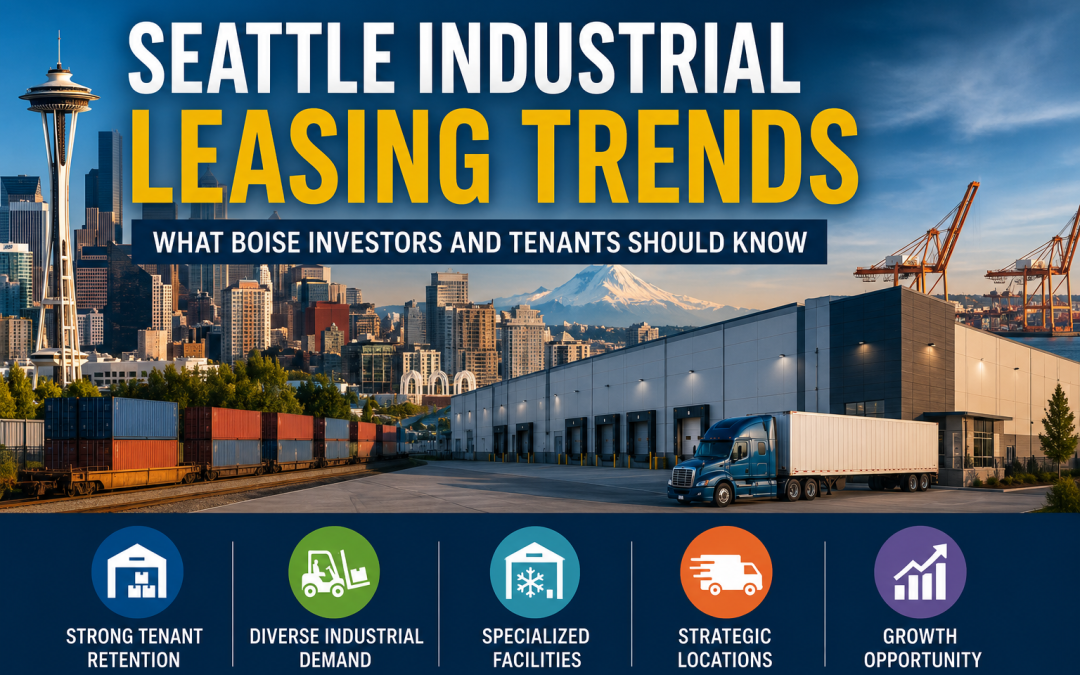
Seattle’s Biggest Industrial Leases Highlight Trends Boise Should Be Watching
Seattle’s latest industrial leasing activity sends a clear message: companies still value well-located, functional industrial space — and many established tenants would rather renew a good facility than disrupt their operations by moving.
That matters for Boise commercial real estate.
The Seattle-Puget Sound market is much larger than the Treasure Valley, but the types of companies signing leases there look familiar: building-material distributors, manufacturers, food companies, electrical suppliers, logistics operators, and growing consumer brands.
According to reporting by CoStar Research, several major Seattle-area industrial transactions were recognized among the market’s leading deals for the second quarter of 2026. The largest involved nearly 273,000 square feet, while the list also included specialized cold storage, advanced manufacturing, food distribution, and beverage production facilities.
You can review the original CoStar News report for the full transaction list and brokers recognized.
For Boise industrial owners, tenants, investors, and developers, the bigger value is understanding what these deals say about where industrial demand may be headed.
Renewals Dominate — and That Matters for Landlords
The first thing that jumps out from Seattle’s major transactions is the number of renewals.
Serta Simmons Bedding renewed 272,834 square feet in Puyallup for manufacturing and distribution.
Metropolitan, a flooring manufacturer and distributor, renewed approximately 107,000 square feet in Kent.
Hypertherm committed again to roughly 93,000 square feet for its advanced industrial operations.
Stoneway Electric Supply stayed in 88,000 square feet in Kent.
Milgard Windows & Doors renewed nearly 85,000 square feet in Fife.
Even the U.S. Food and Drug Administration renewed more than 30,000 square feet in Bothell.
For industrial landlords, that’s significant.
New leases get attention because they represent movement and expansion. But renewals can be just as important to property performance.
Moving an industrial operation isn’t like changing offices.
Manufacturers may have equipment to relocate. Distributors have inventory systems and delivery routes. Employees become accustomed to a location. Businesses may have racking, electrical improvements, refrigeration, loading configurations, or production lines built around a specific building.
Once a facility works, there can be strong incentives to stay.
For Boise industrial landlords, this reinforces the value of tenant retention.
Keeping a strong tenant can reduce downtime, commissions, tenant improvement costs, and the uncertainty of finding a replacement.
Building Materials and Construction Continue to Support Industrial Demand
Seattle’s leasing activity also highlights the connection between construction and industrial real estate.
Capital Lumber Co. signed a new lease for almost 126,000 square feet in Puyallup. The company distributes specialty building materials throughout the western United States.
Stoneway Electric Supply renewed its Kent facility.
Milgard Windows & Doors maintained its industrial operation in Fife.
These companies support construction activity, and they require physical real estate to store, manufacture, and distribute products.
That connection is especially relevant to the Treasure Valley.
Boise, Meridian, Nampa, Caldwell, Kuna, Star, and Eagle continue to grow. Every new home, apartment project, shopping center, office, medical building, and industrial facility creates demand for materials.
Those materials have to come from somewhere.
Lumber, windows, electrical equipment, plumbing products, HVAC components, roofing materials, flooring, and countless other products move through industrial buildings before reaching construction sites.
That’s why Boise development and Boise industrial real estate are closely connected.
Residential and commercial construction don’t just create demand for land. They create demand for the entire supply chain behind development.
Specialized Industrial Buildings Can Command Attention
One of Seattle’s more interesting transactions involved Plymouth Poultry Co.
The company leased approximately 71,600 square feet in Kent. What makes the transaction notable isn’t simply its size.
The property offers cold storage.
Refrigerated and freezer facilities represent a relatively specialized part of the industrial market. They can be expensive to construct and difficult to replace quickly.
That scarcity can make existing cold storage valuable to the right tenant.
The same principle applies to other specialized industrial properties.
Heavy power can matter to manufacturers.
Large yards can matter to construction and transportation companies.
Food users may require floor drains and specialized mechanical systems.
Automotive businesses may need grade-level doors.
Advanced manufacturers may need combinations of warehouse, laboratory, production, and office space.
Industrial real estate isn’t one product type.
For Boise investors, understanding the functional characteristics of a building can be just as important as looking at its square footage.
A specialized feature may significantly narrow the tenant pool — but it can also make the property much more valuable to businesses that actually need it.
Seattle’s New Leases Show How Diverse Industrial Demand Has Become
Not every transaction involved a traditional warehouse user.
Omega Morgan, a heavy transport, rigging, and logistics company, leased more than 53,000 square feet in Woodinville.
Vale Matcha & Coffee took approximately 36,000 square feet in Seattle’s industrial district.
The beverage company’s space will support production and distribution as the brand expands.
That’s an interesting example of how a consumer-facing company can eventually become an industrial tenant.
A business may start with a storefront.
Then it adds online sales.
Then wholesale distribution.
Then manufacturing or food production.
Eventually, that company needs warehouse space.
This is an important connection between retail leasing in Boise and the industrial market.
Growing restaurant, beverage, beauty, apparel, and consumer-product companies can eventually create industrial demand as their businesses scale.
The tenant occupying a small Boise retail storefront today could become tomorrow’s 20,000-square-foot warehouse user.
Logistics Location Remains Critical
Many of Seattle’s recognized industrial deals are clustered around Kent, Puyallup, and Fife.
There’s a reason.
These locations offer access to major transportation infrastructure and the region’s population base.
Metropolitan’s facility, for example, sits between the Port of Seattle and Port of Tacoma while also offering access to Seattle-Tacoma International Airport.
For industrial businesses, transportation efficiency can directly affect profitability.
A cheaper building in the wrong location may cost a company more through additional fuel, labor, and delivery time.
The same calculation applies in Boise.
Interstate 84 continues to define much of the Treasure Valley’s industrial geography.
Boise offers access to the region’s largest population concentration.
Meridian provides a central Treasure Valley location.
Nampa and Caldwell offer significant industrial growth opportunities farther west.
For logistics and distribution companies, the best location isn’t necessarily the cheapest.
It’s the one that makes the operation work.
What Seattle Could Tell Us About Boise Industrial Growth
Seattle is a major West Coast logistics market with ports, international trade, and a population far larger than Boise’s.
The Treasure Valley isn’t going to duplicate Seattle.
But it can benefit from some of the same demand drivers on a smaller scale.
The Seattle leases highlight several industrial tenant categories worth watching in Idaho:
- Building-material suppliers
- Electrical and plumbing distributors
- Food production and distribution
- Cold storage
- Advanced manufacturing
- Industrial services
- Transportation and logistics
- Consumer-product manufacturing
- Beverage production
- Government and technical users
Many of these industries already operate in Idaho.
The question is how much more space they will need as the state’s population and economy grow.
For developers, this means paying attention to more than total warehouse demand.
Future projects should consider which building features will make them competitive across several industries.
Local Insight: Boise’s Best Industrial Buildings Will Be the Ones Businesses Can Actually Use
Industrial real estate can look simple from the outside.
It’s easy to see a large concrete building and think one warehouse is basically interchangeable with another.
Tenants know that’s not true.
Clear height matters.
Power matters.
Truck access matters.
Dock doors matter.
Yard space matters.
Column spacing matters.
Parking matters.
Freeway access matters.
And for certain businesses, refrigeration, manufacturing infrastructure, or specialized improvements can determine whether a building works at all.
That’s the biggest lesson I take from Seattle’s latest leasing activity.
Functional industrial buildings retain value because businesses depend on them.
For Boise commercial real estate investors, I would pay close attention to buildings that can serve multiple types of tenants while still offering the infrastructure today’s industrial users need.
For developers, flexibility should be built into projects whenever possible.
And for industrial tenants, don’t wait until you’re out of space before planning your next move. Finding the right building can take considerably longer than finding square footage on a listing website.
As the Treasure Valley grows, industrial demand will become more diverse.
Boise won’t become Seattle — and it doesn’t need to.
But the companies supporting Idaho’s next phase of growth will still need places to manufacture products, store inventory, service equipment, and move goods.
That makes Boise industrial real estate one of the most important parts of the region’s growth story.
Mike Gioioso (joy-OH-so)
has for 16+ years been helping companies of all sizes buy, build, and lease perfect places for business in greater Boise, Idaho and beyond.
www.streetsmartidaho.com mike@streetsmartidaho.com 208-209-9166
Tags: #boisecommercialrealestate, #boiseindustrialrealestate, #boiseindustrialleasing, #boisedevelopment, #boiseinvestmentproperty, #idahocommercialrealestate, #treasurevalleycommercialrealestate, #treasurevalleyindustrial, #seattlecommercialrealestate, #seattleindustrialmarket, #pugetsoundindustrialrealestate