
Seattle’s Biggest Retail Leases Show What’s Driving Physical Stores—and What Boise Should Watch
What do a Japanese lifestyle store, a 24-hour gym, a hardware store and a luxury restaurant have in common?
They’re all expanding through physical real estate.
Seattle and the Puget Sound’s biggest recent retail leases show that successful brick-and-mortar retail is becoming more diverse—not less important.
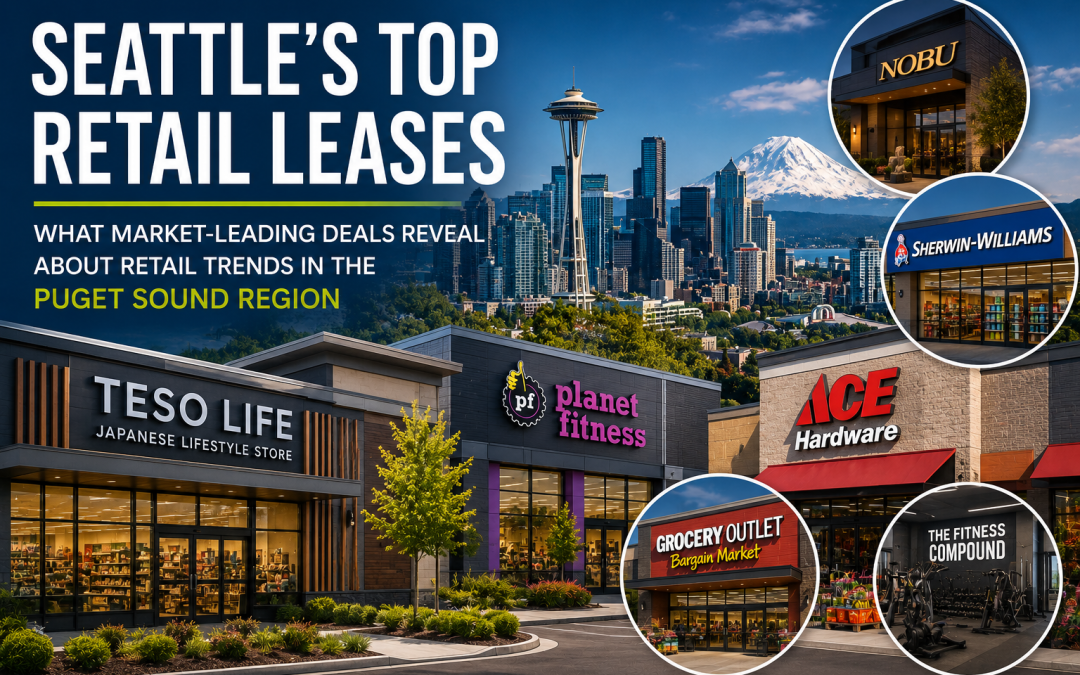
According to CoStar Research’s August 3 report on its second-quarter 2026 Power Broker Quarterly Deal Awards, notable Seattle-area transactions included leases involving Teso Life, The Fitness Compound, Ace Hardware, Sherwin-Williams, Nobu and several restaurant and service businesses.
The original CoStar News report provides details on the individual transactions and commercial real estate professionals recognized by CoStar.
While these leases occurred in Washington, the tenant mix offers useful clues for Boise commercial real estate. Seattle is one of the closest major markets feeding brands, investment and business concepts into Idaho, making its leasing activity worth watching.
Retail Growth Is Coming From Very Different Directions
The largest transaction recognized by CoStar involved Teso Life, a Japanese lifestyle retailer selling products ranging from beauty and fashion to food and home goods.
The company leased approximately 25,200 square feet at Alderwood in Lynnwood.
It didn’t stop there.
Teso Life also signed for another roughly 11,200 square feet at The Marketplace at Factoria in Bellevue.
That’s significant because it represents an international retail concept using multiple locations to establish a stronger Pacific Northwest presence.
Meanwhile, a very different business was expanding in Marysville.
The Fitness Compound leased approximately 21,900 square feet at Marysville Town Center for a gym offering around-the-clock access, specialized equipment and training.
Ace Hardware took another 20,800 square feet in University Place.
Those three concepts represent completely different retail categories.
Yet each has a strong reason for operating physical locations.
Teso Life offers discovery and specialty merchandise.
Fitness requires physical participation.
Hardware benefits from convenience, inventory and immediate customer needs.
That’s a good snapshot of today’s retail market.
Necessity, Experience and Service Are Driving Demand
Several other Seattle-area transactions reinforce the same theme.
Sherwin-Williams leased approximately 10,400 square feet in Puyallup. The paint and coatings business serves homeowners, contractors and professional customers who regularly need physical products.
In Bellevue, global restaurant and hospitality brand Nobu leased approximately 9,600 square feet.
Riviera Maya Cantina Cocina took another 7,000 square feet in Bellevue Towers.
An Indian restaurant, Taste & Best, leased approximately 4,600 square feet along California Avenue in Seattle.
J&A Auto Salon renewed approximately 5,700 square feet in Bellevue.
Put these together and a pattern starts to emerge.
Retail demand is increasingly concentrated around three broad categories:
Necessity. Hardware, paint, groceries and other products consumers need regardless of economic cycles.
Experience. Restaurants, fitness and entertainment give customers reasons to leave home.
Service. Automotive, medical, wellness, beauty and similar businesses require local physical locations.
Those categories are difficult for e-commerce to completely replace.
And that makes them especially important when thinking about retail leasing in Boise.
What Seattle Could Tell Us About Boise’s Next Tenants
One of the most interesting parts of Seattle’s leasing activity is the presence of expanding concepts.
For Boise landlords and tenant representatives, that’s worth watching.
Retail brands often expand geographically in stages.
A company may establish itself in California, Oregon or Washington before looking toward Idaho. Seattle and Portland can therefore function as early indicators of concepts that could eventually consider Boise, Meridian or other Treasure Valley locations.
That doesn’t mean every brand opening in Seattle will come to Idaho.
Far from it.
Population requirements, household income, distribution networks, competition and franchise structures all affect expansion decisions.
But tracking brands that are adding multiple Pacific Northwest locations can help landlords identify potential prospects before those companies formally enter the Boise market.
Teso Life is a good example of the type of retailer worth watching.
Two substantial leases in the same region suggest an intentional Pacific Northwest expansion strategy rather than a one-off location.
Whether that eventually leads to Idaho is unknown, but it’s the type of activity commercial real estate professionals should notice.
Big-Box Space Doesn’t Need Another Big-Box Store
The Fitness Compound transaction also offers an important lesson for shopping center owners.
A nearly 22,000-square-foot vacancy can be difficult to fill with traditional retail.
But fitness can make sense.
We’ve seen this across commercial real estate for years. Gyms, indoor recreation, entertainment, medical and other service businesses can absorb spaces that once might have been occupied by traditional retailers.
That can give older shopping centers a second life.
The same opportunity exists throughout Boise commercial real estate.
A former grocery box or junior anchor space may potentially accommodate fitness, pickleball, children’s recreation, furniture, specialty grocery, medical services or other nontraditional retail uses.
The economics still have to work.
Large spaces often require significant tenant improvements. HVAC, plumbing, electrical capacity, parking and neighboring tenant restrictions can become major issues.
But landlords willing to think beyond conventional retail categories can dramatically expand the pool of potential tenants.
Mixed-Use Development Is Creating Another Kind of Retail
Seattle’s transactions also highlight a second trend that should matter for Boise development.
Nobu and Riviera Maya both leased space associated with major mixed-use or high-rise developments in Bellevue.
That’s a different retail model from the suburban shopping center.
Restaurants and premium retailers can help create identity at the street level of residential, office and mixed-use developments.
Instead of viewing ground-floor retail simply as space that needs to be filled, developers increasingly use restaurants and distinctive concepts as amenities for the entire project.
That’s particularly relevant as Downtown Boise and parts of Meridian become denser.
Ground-floor commercial space can help differentiate apartment, condominium and office projects.
But there’s a challenge.
Not every ground-floor retail space is good retail.
Developers need to think about visibility, signage, patio opportunities, parking, loading, grease ventilation, ceiling height and customer access early in the design process.
Trying to turn poorly designed leftover space into a restaurant after construction is much harder.
The best mixed-use projects design the retail component intentionally.
Local Insight: Seattle Is a Tenant Pipeline Worth Watching
For Boise commercial real estate, I think Seattle and Portland are two of the most useful markets to monitor for retail expansion.
They’re larger than Boise, but geographically close enough that many regional businesses already think about the Pacific Northwest as a connected territory.
Once a company establishes enough locations in Washington and Oregon, Idaho can become a logical next step.
The Treasure Valley offers something those larger markets don’t always provide: strong population growth combined with comparatively manageable market size.
A brand doesn’t necessarily need dozens of Idaho locations.
One strong Boise-area store can potentially reach a significant portion of the Treasure Valley.
That makes site selection extremely important.
A retailer entering Boise for the first time may prioritize visibility, freeway access and regional drawing power rather than immediately building a network of neighborhood stores.
That’s why areas around major corridors in Boise and Meridian remain so important.
For landlords, the opportunity is to identify expanding concepts early.
For developers, it’s about creating spaces flexible enough to accommodate the next generation of tenants.
And for investors evaluating Boise investment property, tenant mix deserves just as much attention as occupancy.
A shopping center can be completely leased and still have a weak long-term tenant profile.
Another property might have vacancy today but possess the location, parking and configuration needed to capture tomorrow’s strongest concepts.
Seattle’s recent leasing activity reinforces that distinction.
Retail isn’t moving in one direction.
International brands are expanding. Fitness concepts are taking large spaces. Hardware and paint stores continue to need neighborhood locations. Restaurants are helping anchor mixed-use developments. Automotive services are staying close to customers.
The common denominator is that each tenant gives people a reason to visit a physical location.
That’s the type of retail demand Boise landlords should be chasing.
Mike Gioioso (joy-OH-so) has for 16+ years been helping companies of all sizes buy, build, and lease perfect places for business in greater Boise, Idaho and beyond.
www.streetsmartidaho.com mike@streetsmartidaho.com 208-209-9166
Tags: #boisecommercialrealestate, #boiseretailleasing, #retailleasingboise, #seattlecommercialrealestate, #seattleretailleasing, #pacificnorthwestcommercialrealestate, #boisedevelopment, #idahocommercialrealestate, #meridiancommercialrealestate, #boiseinvestmentproperty, #treasurevalleycommercialrealestate, #experientialretail, #shoppingcenterleasing, #mixedusedevelopment, #boiseretailrealestate