
Seattle’s Office Leasing Comeback Offers Lessons for Boise Commercial Real Estate
The office market isn’t dead. It’s becoming more selective.
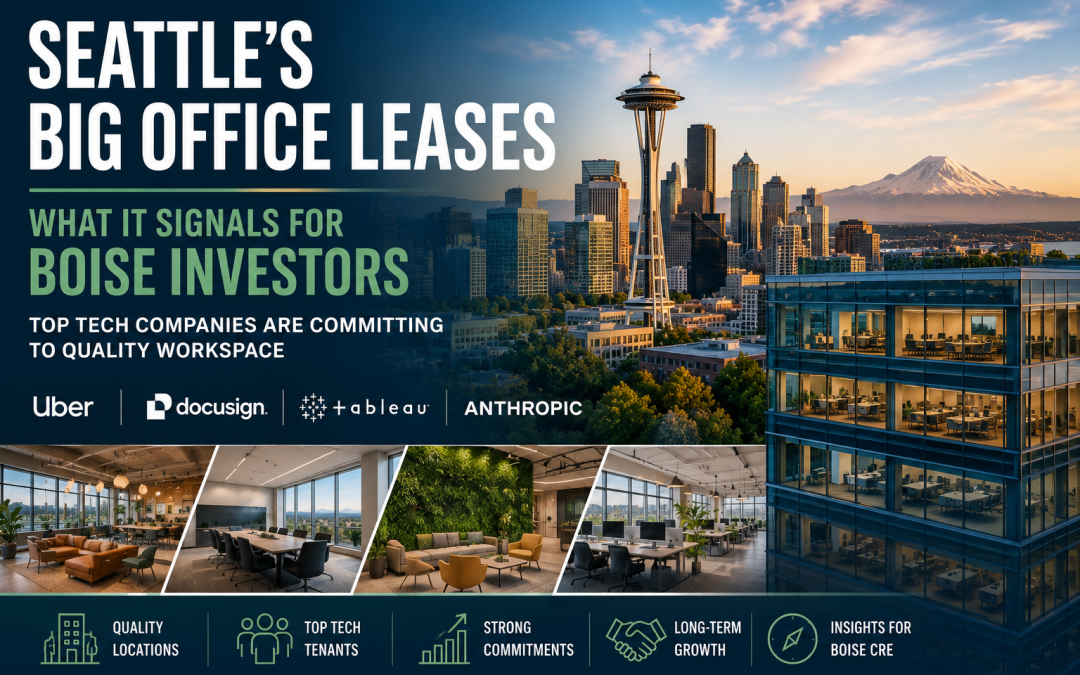
Seattle’s latest major office leases show some of the country’s biggest technology companies committing to substantial amounts of physical workspace. Uber, Docusign, Tableau, Anthropic, Stripe and other employers signed new leases or renewals during the second quarter of 2026.
That’s worth watching from Boise.
Seattle and Boise operate at completely different scales, but the underlying message applies to both markets: companies still want offices when those spaces support recruiting, collaboration, culture and business growth.
According to CoStar Research, the transactions were selected among the Seattle-Puget Sound winners of CoStar’s second-quarter 2026 Power Broker Quarterly Deal Awards. The original CoStar News report provides the full transaction details and brokers involved.
For Boise commercial real estate owners, tenants and investors, the more useful question isn’t whether employees are returning to the office five days a week.
It’s which offices companies are willing to commit to now.
Technology Companies Are Making Big Office Commitments
Some of Seattle’s largest leases were substantial.
Uber signed a new lease for approximately 168,700 square feet at Four106 in Bellevue. Combined with its existing Seattle space, CoStar reported that Uber’s regional footprint grew to roughly 285,000 square feet.
Docusign committed to another 115,500 square feet in downtown Seattle as part of an office relocation.
Tableau renewed approximately 114,000 square feet at its Fremont location, with the long-term agreement scheduled to begin after its existing lease expires in 2029.
Anthropic signed for about 113,000 square feet at Dexter Yard North.
Together, just those four transactions represent more than half a million square feet of office commitments.
And the activity didn’t stop there.
Wizards of the Coast expanded into approximately 76,000 square feet in Renton.
Stripe leased more than 53,000 square feet.
Dell Technologies renewed roughly 46,000 square feet.
SoFi took approximately 33,000 square feet.
AI infrastructure company Nscale leased nearly 24,000 square feet in Bellevue.
These aren’t companies reluctantly holding onto leftover office space.
Several are making new commitments.
That’s an important distinction.
AI Could Become a New Source of Office Demand
One of the most interesting parts of Seattle’s leasing activity is the presence of artificial intelligence companies.
Anthropic’s roughly 113,000-square-foot transaction is especially notable.
Nscale, an AI infrastructure company, also signed a new Bellevue lease.
AI has received enormous attention for its impact on data centers and power demand, but its effect on traditional office real estate deserves attention too.
AI companies need engineers.
They need software developers.
They need sales teams, executives, researchers and support staff.
Many of those companies compete aggressively for highly skilled employees.
That makes office space part of the recruiting package.
Location, amenities, building quality and proximity to other technology companies can all become important.
This could eventually matter for Boise commercial real estate as Idaho’s technology sector develops.
Boise isn’t going to suddenly absorb hundreds of thousands of square feet because of AI.
But growing technology companies don’t need to lease 100,000 square feet to influence a smaller market.
A handful of companies taking 5,000, 10,000 or 20,000 square feet can make a noticeable difference in Boise.
The Office Market Is Splitting Into Winners and Losers
The bigger takeaway from Seattle isn’t simply that companies are leasing offices again.
It’s that tenants can afford to be selective.
Hybrid work has changed how companies evaluate space. Businesses may need fewer square feet per employee, but they often expect more from the space they keep.
That can favor newer and well-maintained buildings with strong locations and amenities.
Stripe’s new Seattle building, for example, offers meeting and gathering facilities along with rooftop space.
Nscale selected space in a newer Bellevue project.
Anthropic chose a property designed around technology and life science users.
Those details matter.
Companies increasingly want workplaces employees will actually use.
That can include:
- Natural light and attractive common areas
- Meeting and collaboration spaces
- Nearby restaurants and services
- Convenient parking or transportation
- Modern building systems
- Flexible floor plans
- High-quality technology infrastructure
- Fitness and wellness amenities
That creates a challenge for older commodity office buildings.
A building can’t compete on rent alone if tenants don’t believe employees will want to work there.
What This Means for Boise Office Owners
Boise has its own version of this flight-to-quality trend.
The scale is smaller, but the decision-making process is similar.
Businesses considering Downtown Boise, Meridian, Eagle or other Treasure Valley office locations aren’t simply comparing rent per square foot.
They’re asking whether the building helps their company operate.
Can employees park?
Are restaurants nearby?
Is the space easy to reach?
Does the building make a good impression on clients?
Can the floor plan support both private work and collaboration?
Does the space help recruit employees?
Those questions can increasingly determine which buildings win leases.
For Boise landlords with older office properties, that doesn’t necessarily mean undertaking a massive renovation.
Sometimes relatively targeted improvements can make a meaningful difference.
Updated common areas, improved lighting, better signage, upgraded conference facilities, modern finishes and more flexible tenant improvement packages can help older properties compete.
The key is understanding what today’s tenant actually values.
Flexible Office Space Is Still Part of the Equation
Another notable Seattle transaction involved Industrious, which leased more than 20,000 square feet in Bellevue.
Flexible workspace survived the remote-work disruption for an important reason.
Not every company wants to sign a traditional long-term lease.
A growing company may not know how many employees it will have three years from now.
A company entering Boise may want to test the market before making a larger commitment.
A remote company may need professional meeting and collaboration space without maintaining a full-time office.
And established companies may want satellite locations closer to employees.
That creates opportunities for coworking, executive suites and flexible office providers.
For Boise development and office leasing, flexibility could become an increasingly important part of the market rather than simply a temporary alternative to traditional leases.
Boise Tenants Could Have a Window of Opportunity
There’s another side of today’s office market that businesses should understand.
Tenants can often negotiate.
Depending on the property, landlords may offer improvement allowances, free rent, flexible commencement dates or other incentives to secure quality tenants.
That makes today’s market potentially attractive for companies that know they’ll need physical office space for the next several years.
Instead of simply renewing automatically, businesses should evaluate alternatives.
A company might be able to upgrade its location or building quality without increasing occupancy costs as much as expected.
That’s especially relevant for tenants approaching lease expiration.
Good office strategy starts well before the current lease ends.
Businesses should give themselves enough time to compare renewal terms against relocation opportunities.
Local Insight: Boise’s Office Market Isn’t Disappearing — It’s Evolving
I don’t think the right question is:
“Is office coming back?”
Office never completely went away.
The better question is:
“What kind of office space will companies continue paying for?”
Seattle’s largest leases give us some clues.
Companies are committing to space when the building supports their employees and business strategy.
Technology companies are still leasing offices.
AI companies are emerging as a new source of demand.
Established employers are renewing when existing locations continue to work.
And flexible workspace remains part of the mix.
For Boise landlords, that means understanding your competitive position.
For tenants, it means taking advantage of choice.
For investors, it means being careful about treating every office building as if it has the same risk.
A well-located Boise office building with parking, modern systems, flexible floor plates and nearby amenities may have a very different outlook from an obsolete property that needs significant capital investment.
Boise’s growing economy should continue generating businesses that need professional workspace.
But future demand may be concentrated in the properties that give employers a reason to bring people together.
That’s the opportunity.
The Boise office market doesn’t necessarily need every employee back at a desk every day.
It needs companies that see enough value in physical space to sign a lease and stay.
Mike Gioioso (joy-OH-so) has for 16+ years been helping companies of all sizes buy, build, and lease perfect places for business in greater Boise, Idaho and beyond.
www.streetsmartidaho.com mike@streetsmartidaho.com 208-209-9166
Tags: #boisecommercialrealestate, #boiseofficespace, #boiseofficeleasing, #boisedevelopment, #idahocommercialrealestate, #seattlecommercialrealestate, #boisetechnologycompanies, #boiseofficemarket, #commercialofficeleasing, #meridianofficespace, #downtownboiseoffice, #treasurevalleycommercialrealestate, #retailleasingboise, #boiseinvestmentproperty, #flexibleofficespace, #aicommercialrealestate