
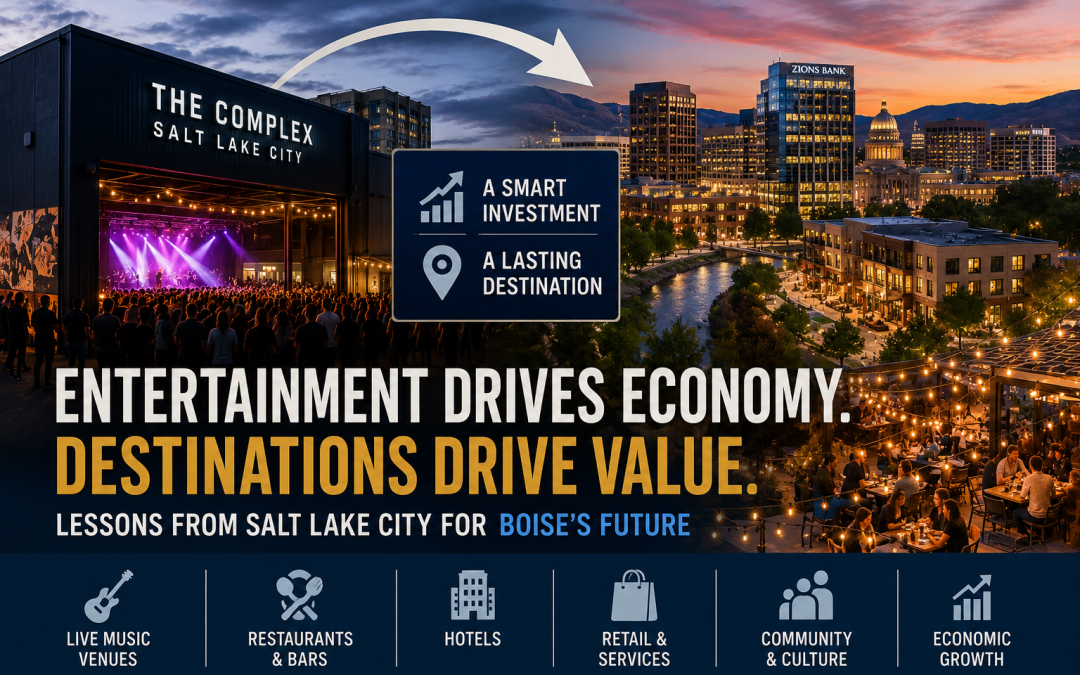
What a Major Salt Lake City Music Venue Sale Could Teach Boise Commercial Real Estate Investors
Some commercial real estate assets generate rent.
Others generate destinations.
As cities compete for residents, visitors, talent, and investment, entertainment venues have become an increasingly important part of economic development strategies. Restaurants, retail centers, hotels, and mixed-use projects often benefit from being located near places where people naturally gather.
A recent transaction in Salt Lake City highlights this trend and offers some interesting lessons for Boise commercial real estate investors, developers, and city leaders.
According to reporting by Jacob Stillman of CoStar Research, a private investor recently acquired The Complex, one of Salt Lake City’s best-known live music and special events venues. The original CoStar article can be found here: https://product.costar.com/home/news/2127031174
While the transaction took place hundreds of miles from Boise, the investment raises larger questions about the growing value of entertainment-driven real estate and what that could mean for future Boise development.
Entertainment Real Estate Is Becoming an Asset Class of Its Own
The property involved in the transaction is The Complex, a live entertainment venue encompassing approximately 48,700 square feet in downtown Salt Lake City.
The venue has hosted nationally recognized performers and has established itself as a major gathering place within the city’s entertainment ecosystem.
Key transaction details include:
- Sale price of approximately $7.43 million
- Roughly $152 per square foot
- Reported capitalization rate of 5.01%
- Originally constructed in 1967
- Includes multiple event and performance spaces
- Located within downtown Salt Lake City’s urban core
Perhaps the most interesting takeaway is not the building itself, but the income investors are willing to accept for a well-positioned entertainment property.
A cap rate near 5% suggests buyers see long-term value in venues capable of attracting consistent crowds and generating recurring activity.
Why Experiential Real Estate Continues to Gain Momentum
For years, many investors focused primarily on traditional office, retail, industrial, and multifamily assets.
Today, consumers increasingly spend money on experiences rather than physical goods alone.
That shift has helped create demand for:
- Concert venues
- Entertainment districts
- Food halls
- Sports facilities
- Event centers
- Mixed-use destinations
- Hospitality-focused developments
These uses often create a ripple effect that extends far beyond the property itself.
A successful entertainment venue can support nearby restaurants, bars, hotels, parking operators, retail businesses, and surrounding commercial development.
In many cases, the venue becomes the anchor that drives foot traffic for an entire district.
What This Could Mean for Boise Development
Boise has experienced significant population growth over the past decade, but its entertainment infrastructure continues to evolve.
As the Treasure Valley grows, demand for larger event spaces, music venues, sports facilities, and destination-oriented developments is likely to increase as well.
Many of the most successful urban districts across the country share a common characteristic:
They combine entertainment, hospitality, dining, residential, and commercial uses into walkable environments that encourage people to stay longer and spend more money.
Projects that incorporate entertainment components often create economic activity well beyond traditional business hours.
That can significantly improve the performance of surrounding commercial real estate.
For Boise developers, the question is not whether entertainment matters.
The question is how much future growth will be influenced by projects that create experiences rather than simply providing square footage.
The Economic Development Angle
Entertainment venues are often viewed solely as cultural assets.
In reality, they can function as economic engines.
Major concerts and events attract visitors from outside the market, increase hotel occupancy, boost restaurant sales, and generate spending across multiple sectors.
As Boise continues discussing convention facilities, sports tourism, mixed-use projects, and downtown activation strategies, transactions like this provide another example of investors placing real value on destination-oriented properties.
The purchase of The Complex demonstrates that entertainment infrastructure can be viewed as an investment asset—not just a community amenity.
Local Insight
One of the biggest trends shaping commercial real estate today is the growing importance of placemaking.
The most successful developments are no longer simply collections of buildings. They are places people actively choose to visit.
Boise has already seen this trend emerge through downtown revitalization efforts, restaurant growth, public gathering spaces, and entertainment-oriented projects.
As the market matures, properties that help create experiences and community engagement may become increasingly valuable.
The Salt Lake City venue sale reinforces an important lesson for Boise commercial real estate investors: people create value, activity creates demand, and destinations often become some of the most durable real estate assets in a growing market.
As Boise continues attracting residents and businesses, expect entertainment-focused development to play an increasingly important role in shaping where future investment flows.
Mike Gioioso (joy-OH-so) has for 16+ years been helping companies of all sizes buy, build, and lease perfect places for business in greater Boise, Idaho and beyond.
www.streetsmartidaho.com mike@streetsmartidaho.com 208-209-9166
Tags: #boisecommercialrealestate, #boisedevelopment, #commercialrealestate, #entertainmentrealestate, #mixedusedevelopment, #economicdevelopment, #retailleasingboise, #boiserealestate, #treasurevalleyrealestate, #hospitalityrealestate, #destinationdevelopment, #placemaking, #urbandevelopment, #livemusicvenue, #commercialdevelopment