
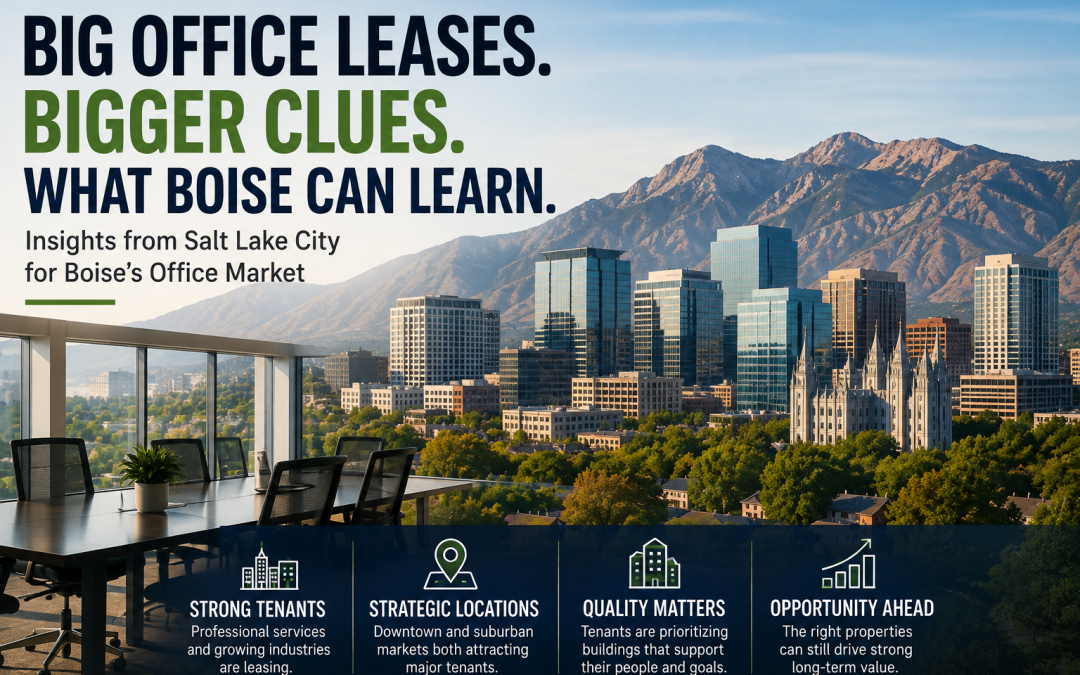
Salt Lake City’s Biggest Office Leases Offer Clues for Boise’s Office Market
Office real estate isn’t disappearing. It’s becoming more selective.
Five notable Salt Lake City-area leases completed during the second quarter of 2026 ranged from roughly 15,500 to more than 40,000 square feet. The tenants came from law, accounting, insurance technology, consumer products and engineering.
That’s worth watching from Boise.
According to reporting by CoStar Research, these transactions were selected as Salt Lake City’s second-quarter 2026 winners in CoStar’s Power Broker Quarterly Deal Awards. You can view the original CoStar News article for the full deal information and broker recognition.
The transactions aren’t Boise deals, but they provide a useful window into what larger office users are choosing in another fast-growing Intermountain West market.
And there are some lessons for Boise commercial real estate.
Large Companies Are Still Signing Meaningful Office Leases
The five highlighted transactions represented a combined 124,477 square feet of office leasing.
The largest was a 40,618-square-foot lease by intellectual property law firm Workman Nydegger at 60 E. South Temple Street in downtown Salt Lake City.
The other recognized leases included:
- Minky Couture — 26,260 SF in Draper
- Orion180 — 22,174 SF in Draper
- Eide Bailly — 19,895 SF in downtown Salt Lake City
- Dashiell Corp. — 15,530 SF in Draper
What’s interesting isn’t simply the amount of space.
It’s who is leasing it and where they’re going.
Professional services firms are still making substantial office commitments. So are growing technology-related businesses and companies connected to engineering and infrastructure.
And tenants aren’t choosing just one type of location.
Two of the highlighted transactions were in downtown Salt Lake City, while three were in Draper.
That tells us something important.
The downtown-versus-suburban office debate may be too simple.
Both can work when the building, location and tenant needs line up.
What Salt Lake City Can Tell Us About Boise Office Demand
Salt Lake City is obviously a larger office market than Boise, and we shouldn’t assume every trend there will repeat in the Treasure Valley.
But the two markets share some characteristics.
Both are growing Intermountain West business centers. Both compete for expanding companies, professional talent and regional operations. Both also have suburban employment corridors competing with traditional downtown office districts.
That’s why these Salt Lake City leases are relevant.
Look at the locations tenants selected.
Workman Nydegger chose a major downtown tower near Temple Square.
Eide Bailly also committed to downtown space, taking nearly 20,000 square feet in a newer mixed-use office building that opened in 2022.
Meanwhile, Minky Couture, Orion180 and Dashiell Corp. selected Draper, putting them closer to the Silicon Slopes business corridor and major transportation routes.
Boise has a similar location question playing out on a smaller scale.
A professional services company might value Downtown Boise for its restaurants, client access, visibility and urban environment.
Another employer might prefer Meridian because of parking, freeway access, newer buildings and proximity to employees living throughout the Treasure Valley.
Neither strategy is automatically better.
The office has to fit the company.
Quality Could Matter More Than Quantity
One of the biggest post-pandemic changes in office real estate is that companies don’t necessarily need as much space as they once did.
But that doesn’t mean they don’t care about the space they keep.
In many cases, the opposite may be true.
If employees are only expected in the office part of the week, employers have another challenge:
How do we make people actually want to come in?
That can increase the importance of building quality, location and amenities.
For landlords, that means competition isn’t simply about asking rent.
Tenants may compare:
- Parking
- Building condition
- Natural light
- Restaurants and services nearby
- Freeway and transit access
- Flexible floor plans
- Conference and collaboration areas
- Employee commute times
- Signage and visibility
- Overall workplace experience
Older office buildings that can’t compete in these areas may have to compete harder on price or invest in improvements.
That’s important for Boise office owners.
Professional Services Remain an Important Office Demand Driver
Another thing stands out in CoStar’s Salt Lake City list.
Traditional office users aren’t gone.
Workman Nydegger is a law firm.
Eide Bailly provides accounting and advisory services.
Orion180 is an insurance technology company.
Dashiell works in engineering and energy infrastructure.
These are businesses where offices can still serve an important operational purpose.
That matters because discussions about office real estate sometimes treat every company as though it has the same workplace strategy.
They don’t.
A call center, law firm, technology company, medical office and engineering company may have completely different real estate requirements.
That’s why Boise office leasing needs to be examined industry by industry.
Professional services could remain particularly important to Downtown Boise and other established office corridors because these companies often value client-facing environments, meeting space and proximity to other businesses.
Meanwhile, companies with larger employee counts or more operational requirements may find suburban locations attractive.
Why This Matters for Boise Office Investors
For investors, these Salt Lake City deals reinforce a basic principle:
Office real estate needs to be evaluated building by building.
National office headlines can make the entire sector sound like one market.
It isn’t.
There can be a major difference between a well-located, modern building with strong tenants and an outdated property struggling to compete for users.
That distinction may become even more important.
If tenants become more selective, the strongest buildings could capture a larger share of leasing demand while weaker properties experience longer vacancies.
For Boise commercial real estate investors, that makes several questions increasingly important.
Who is the likely tenant for this building?
Why would that company choose this property instead of another?
How much money will be needed to prepare vacant space?
What concessions will tenants expect?
How much competing space exists nearby?
And perhaps most importantly:
What would it cost to replace this building today?
Those questions tell you more than market-wide vacancy statistics alone.
Local Insight: Boise Doesn’t Need Every Office Worker Back
From a Boise commercial real estate perspective, I don’t think the future of the office market depends on everyone returning to a desk five days a week.
That’s probably the wrong benchmark.
What matters is whether companies continue seeing enough value in physical workplaces to sign leases.
The Salt Lake City transactions highlighted by CoStar show that some clearly do.
A law firm committing to more than 40,000 square feet is meaningful.
So is an accounting firm taking nearly 20,000 square feet in a newer downtown building.
And three separate companies selecting Draper demonstrates that suburban business corridors remain relevant.
Boise could continue seeing a similar split.
Downtown Boise should remain attractive to companies that value a central location, professional image, restaurants and an urban environment.
Meridian and other suburban areas can compete through parking, accessibility, population growth and proximity to employees.
That creates opportunity—but also risk.
I would expect the gap between strong and weak office properties to become more noticeable.
Buildings that offer a compelling reason for tenants to choose them should have an advantage.
Properties that are functionally outdated, poorly located or expensive to improve could face a much tougher leasing environment.
What Boise Landlords and Developers Should Watch
There is also a development lesson here.
One of the recognized Salt Lake City transactions involved Eide Bailly leasing space in a building completed in 2022.
Newer buildings can attract tenants, but developing additional office space today remains difficult because construction and financing costs can require rents well above older inventory.
That means Boise development needs to be very targeted.
Building speculative office space simply because population is growing is a much different proposition than developing space around a known tenant or demonstrated demand.
Developers should be asking:
Which users actually need new space—and what are they willing to pay for it?
The same applies to renovations.
In some cases, repositioning an existing Boise office property could make more economic sense than constructing from the ground up.
Owners who can modernize common areas, improve building systems, create attractive suites and offer competitive tenant improvement packages may be able to capture tenants looking for quality without paying new-construction rents.
The Bigger Intermountain West Office Story
The five Salt Lake City leases don’t mean the office market has returned to its old normal.
It probably hasn’t.
But they do show that meaningful office transactions are still happening.
Companies are making commitments.
Professional services firms are leasing downtown space.
Growing businesses are choosing suburban locations.
And employers are still willing to invest in physical workplaces when those spaces support the company’s goals.
For Boise, that’s the more useful way to think about office demand.
The question isn’t whether “office is back.”
The better questions are:
Which companies still need offices?
What kind of space do they want?
Where do they want to be?
And:
Which Boise properties are best positioned to win those tenants?
For landlords, investors and developers, answering those questions may matter far more than trying to predict whether the traditional office market ever completely returns.
Source: This article is based on reporting and transaction information published by CoStar Research on August 3, 2026. The Salt Lake City lease details and broker information originated from CoStar’s Power Broker Quarterly Deal Awards coverage. The discussion of Boise commercial real estate, office leasing, investment and development implications represents independent commentary and should not be considered original reporting.
Mike Gioioso (joy-OH-so)
has for 16+ years been helping companies of all sizes buy, build, and lease perfect places for business in greater Boise, Idaho and beyond.
www.streetsmartidaho.com mike@streetsmartidaho.com 208-209-9166
Tags: #boisecommercialrealestate, #boiseofficemarket, #boiseofficeleasing, #boisedevelopment, #saltlakecitycommercialrealestate, #saltlakecityofficemarket, #idahocommercialrealestate, #treasurevalleycommercialrealestate, #meridianofficespace, #downtownboiseoffice, #boiseinvestmentproperty, #commercialrealestateinvestment, #officeleasingboise, #intermountainwestrealestate, #meridiancommercialrealestate