
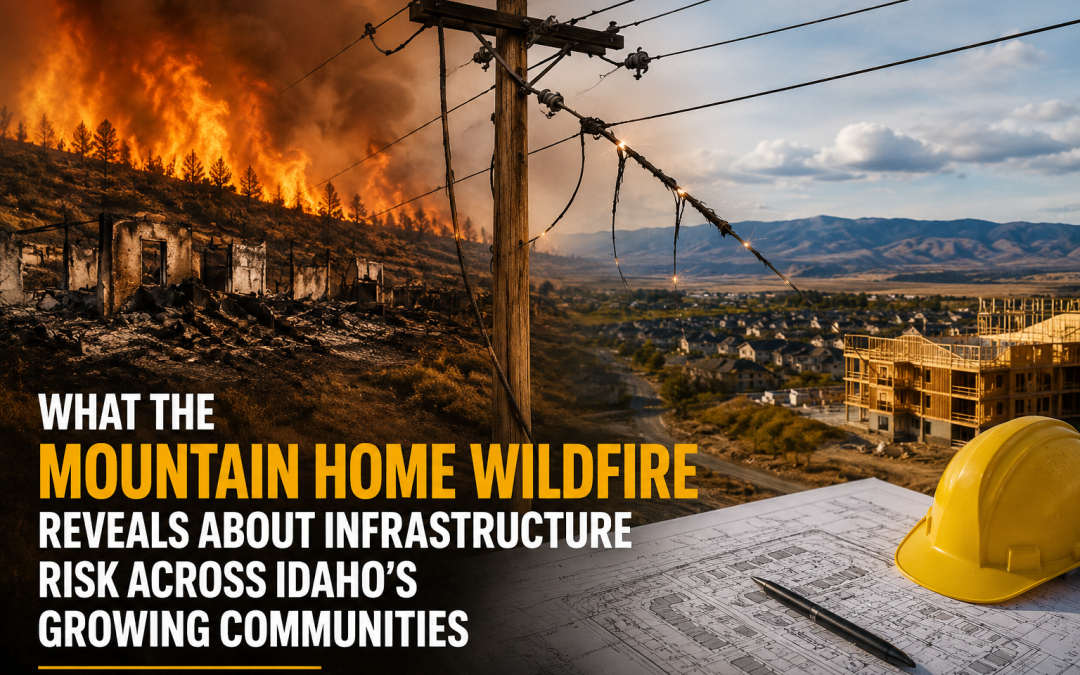
What the Mountain Home Wildfire Reveals About Infrastructure Risk Across Idaho’s Growing Communities
As Idaho continues to add new homes, businesses, and development projects, one challenge is becoming increasingly important: infrastructure resilience.
A wildfire that recently swept through Mountain Home serves as a reminder that growth, utility systems, weather conditions, and public safety are all closely connected.
According to reporting by IBR Staff in the Idaho Business Review, a wildfire that destroyed homes and property in Mountain Home was traced back to electrical equipment owned by Idaho Power. The original Idaho Business Review article can be found here: https://idahobusinessreview.com/2026/06/02/idaho-power-equipment-sparked-mountain-home-wildfire/
While the immediate focus remains on the families and property owners affected by the fire, the incident also highlights larger conversations about infrastructure maintenance, wildfire preparedness, and risk management throughout Idaho.
Key Facts From the Investigation
Investigators with the Idaho State Fire Marshal’s Office determined that strong winds caused two electrical service lines to come into contact with one another.
The contact created arcing and sparking, which led to molten aluminum and melted insulation falling into dry vegetation below. With sustained winds reportedly reaching 30 to 35 mph and gusts exceeding 50 mph, the fire spread rapidly after ignition.
Reported impacts included:
- Approximately 300 acres burned
- 15 homes destroyed
- At least 12 vehicles lost
- Numerous outbuildings damaged or destroyed
- An Elmore County Sheriff’s deputy injured during the response
Idaho Power acknowledged that its equipment was likely involved in starting the fire and has stated that it is working directly with affected customers regarding claims and recovery efforts.
Why This Matters Beyond Mountain Home
Wildfires have traditionally been viewed as challenges for rural communities, forests, and agricultural areas.
That distinction is becoming less clear.
As Idaho’s population continues expanding into previously undeveloped areas, more residential neighborhoods, commercial properties, industrial sites, and infrastructure corridors are being built in locations exposed to wildfire risk.
For Boise commercial real estate professionals, developers, and property owners, this trend matters because insurance costs, construction standards, utility planning, and site selection decisions are increasingly influenced by environmental risk factors.
A single event can create ripple effects that impact property values, operating costs, and future development requirements.
Infrastructure Is Becoming a Bigger Real Estate Issue
Commercial real estate conversations often focus on vacancy rates, leasing activity, tenant demand, and new construction.
Infrastructure rarely receives the same attention until something goes wrong.
This incident highlights the growing importance of utility systems, electrical service reliability, and ongoing maintenance throughout Idaho’s expanding communities.
As Boise development continues pushing outward into surrounding areas, infrastructure planning will likely become an even larger factor in site evaluation and project feasibility.
Developers may increasingly consider:
- Utility system capacity
- Fire mitigation measures
- Emergency access routes
- Vegetation management requirements
- Insurance availability and costs
- Long-term infrastructure maintenance responsibilities
These considerations are no longer limited to large-scale master planned communities. They are becoming relevant for many residential, industrial, and commercial projects throughout the region.
What Property Owners Should Be Thinking About
The Fire Marshal’s Office encouraged property owners to regularly inspect service lines and report concerns such as low-hanging wires, damaged equipment, or vegetation contacting electrical lines.
For property owners, landlords, and investors, preventative maintenance can play a major role in reducing risk.
Routine inspections may help identify issues before weather conditions turn a small problem into a significant event.
As Idaho experiences recurring periods of drought, high winds, and elevated fire danger, proactive maintenance becomes increasingly important for protecting both property and occupants.
Local Insight
From a Boise commercial real estate perspective, this story is about more than a single wildfire.
It reflects a broader reality facing Idaho’s fastest-growing communities.
As development spreads into new areas, infrastructure resilience becomes just as important as location, demographics, and market demand. Utility systems, emergency preparedness, and risk mitigation are increasingly part of the commercial real estate conversation.
Investors, developers, landlords, and business owners who understand these risks early will be better positioned to protect assets and make informed long-term decisions.
Mountain Home’s wildfire is a tragic event for those affected, but it also serves as a reminder that growth requires ongoing attention to the infrastructure that supports it.
Mike Gioioso (joy-OH-so) has for 16+ years been helping companies of all sizes buy, build, and lease perfect places for business in greater Boise, Idaho and beyond.
www.streetsmartidaho.com mike@streetsmartidaho.com 208-209-9166
Tags: #boisecommercialrealestate, #idahocommercialrealestate, #boisedevelopment, #idahodevelopment, #mountainhomeidaho, #wildfirerisk, #infrastructureplanning, #utilityinfrastructure, #propertydevelopment, #commercialproperty