
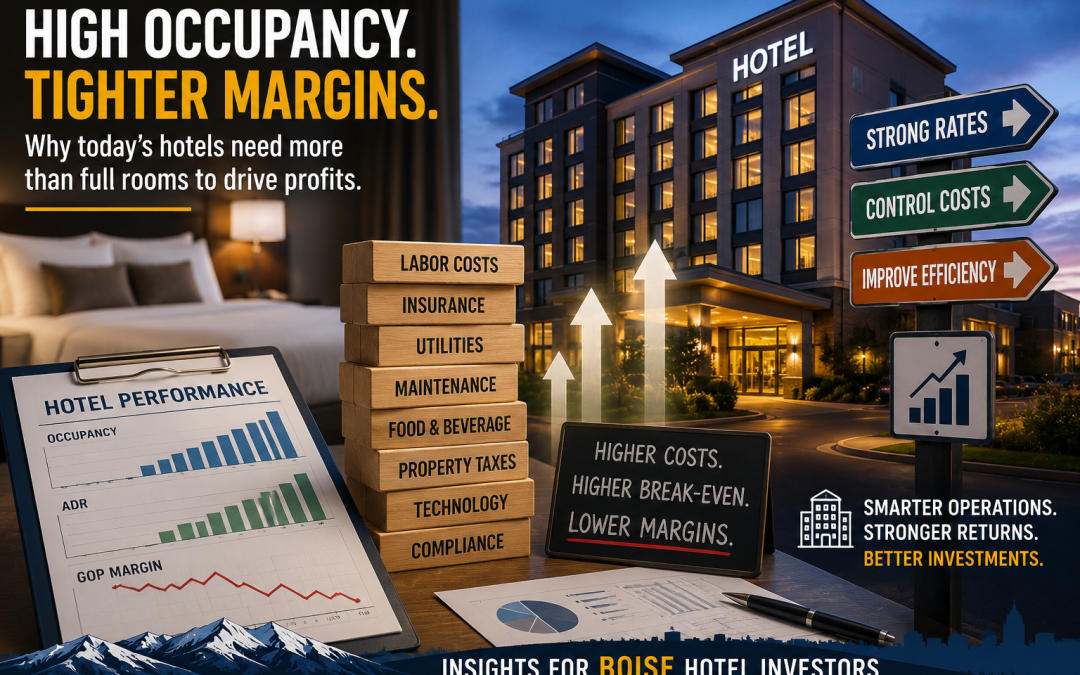
Why High Hotel Occupancy No Longer Guarantees Strong Profits
For years, hotel owners viewed occupancy as one of the clearest indicators of success.
Fill more rooms, generate more revenue, and profits should follow.
Today’s hospitality market is proving that equation isn’t always so simple.
A recent analysis from CoStar suggests that many hotels are facing a new challenge: operating costs are rising so quickly that even strong occupancy levels may not be enough to generate healthy profits.
According to reporting by Michael Stathokostopoulos of CoStar Analytics, growing expenses are increasing break-even occupancy thresholds across many major U.S. hotel markets. The original CoStar article can be found here:
https://product.costar.com/home/news/1386033505
While the research focused on full-service hotels in several large metropolitan areas, the findings offer important lessons for hotel owners, investors, and developers throughout Idaho.
Occupancy Isn’t the Whole Story Anymore
Many people assume a hotel operating at 70% to 80% occupancy must be performing exceptionally well.
The reality can be very different.
The CoStar analysis found that some hotels in expensive coastal markets require occupancy levels approaching 50% to 60% just to cover operating expenses. After those costs are paid, profit margins can remain surprisingly thin despite strong guest demand.
Meanwhile, hotels in lower-cost markets may achieve better profitability with lower occupancy because their operating expenses consume a smaller percentage of revenue.
The lesson is straightforward:
Revenue matters.
Costs matter more than many investors realize.
What’s Driving the Pressure?
Several factors continue pushing hotel operating expenses higher:
- Labor costs
- Insurance premiums
- Utilities
- Property maintenance
- Food and beverage expenses
- Property taxes
- Technology investments
- Regulatory compliance costs
These expenses affect nearly every hotel owner regardless of market size.
As costs rise, hotels need either stronger room rates, improved operational efficiency, or both to maintain profitability.
That creates a challenging environment for owners who rely solely on occupancy growth to improve performance.
Why Boise Investors Should Pay Attention
Boise commercial real estate investors often focus on population growth, tourism trends, and economic expansion when evaluating hospitality opportunities.
Those factors remain important.
However, this report highlights the growing importance of understanding operating fundamentals.
A hotel with slightly lower occupancy but strong pricing power may outperform a property that fills more rooms but struggles with margins.
For investors evaluating Boise hotels, key questions increasingly include:
- Can room rates continue growing?
- How exposed is the property to rising labor costs?
- What capital improvements may be required?
- How efficiently is the hotel being operated?
- Can expenses be controlled without affecting guest experience?
These considerations can have a significant impact on long-term asset value.
Boise’s Hospitality Market Continues to Evolve
The Boise metro has experienced significant growth over the past decade.
Population gains, business travel, tourism activity, and corporate expansion have helped support demand across multiple lodging segments.
As Boise development continues, additional hotels will likely enter the market, creating both opportunities and competition.
That means future winners may not necessarily be the hotels with the highest occupancy.
Instead, success may increasingly depend on a property’s ability to balance rate growth, operational efficiency, and guest experience.
Investors who understand those dynamics may be better positioned to navigate future market cycles.
What This Means for Commercial Real Estate
The hospitality sector often serves as an early indicator of broader economic trends.
When hotel operators face margin pressure despite strong demand, it highlights how inflation and rising operating costs can impact commercial real estate performance across multiple property types.
Office buildings, retail centers, industrial properties, and multifamily assets all face similar challenges.
Revenue growth remains important, but expense management is becoming equally critical.
As a result, investors across Boise commercial real estate are paying closer attention to operational efficiency than they were just a few years ago.
Local Insight
From a Boise commercial real estate perspective, the biggest takeaway is that occupancy alone is no longer the best measure of success.
Whether evaluating a hotel, retail center, office building, or industrial property, profitability increasingly depends on the relationship between revenue and expenses.
The hospitality sector simply happens to illustrate this trend more clearly.
As operating costs continue rising nationwide, investors who focus on margin preservation, pricing power, and efficient operations may outperform those who focus exclusively on top-line growth.
For Boise’s growing hospitality market, that distinction could become increasingly important in the years ahead.
Mike Gioioso (joy-OH-so) has for 16+ years been helping companies of all sizes buy, build, and lease perfect places for business in greater Boise, Idaho and beyond.
www.streetsmartidaho.com mike@streetsmartidaho.com 208-209-9166
Tags: #boisecommercialrealestate, #boisehotels, #hospitalityrealestate, #hotelinvestment, #commercialrealestate, #boisedevelopment, #hotelindustry, #hospitalityinvestment, #investmentproperty, #hotelprofitability, #realestateinvesting, #commercialproperty, #boisebusiness, #treasurevalleygrowth, #hoteldevelopment