
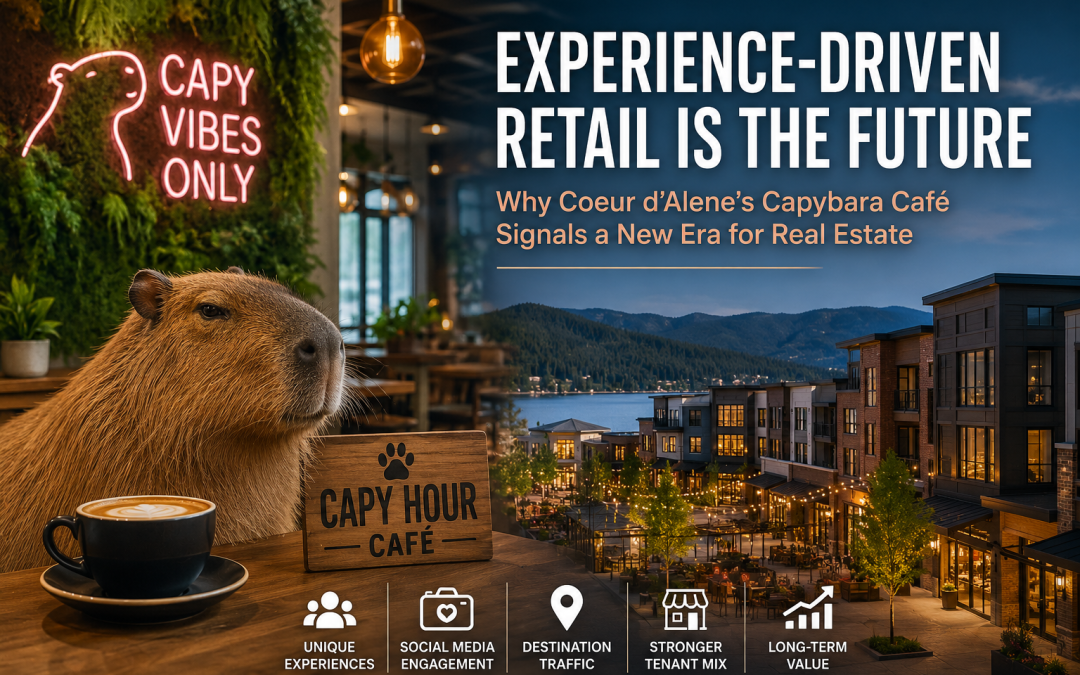
Why Coeur d’Alene’s New Capybara Café Could Signal a Bigger Trend in Experience-Driven Real Estate
Restaurants and retail spaces are no longer competing on products alone.
Across Idaho and the western United States, consumers are increasingly spending money on memorable experiences — especially concepts that combine entertainment, hospitality, social media appeal, and personal interaction.
That is one reason a new animal-themed café in north Idaho may matter more to commercial real estate professionals than it first appears.
According to reporting by Idaho Business Review reporter Brooke Strickland in this article about Capy Hour Café in Coeur d’Alene, the Harris family recently opened Capy Hour Café — a reservation-based café where guests interact with live capybaras while enjoying drinks and private experiences.
At first glance, it sounds like a novelty business.
But from a Boise commercial real estate perspective, it may also reflect a larger shift happening in retail leasing, consumer behavior, and experiential development.
Consumers Want More Than Traditional Retail
For years, many brick-and-mortar businesses competed primarily on convenience.
Today, online shopping has changed that equation.
Consumers can already buy products faster and cheaper online. That means physical retail locations increasingly need to offer something the internet cannot replicate: emotional connection, entertainment, community, and shareable experiences.
That is where concepts like Capy Hour Café stand out.
The business combines:
- Hospitality
- Interactive entertainment
- Social media engagement
- Reservation-based traffic
- Specialty food and beverage service
- Family-oriented experiences
Those types of concepts are becoming increasingly attractive tenants for landlords because they often generate repeat visits, destination traffic, and strong online visibility.
In many ways, this mirrors broader trends already influencing Boise development and retail leasing Boise strategies.
Experience-Based Tenants Are Expanding Across Idaho
The article notes that visitors are already traveling from outside the local area to experience the café.
That matters because destination-oriented businesses can help drive surrounding economic activity.
When unique concepts succeed, nearby businesses often benefit from increased traffic, including:
- Coffee shops
- Boutique retail
- Hotels
- Restaurants
- Entertainment venues
- Mixed-use developments
This is one reason many developers are actively pursuing experiential tenants instead of relying entirely on traditional soft goods retail.
Across Boise commercial real estate, landlords are increasingly interested in users that create energy and activity within a project.
That includes businesses like:
- Interactive entertainment venues
- Boutique fitness concepts
- immersive dining experiences
- family entertainment users
- specialty cafés
- social-media-friendly retail concepts
The capybara café may be unusual, but the underlying business model is becoming more common.
Social Media Is Quietly Reshaping Retail Real Estate
One of the biggest takeaways from the Idaho Business Review story is how strongly the concept has performed online.
The owners reportedly described significant social media engagement and strong customer response shortly after opening.
That is important because modern retail success is increasingly tied to visibility on platforms like Instagram and TikTok.
Businesses that naturally encourage photos, videos, and online sharing often generate free marketing momentum that traditional businesses struggle to replicate.
For commercial landlords, these highly visual concepts can create additional exposure for shopping centers and mixed-use projects themselves.
A tenant that consistently drives online attention can indirectly market the entire property.
That changes how some landlords evaluate tenant mix and long-term leasing strategy.
What This Could Mean for Boise Commercial Real Estate
Boise continues evolving into a more experience-focused market.
As population growth continues and competition for consumer attention increases, developers may continue shifting toward projects built around entertainment, hospitality, and lifestyle-oriented uses.
That could influence future demand for:
- Mixed-use developments
- Flexible retail layouts
- Outdoor gathering areas
- Event-oriented retail space
- Food-and-beverage concepts
- High-traffic destination corridors
Retail centers that once prioritized only national chains may increasingly seek tenants that create community engagement and social activity.
In some cases, smaller experiential businesses can drive more consistent foot traffic than larger traditional retailers.
Local Insight
One of the more interesting parts of this story is not necessarily the capybaras themselves.
It is the fact that a family-owned Idaho business identified a niche experience people could not easily find elsewhere — and demand followed quickly.
That entrepreneurial creativity is becoming a major driver in modern retail real estate.
As Boise commercial real estate continues evolving, some of the most successful future retail projects may not look like traditional shopping centers at all.
Instead, they may function more like entertainment ecosystems designed around memorable experiences, community interaction, and social engagement.
That is a trend worth watching closely across the Treasure Valley.
Mike Gioioso (joy-OH-so) has for 16+ years been helping companies of all sizes buy, build, and lease perfect places for business in greater Boise, Idaho and beyond.
www.streetsmartidaho.com mike@streetsmartidaho.com 208-209-9166
Tags: #boisecommercialrealestate, #boiserealestate, #retailleasingboise, #experientialretail, #retaildevelopment, #mixedusedevelopment, #boisedevelopment, #idahocommercialrealestate, #treasurevalleyrealestate, #retailtrends, #hospitalityrealestate, #entertainmentrealestate, #destinationretail