
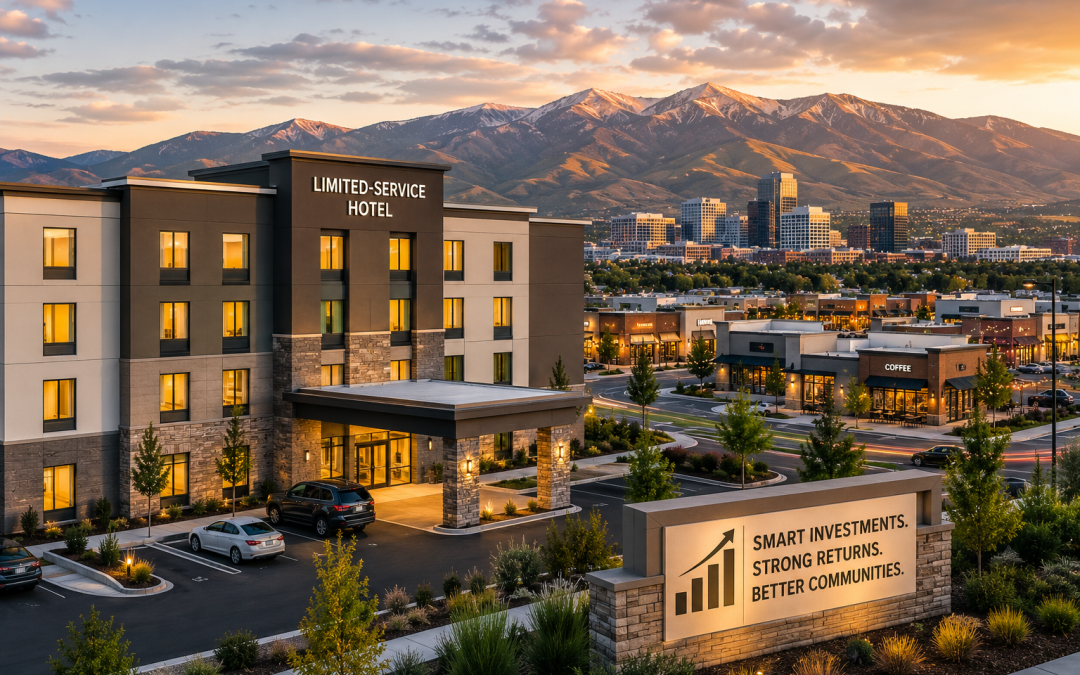
What Profitable Limited-Service Hotels Could Signal for Idaho’s Next Wave of Hospitality Development
Bigger isn’t always better.
In today’s hospitality market, some of the strongest-performing hotel properties aren’t luxury resorts or full-service convention hotels. Instead, many investors are finding attractive returns in properties with fewer amenities, lower operating costs, and simpler business models.
According to reporting by Michael Stathokostopoulos of CoStar Analytics, a recent analysis found that limited-service hotels across numerous U.S. markets are achieving strong profitability even without exceptionally high occupancy levels. The original CoStar article can be found here:
https://product.costar.com/home/news/973082168
While the research focuses on hotel operations, the broader implications may be particularly relevant for Boise commercial real estate investors, developers, lenders, and hospitality operators evaluating future opportunities across Idaho.
Why Smaller Hotel Models Are Attracting Investor Interest
The traditional assumption in hospitality has often been that more amenities create more value.
That may not always be the case.
Limited-service hotels generally operate with fewer employees, reduced food and beverage operations, lower maintenance requirements, and simpler facilities. Those efficiencies allow owners to generate profits at occupancy levels that would be challenging for many full-service hotels.
The CoStar analysis found that many limited-service properties can cover operating expenses at occupancy rates well below what is typically required in more complex hotel formats.
That creates an important advantage.
When occupancy falls during economic slowdowns, seasonal fluctuations, or travel disruptions, owners often have a larger financial cushion before profitability begins to deteriorate.
The Economics Investors Are Watching
One of the most notable findings from the report is how effectively additional revenue converts into profit once these hotels move beyond their break-even point.
Several major markets demonstrated strong operating margins despite average daily room rates that remain relatively affordable compared to luxury properties.
The formula is straightforward:
- Lower staffing costs
- Reduced operational complexity
- Fewer amenities to maintain
- Lower fixed expenses
- Greater flexibility during demand shifts
For investors, this often translates into more predictable cash flow and potentially lower operating risk.
In uncertain economic environments, those characteristics become increasingly attractive.
What This Could Mean for Boise Commercial Real Estate
The Treasure Valley continues to experience population growth, business expansion, healthcare investment, and increasing visitor activity.
As Boise develops as both a regional business center and tourism destination, hospitality demand continues evolving alongside it.
This creates opportunities for hotel developers to evaluate which product types best fit emerging demand patterns.
Potential demand drivers include:
- Corporate travel
- Healthcare-related travel
- Youth sports tournaments
- University events
- Government travel
- Outdoor recreation tourism
- Regional business activity
Many of these travelers prioritize convenience, cleanliness, location, and value over extensive amenities.
That profile often aligns well with limited-service hospitality concepts.
For developers evaluating Boise development opportunities, the ability to build profitable hotels with lower operating complexity may improve project feasibility, particularly in suburban growth corridors and secondary markets throughout the Treasure Valley.
Hospitality Growth Often Creates Additional Real Estate Demand
Hotel development rarely occurs in isolation.
When hospitality activity increases, surrounding commercial real estate often benefits as well.
New hotels can support demand for:
- Retail space
- Restaurants
- Coffee shops
- Medical offices
- Entertainment venues
- Mixed-use developments
- Service-oriented businesses
As visitor traffic grows, adjacent properties frequently experience increased leasing activity and higher visibility.
This is one reason many developers view hospitality projects as economic catalysts rather than standalone investments.
Local Insight
One trend worth watching is whether Boise begins attracting additional limited-service hotel development in emerging growth corridors rather than concentrating new projects exclusively near downtown or the airport.
Areas experiencing significant residential growth, healthcare expansion, industrial development, and retail leasing activity may increasingly support hospitality projects designed around efficiency and convenience.
The CoStar data reinforces a broader investment lesson that applies well beyond hotels.
In many commercial real estate sectors, the most successful projects are not necessarily the most elaborate. Often, they are the properties that balance customer demand with operational efficiency.
As Idaho continues growing, that principle may become increasingly important for investors evaluating future hospitality opportunities across Boise, Meridian, Nampa, Caldwell, and surrounding markets.
Mike Gioioso (joy-OH-so) has for 16+ years been helping companies of all sizes buy, build, and lease perfect places for business in greater Boise, Idaho and beyond.
www.streetsmartidaho.com mike@streetsmartidaho.com 208-209-9166
Tags: #boisecommercialrealestate, #hospitalityrealestate, #hoteldevelopment, #boisedevelopment, #commercialrealestate, #hotelinvestment, #limitedservicehotels, #hospitalityindustry, #investmentproperty, #boiserealestate, #treasurevalleygrowth, #commercialdevelopment, #retailleasingboise, #economicdevelopment, #hotelmarket