
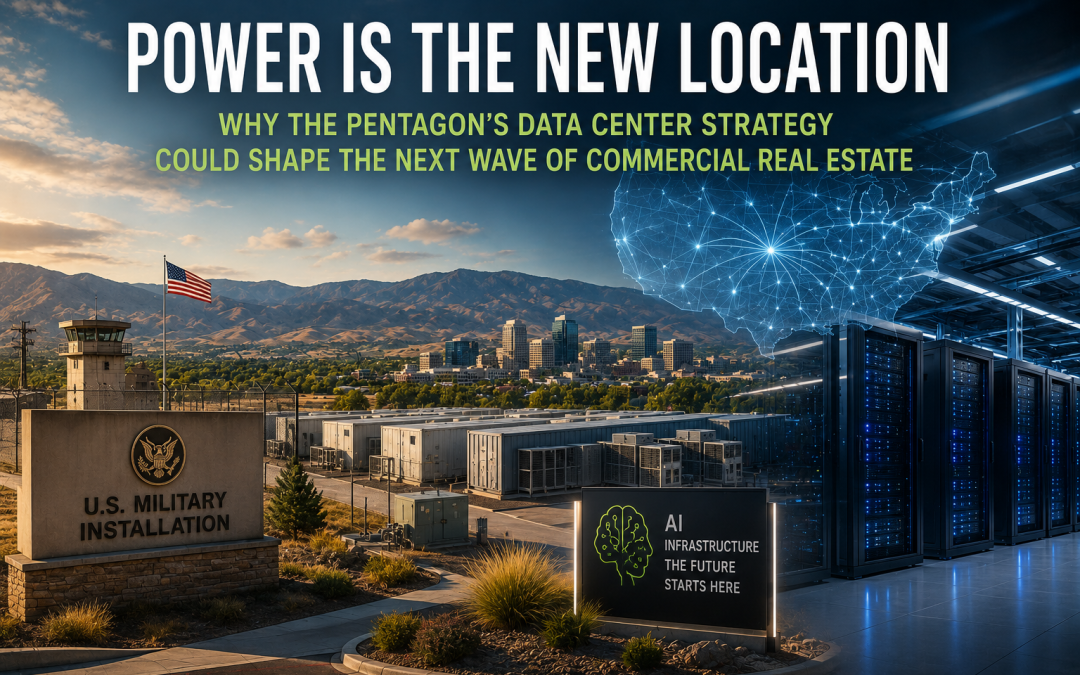
Why the Pentagon’s New Data Center Strategy Could Signal the Next Wave of Commercial Real Estate Development
For years, location was the most important factor in commercial real estate.
Today, power may be taking that title.
A recent federal initiative involving military land and artificial intelligence infrastructure highlights a trend that is rapidly reshaping industrial real estate, land development, and investment strategies across the country.
According to reporting by Mark Heschmeyer in CoStar News, the U.S. Army and Air Force are opening thousands of acres of underutilized military property for potential data center development. The original CoStar article can be found here: https://product.costar.com/home/news/902445188
While the projects are currently focused on installations in Texas, Utah, Alaska, and other military locations under consideration, the broader implications extend far beyond those markets. For Boise commercial real estate professionals, the story offers an important glimpse into how artificial intelligence may influence future land use, infrastructure planning, and economic development throughout Idaho.
The Real Story Isn’t Military Land — It’s Power
The headlines focus on military bases.
The bigger story is the race to secure infrastructure capable of supporting artificial intelligence.
Modern AI facilities consume enormous amounts of electricity. In many cases, the proposed projects require enough power to support communities the size of small cities.
Federal officials are looking at military installations because many already offer characteristics that large-scale data center operators need:
- Significant land availability
- Existing security infrastructure
- Limited residential conflicts
- Expansion potential
- Strategic locations
- Access to utility infrastructure
The federal government’s effort effectively creates a new pipeline of developable land specifically targeted toward next-generation computing facilities.
That alone is a notable shift in commercial real estate strategy.
What This Means for the Future of Site Selection
For decades, data centers clustered around major population centers and technology hubs.
Today, the industry is increasingly focused on a different question:
Where can operators find enough power?
The answer is becoming harder to find.
Across the country, utility constraints, permitting delays, environmental reviews, and neighborhood opposition are making traditional data center development more challenging.
As a result, developers are expanding their search criteria and exploring locations that previously may not have been considered viable.
That trend has important implications for western growth markets, including Idaho.
Why Boise Should Pay Attention
The Treasure Valley is not currently competing directly with Northern Virginia, Dallas, or Phoenix for hyperscale data center development.
However, Boise possesses several characteristics that are becoming increasingly attractive in the AI era:
Growing Technology Ecosystem
The Boise region continues attracting technology investment, advanced manufacturing, engineering talent, and research-driven industries.
Major employers and institutions are helping strengthen the area’s reputation as a technology-oriented market.
Strategic Inland Location
Companies seeking geographic diversification often look beyond traditional coastal markets.
Idaho’s location offers advantages related to resilience, risk diversification, and long-term growth potential.
Industrial Land Availability
Compared with many coastal markets, portions of the Treasure Valley still offer developable industrial land at costs that remain relatively competitive.
While land prices have increased substantially in recent years, they often compare favorably to major technology hubs.
Infrastructure Planning
Perhaps most important, the conversation around data centers reinforces a trend many commercial real estate professionals are already seeing:
Infrastructure is becoming a major competitive advantage.
Communities that can deliver power, fiber connectivity, transportation access, and water resources efficiently may become future winners in attracting technology investment.
The Investment Challenges Are Different
One interesting aspect of the Pentagon initiative involves how the government plans to structure these agreements.
Unlike traditional landlords, the Army is reportedly exploring arrangements where developers provide infrastructure improvements, electricity, or computing resources instead of conventional rent payments.
The Air Force, by contrast, is pursuing more traditional cash-based lease structures.
For investors, these arrangements create unique underwriting challenges.
Traditional commercial real estate valuations rely heavily on predictable cash flows.
When compensation comes in the form of services, infrastructure, or other noncash benefits, analyzing risk becomes significantly more complicated.
The lesson for investors is clear: not every real estate opportunity fits neatly into traditional valuation models.
As AI infrastructure expands, new partnership structures may become increasingly common.
Local Insight: Power Is Becoming the New Location
For years, commercial real estate professionals repeated the phrase “location, location, location.”
Today, another phrase is gaining traction throughout the industry:
“Power is the new location.”
The Pentagon’s initiative highlights how valuable electrical capacity has become.
Whether the future involves data centers, semiconductor manufacturing, advanced research facilities, or AI-related development, access to reliable power is increasingly driving site selection decisions.
This is particularly relevant for Idaho.
The Treasure Valley continues attracting population growth, business expansion, and new development. But long-term competitiveness may depend less on available land and more on infrastructure readiness.
Developers, investors, and economic development leaders who understand this shift early may be better positioned to capitalize on future opportunities.
The Pentagon’s land-leasing program may seem far removed from Boise commercial real estate today.
But the underlying trend—growing demand for power-intensive technology infrastructure—could influence industrial development, land values, utility planning, and investment strategies across Idaho for years to come.
Mike Gioioso (joy-OH-so) has for 16+ years been helping companies of all sizes buy, build, and lease perfect places for business in greater Boise, Idaho and beyond.
www.streetsmartidaho.com mike@streetsmartidaho.com 208-209-9166
Tags: #boisecommercialrealestate, #datacenters, #artificialintelligence, #industrialrealestate, #commercialdevelopment, #boisedevelopment, #treasurevalleyrealestate, #economicdevelopment, #technologyinfrastructure, #industrialdevelopment, #siteselection, #commercialland, #investmentproperty, #datacenterdevelopment, #powerinfrastructure