
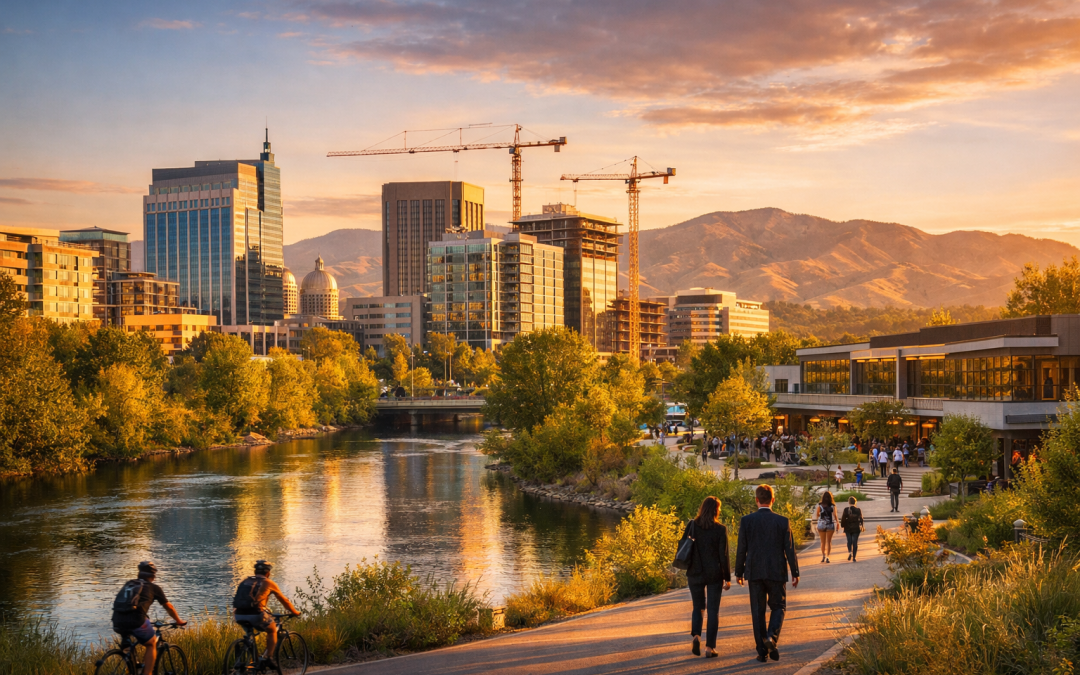
Boise Is Getting National Attention for Its Growth
Over the past decade, Boise has steadily moved from a regional city to a nationally recognized growth market. Now, new data suggests the momentum is still building.
According to reporting by Kelly Holm in the Idaho Press (read the original article here: https://www.idahopress.com/news/local/why-was-boise-named-linkedins-no-2-city-on-the-rise/article_9b280528-0bf5-46ee-a3b3-fe3a06217514.html), LinkedIn recently ranked Boise second on its inaugural “Cities on the Rise” list.
The ranking looked at emerging American cities where professionals are increasingly relocating for career opportunities and quality of life.
Boise placed ahead of more than twenty other metro areas, including cities with far larger populations and longer-established economies.
For those involved in Boise commercial real estate, the recognition reinforces something local professionals have been seeing firsthand: the Treasure Valley continues attracting talent, investment, and business expansion.
What LinkedIn’s Ranking Measured
LinkedIn’s “Cities on the Rise” list evaluated metropolitan areas based on professional activity and economic momentum.
The ranking analyzed trends such as:
- job postings and hiring growth
- relocation activity among professionals
- economic expansion in key industries
- net migration into cities rather than population loss
According to LinkedIn editor Andrew Seaman, Boise stood out because of strong job growth and an influx of professionals moving to the region.
The platform’s internal data showed a steady increase in activity related to hiring, job searches, and professional relocation tied to the Boise area.
This type of migration data is particularly valuable because it reflects real-time movement within the workforce.
The Industries Driving Boise’s Growth
A few major economic sectors played a key role in Boise’s high ranking.
Technology remains one of the largest drivers.
One example highlighted in the report is Micron Technology’s massive semiconductor investment, which includes plans for a new fabrication facility expected to create thousands of jobs.
Healthcare is another important contributor.
Large regional employers like St. Luke’s Health System continue expanding services and hiring to meet the needs of a growing population.
Higher education also plays a role.
Boise State University remains a major employer and talent pipeline that feeds skilled workers into the regional economy.
Together, these sectors form a strong foundation for long-term job growth.
Why Professionals Are Moving to Boise
Economic opportunity is only part of the story.
The Treasure Valley’s lifestyle advantages also contribute to its growing reputation.
Labor economists interviewed in the Idaho Press article noted that Boise’s geography and outdoor access make it particularly attractive to professionals — especially those working in technology or remote-friendly industries.
Key lifestyle factors often cited include:
- proximity to outdoor recreation
- relatively manageable commute times
- access to trails, rivers, and mountains
- a growing urban core with expanding amenities
For many workers relocating from larger metropolitan areas, Boise offers a balance between career opportunity and lifestyle quality.
Population Growth Continues to Reshape the Region
The migration trends highlighted by LinkedIn align with broader population data.
Since the start of the pandemic, Idaho’s population has grown significantly, with the Treasure Valley capturing a large portion of that growth.
Canyon County in particular has seen especially rapid expansion as housing development spreads westward from Boise.
Population growth has ripple effects across many sectors of the economy, including housing, infrastructure, and commercial real estate.
Why This Matters for Boise Commercial Real Estate
From a real estate perspective, professional migration and job creation are two of the strongest drivers of market activity.
When a city attracts skilled workers and expanding employers, several real estate trends typically follow:
Office demand increases
Companies expanding operations often require new office space or upgraded facilities.
Retail activity grows
More residents and workers support restaurants, service businesses, and neighborhood retail centers.
Industrial space becomes more valuable
Manufacturing, logistics, and supply chain operations expand to serve a larger population.
Housing demand rises
Population growth fuels demand for apartments, townhomes, and single-family housing.
In Boise, these dynamics have already begun shaping development across the region.
Local Insight: Boise’s Growth Story Is Still Unfolding
For commercial real estate professionals, rankings like LinkedIn’s “Cities on the Rise” are more than just headlines.
They reflect underlying economic forces that influence development decisions, investment strategies, and tenant demand.
Boise’s continued recognition at the national level sends a strong signal to businesses considering relocation or expansion.
The combination of job growth, outdoor lifestyle, and economic diversification continues to attract professionals from across the country.
For investors, developers, and business owners watching the Treasure Valley, the takeaway is simple:
Boise’s growth cycle is still in motion — and the next decade of development may be even more transformative than the last.
Mike Gioioso (joy-OH-so) has for 16+ years been helping companies of all sizes buy, build, and lease perfect places for business in greater Boise, Idaho and beyond.
www.streetsmartidaho.com
mike@streetsmartidaho.com
208-209-9166
Tags: #boisecommercialrealestate, #boiseeconomicgrowth, #boisedevelopmenttrends, #treasurevalleygrowth, #boisejobmarket, #boisetechindustrygrowth, #boisepopulationgrowth, #boiserealestateinvestment, #treasurevalleyeconomicdevelopment, #boisebusinessexpansion, #boiseworkforcegrowth, #boiseofficemarket