
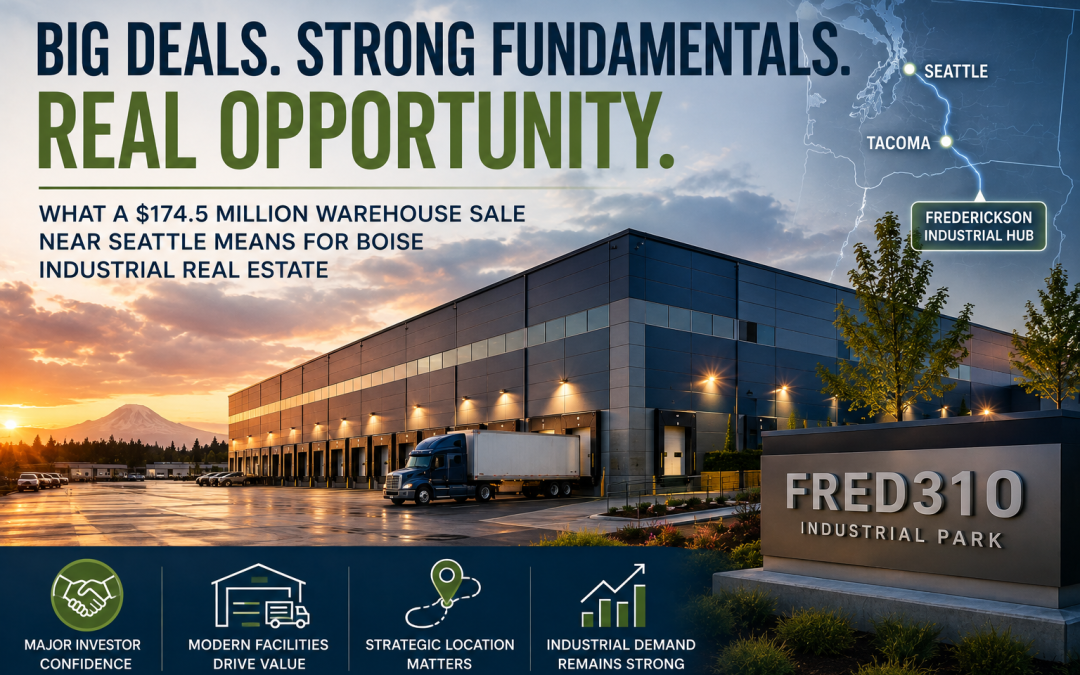
Why a $174.5 Million Warehouse Sale Matters for Boise Industrial Real Estate
Big investors appear willing to write big checks for the right industrial real estate again.
A massive distribution center south of Seattle recently sold for $174.5 million, making it one of the Puget Sound region’s largest industrial transactions of the year.
For Boise commercial real estate, the important part isn’t the Seattle price tag.
It’s what investors are paying for: scale, transportation access, modern construction, strong tenants and something that is becoming increasingly difficult to reproduce—large industrial sites.
According to reporting by Randyl Drummer of CoStar News, Bridge Logistics Properties acquired a 782,775-square-foot warehouse occupied by Harbor Freight at the FRED310 industrial development in Frederickson, Washington.
You can read the original CoStar News article here:
https://product.costar.com/home/news/518950154
The transaction provides a useful look at where institutional investors are finding value in today’s industrial market—and some of the same fundamentals apply to Boise industrial real estate.
Industrial Investors Are Looking Beyond Today’s Rent
The Harbor Freight distribution building is part of FRED310, a major industrial development being built on roughly 310 acres formerly owned by Boeing.
Developers Panattoni Development and Crow Holdings acquired the land from Boeing in 2021 and are transforming it into a large logistics campus.
At full development, FRED310 is expected to contain approximately 4 million square feet across six buildings.
Bridge’s newly acquired property alone contains nearly 783,000 square feet.
That’s an enormous building.
But size isn’t the only reason it attracted institutional capital.
The warehouse offers approximately 40-foot clear heights, more than 150 dock-high loading positions, hundreds of trailer stalls and significant automobile parking.
It is also roughly 17 miles from the Port of Tacoma.
Put those features together and you get something that can be difficult to replicate:
A modern, large-scale logistics facility with access to major transportation infrastructure.
That’s the type of industrial real estate institutional investors tend to think about differently.
They aren’t simply buying today’s rent.
They are buying the long-term usefulness of the location and building.
Large Industrial Sites Are Becoming Strategic Assets
One of the most interesting parts of this transaction is actually the land behind it.
The entire development began with the conversion of a former Boeing property.
That illustrates an important industrial real estate trend.
Large, well-located parcels with sufficient infrastructure are difficult to find near established metropolitan areas.
Even when land is technically available, development can face limitations involving utilities, transportation improvements, zoning, environmental issues and surrounding uses.
That’s why barriers to future supply can become an investment advantage.
If competitors cannot easily build another 800,000-square-foot distribution facility nearby, an existing modern property becomes harder to replace.
The same concept applies at a smaller scale in Boise development.
Treasure Valley industrial users may not routinely require buildings approaching one million square feet, but land capable of supporting significant industrial development is still a limited resource.
The best industrial sites generally need some combination of:
- Interstate or major highway access
- Appropriate zoning
- Reliable utilities and electrical capacity
- Truck circulation
- Trailer storage
- Labor access
- Limited conflicts with residential neighborhoods
- Enough land for future expansion
Finding all of those characteristics in one location isn’t always easy.
And as the Treasure Valley continues developing, it may become even harder.
Industrial Investment Activity Is Recovering
The sale also provides evidence that larger investors are becoming more active.
According to CoStar’s reporting, industrial sales in the Puget Sound region have totaled roughly $1.5 billion so far this year.
For comparison, the market recorded about $2.2 billion in industrial transactions during all of 2025, its strongest annual level in several years.
The Harbor Freight property represents the region’s second-largest industrial transaction by total price this year.
Another major transaction occurred only a few months earlier when Amazon purchased a distribution center occupied by Ashley Furniture for approximately $220 million.
Two transactions don’t define an entire market.
But they do show that substantial capital is available when investors believe an industrial asset offers durable value.
That’s worth watching in Boise commercial real estate.
Higher interest rates and tighter financing have made commercial property buyers much more selective.
Investors can’t rely as heavily on inexpensive debt or aggressive rent growth assumptions.
As a result, property quality matters more.
Tenant credit matters more.
Replacement cost matters more.
Location matters more.
And the ability to attract future tenants matters more.
What This Means for Boise Industrial Real Estate
The Treasure Valley operates at a different scale than Seattle and Tacoma.
But many of the investment principles are similar.
Boise, Meridian, Nampa and Caldwell sit along an important Interstate 84 corridor, giving industrial users access to markets throughout the Northwest and Intermountain West.
Population growth also means more products need to move through the region.
Every new household creates additional demand for groceries, furniture, building materials, packages, automobiles and countless other goods.
That demand eventually requires warehouses and distribution infrastructure.
At the same time, Idaho’s growing manufacturing and technology sectors can create industrial demand that goes beyond traditional logistics.
That could include advanced manufacturing, semiconductor suppliers, construction-related companies, food production and specialized service businesses.
For investors, the opportunity isn’t necessarily limited to giant distribution centers.
In fact, some of the most interesting opportunities in the Treasure Valley may involve much smaller buildings.
Small-bay industrial.
Flex properties.
Contractor buildings.
Owner-user facilities.
Distribution buildings serving regional companies.
Manufacturing facilities with strong power infrastructure.
The important question is whether the property meets a need that will remain difficult to replace.
Location Still Wins—But Industrial Location Means Something Different
Retail investors often talk about visibility and traffic counts.
Office users may focus on employee convenience and amenities.
Industrial properties have their own definition of location.
A warehouse doesn’t necessarily need to sit on the busiest intersection.
It needs to function.
Can trucks get in and out efficiently?
How far is the property from Interstate 84?
Is there adequate loading?
Can trailers maneuver without problems?
Does the site have outdoor storage?
Is enough power available?
Can the building accommodate modern warehouse equipment?
Are nearby land uses compatible with industrial operations?
These questions can have a major effect on long-term value.
A beautiful industrial building with poor truck circulation can become difficult to lease.
An older building with great access, usable yard space and good infrastructure can sometimes be incredibly valuable.
That is why industrial real estate has to be evaluated differently from many other commercial property types.
Local Insight: Pay Attention to What Is Hard to Rebuild
The $174.5 million Harbor Freight warehouse transaction reinforces one of the most important concepts in commercial real estate:
Scarcity creates value.
You can build another warehouse.
But can you find another large parcel with the right zoning?
Can you secure enough power?
Can you create excellent highway access?
Can you provide hundreds of trailer stalls?
Can you complete the project at today’s construction costs?
Can you do all of that close to a major population center?
Those questions help explain why institutional investors can place significant value on modern industrial properties in established logistics markets.
For Boise commercial real estate investors, I think the same principle is worth applying locally.
Don’t just ask what a building earns today.
Ask how difficult it would be to recreate that property tomorrow.
As the Treasure Valley grows and land becomes increasingly fragmented, well-positioned industrial properties may benefit from exactly that kind of scarcity.
And that could make today’s industrial sites more strategically important than they first appear.
Mike Gioioso (joy-OH-so) has for 16+ years been helping companies of all sizes buy, build, and lease perfect places for business in greater Boise, Idaho and beyond.
www.streetsmartidaho.com mike@streetsmartidaho.com 208-209-9166
Tags: #boisecommercialrealestate, #boiseindustrialrealestate, #boiseindustrialproperty, #treasurevalleycommercialrealestate, #idahocommercialrealestate, #boiseinvestmentproperty, #industrialinvestment, #warehouseinvestment, #logisticsrealestate, #boisedevelopment, #meridianindustrialrealestate, #nampaindustrialrealestate, #caldwellindustrialrealestate, #interstate84industrial, #treasurevalleyindustrial, #industrialdevelopmentidaho, #distributioncenters, #warehousedevelopment, #commercialrealestateinvestment, #industriallandboise